
- Siberian larch and ThermoWood are the two most widely specified exterior timber cladding materials for UK homes — both offer excellent durability and low maintenance without chemical preservatives.
- Material costs range from £20–£120 per m² depending on species — from budget Nordic spruce to zero-maintenance charred timber.
- Timber cladding should always be installed as part of a ventilated rainscreen system with a minimum 25mm cavity — this is the single most important installation detail for long-term performance.
- No planning permission is required for most residential timber cladding projects under permitted development rights.
- The total cost to clad a typical UK semi-detached house ranges from £8,000 to £25,000 fully installed depending on size, species, and profile.
Exterior timber cladding has become one of the most popular facade choices for UK homes — on new builds, house extensions, self-build projects, and full house re-cladding programmes. It brings warmth, natural character, and architectural distinction to buildings that brick, render, or composite panels cannot match. When specified and installed correctly, exterior timber cladding on a UK home performs reliably for 20–40 years with minimal intervention. This guide covers everything homeowners, architects, and builders need to know — from species and profiles to costs, installation requirements, and planning rules.
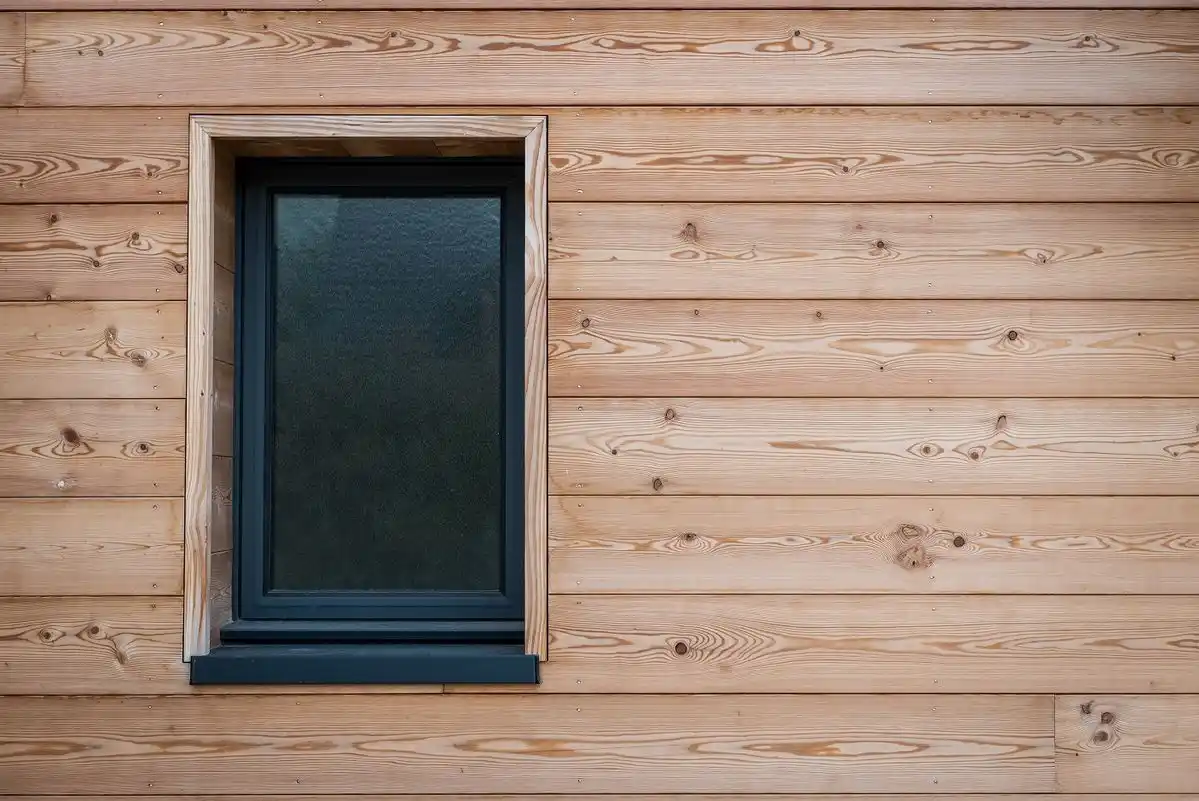
We are a specialist UK supplier of exterior timber cladding for residential projects — supplying Siberian larch, ThermoWood, Nordic spruce, and charred timber across all profiles from UK stock with nationwide delivery in 7–14 days. All timber is FSC and PEFC certified.
Why Choose Exterior Timber Cladding for a UK Home?
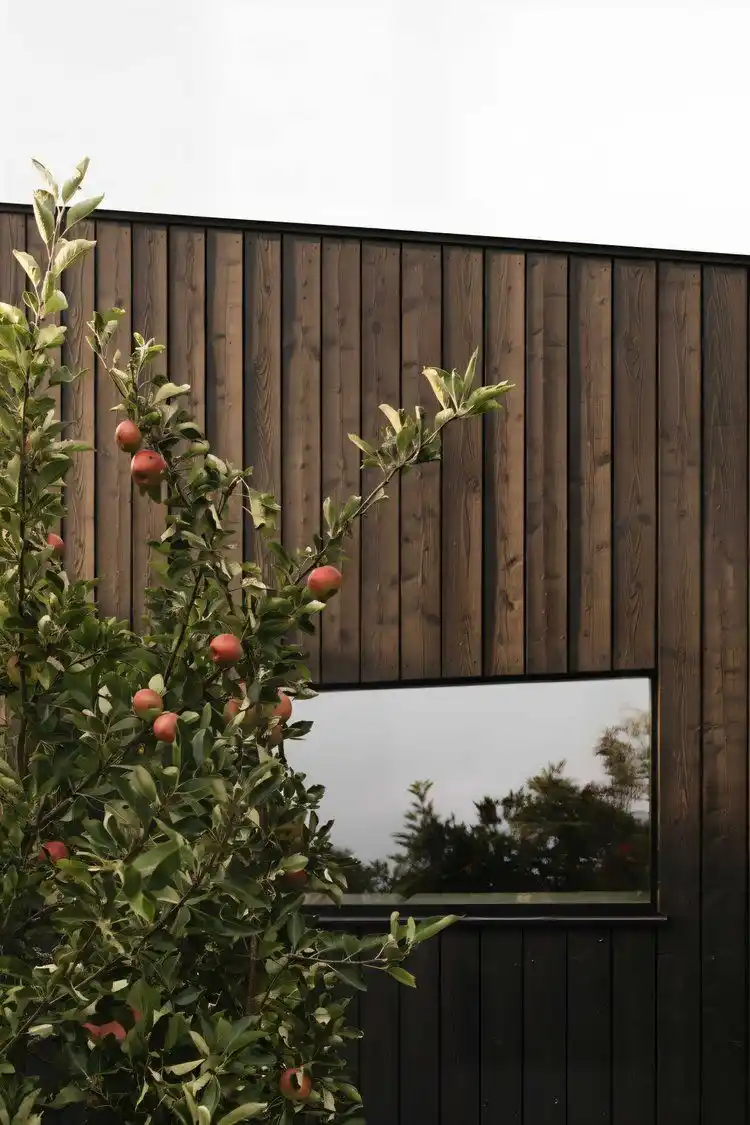
ThermoWood pine cladding on a contemporary UK home — the warm honey-brown colour, consistent grain, and precise shadow gap profile create a facade that brick and render cannot replicate.
Timber cladding on UK homes has grown significantly in popularity over the past decade — driven by the rise of contemporary architecture, the growth in self-build and extension projects, and a broader shift towards natural, sustainable building materials. The appeal is straightforward: no manufactured material replicates the natural warmth, grain variation, and authentic character of real timber on a building facade.
Beyond aesthetics, exterior timber cladding offers practical advantages for UK homes. It is significantly lighter than masonry, making it practical for adding cladding to existing structures without structural modifications. It provides an additional layer of weather protection and thermal performance to the building envelope. And in species like ThermoWood and Siberian larch, it delivers decades of reliable performance with minimal maintenance — at a whole-life cost that compares favourably with painted render or composite panel systems.
The key to exterior timber cladding performing well on a UK home is correct specification from the outset — the right species for the exposure conditions, the right profile for the design intent, and the right installation system for long-term moisture management. This guide covers all three.
Exterior Timber Cladding Species — Which Is Right for Your Home?
Vertical vs Horizontal — Profile and Installation Direction
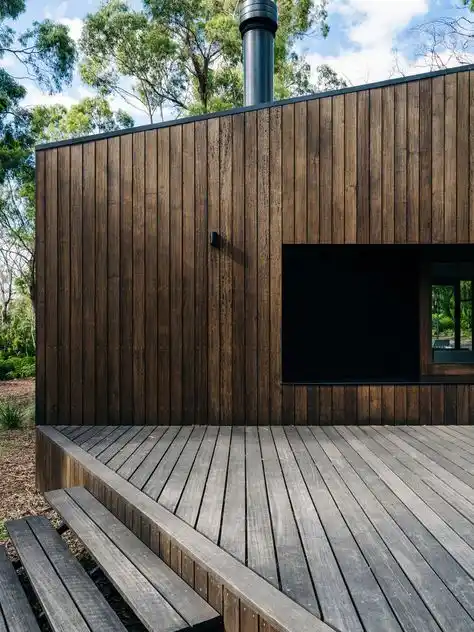
Vertical timber cladding on a UK home — increasingly popular on contemporary extensions and new builds where a strong vertical emphasis makes the building appear taller and more considered.
The choice between horizontal and vertical installation is one of the most significant design decisions in any residential timber cladding project — it fundamentally affects the visual proportions of the building.
Horizontal cladding is the traditional orientation for UK residential buildings — shiplap, feather edge, and shadow gap profiles installed with boards running left to right across the facade. Horizontal cladding makes a building appear wider and lower, sits naturally within the domestic architectural tradition, and provides excellent weather performance with self-draining horizontal joints.
Vertical cladding has become increasingly popular on contemporary UK extensions, garden offices, and new build homes. Boards running top to bottom make a building appear taller, create a stronger architectural statement, and drain exceptionally well — there are no horizontal ledges for water to collect on. Board-on-board vertical cladding using Siberian larch or ThermoWood battens is one of the most popular contemporary facade treatments for UK residential extensions.
The most popular profiles for UK residential exterior cladding are shadow gap, double shadow gap, shiplap, and board-on-board vertical. For a full guide see our shadow gap cladding guide and our vertical vs horizontal cladding guide.
How Exterior Timber Cladding Weathers on a UK Home
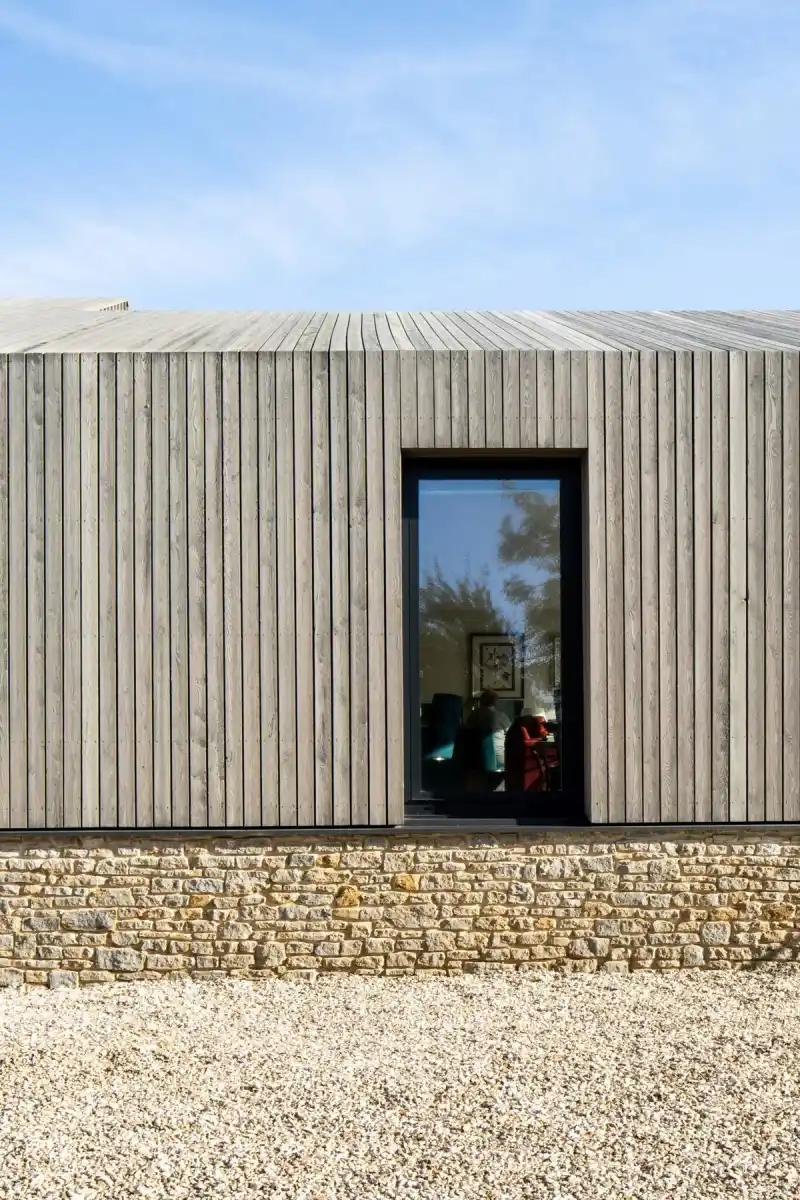
Naturally weathered timber cladding on a UK home — the silver-grey patina develops consistently over 12–24 months on Siberian larch and ThermoWood and requires no ongoing maintenance to maintain.
One of the most common questions about exterior timber cladding on UK homes is what it will look like in 5, 10, and 20 years. The honest answer depends almost entirely on species choice and whether a finish is applied.
Siberian larch and ThermoWood left unfinished weather gradually to a consistent silver-grey patina driven by UV photochemical change. This process takes 12–24 months on an exposed south or west-facing elevation, longer on sheltered or north-facing walls. The silver-grey finish is self-consistent, maintenance-free, and continues to look considered decades after installation. It has become one of the defining aesthetic signatures of contemporary UK residential architecture.
Nordic spruce behaves differently — without regular preservative treatment, spruce greying is driven by surface mould and biological growth rather than UV change, producing a patchy, uneven result. Regular treatment maintains a consistent colour and prevents this.
Charred timber gradually lightens slightly from deep black to a dark charcoal grey as UV exposure breaks down the outermost char layer — but maintains a rich, dark appearance throughout its service life with no treatment required.
For homeowners who want to maintain the original warm colour of larch or ThermoWood, a UV-stable exterior oil applied within 2–4 weeks of installation and re-applied every 3–5 years achieves this effectively. See our timber cladding maintenance guide for full details.
Black Exterior Timber Cladding — The Most Popular Contemporary Finish
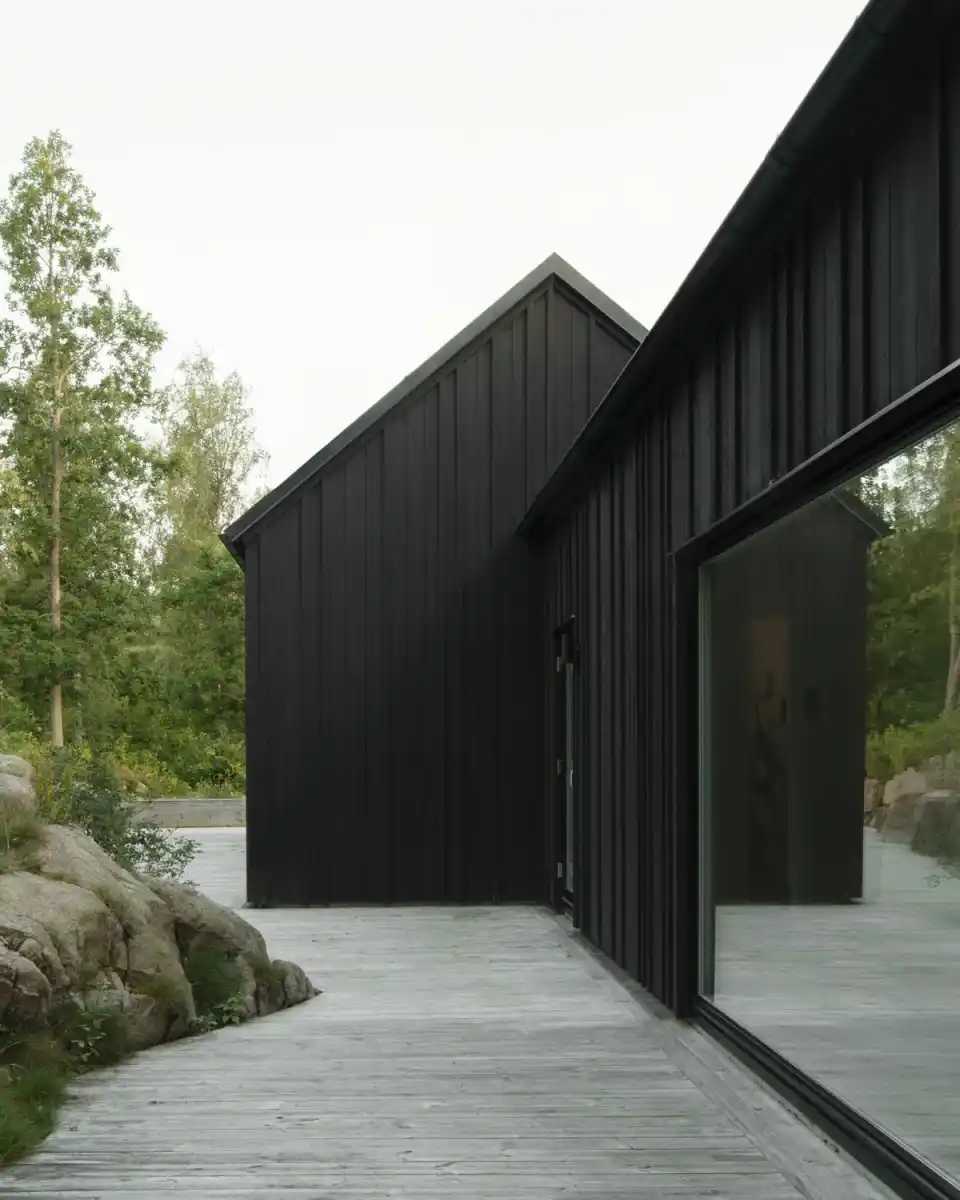
Black timber cladding on a UK home — one of the most searched exterior finishes for contemporary residential architecture, combining striking visual impact with very low maintenance requirements.
Black exterior timber cladding has dominated UK residential architecture trends for the past several years and remains the most searched finish for contemporary homes and extensions in 2026. The combination of dark timber against contrasting materials — stone, brick, white render, or glass — creates some of the most striking residential facades in the UK.
There are three approaches to black exterior timber cladding for a UK home, each with different characteristics. Charred timber (Shou Sugi Ban inspired) applies a carbonised surface to Siberian larch or Nordic spruce, producing a deep black finish with visible grain texture and requiring no ongoing maintenance. Factory-applied black stain achieves a more uniform, controlled black on any species — more consistent in colour than charring but requiring re-application every 5–8 years. ThermoWood with a dark stain combines the stability advantages of thermally modified timber with a coloured finish.
For a full guide to black cladding options see our black timber cladding guide.
Installation — The Ventilated Rainscreen System
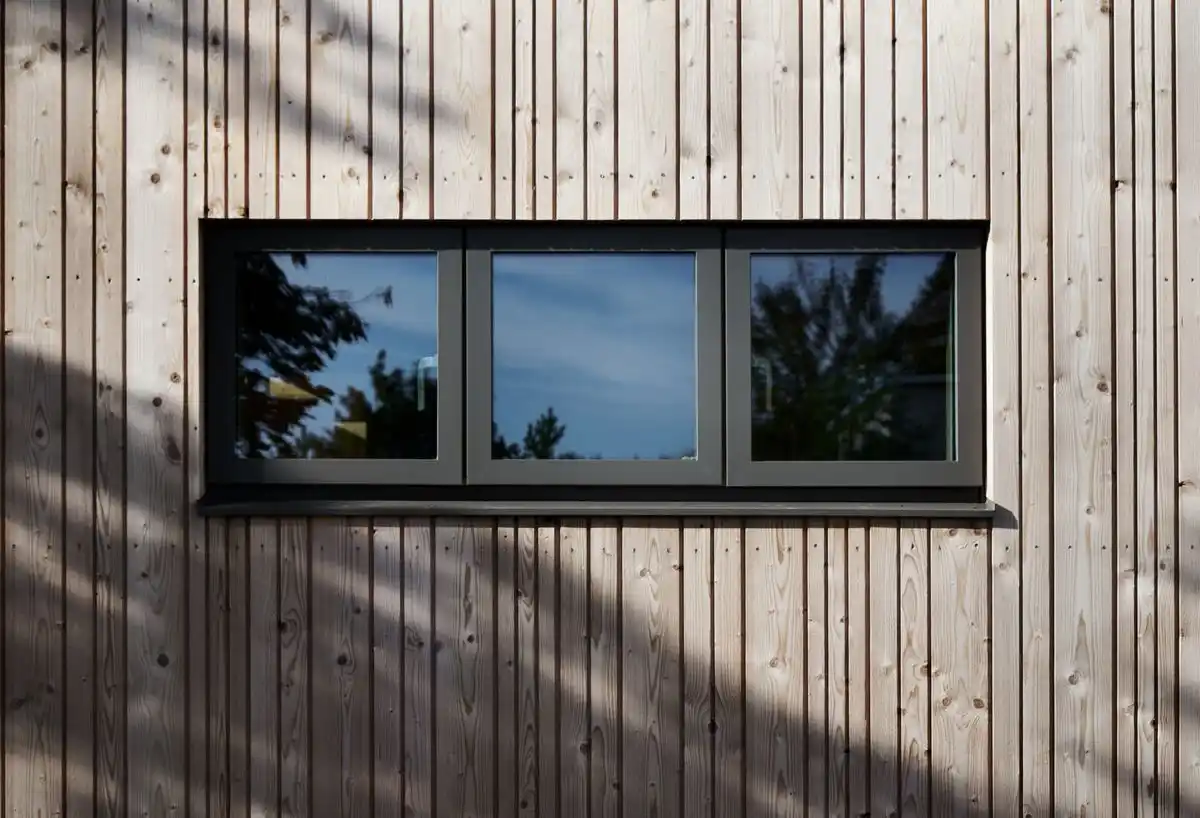
Vertical shadow gap cladding on a UK home — correctly installed as part of a ventilated rainscreen system with a clear cavity behind the boards for drainage and airflow.
The single most important factor in exterior timber cladding performance on a UK home is the installation system — specifically the ventilated cavity behind the boards. Timber cladding installed directly onto a wall substrate without adequate ventilation will deteriorate significantly faster regardless of species. The damp build-up behind boards without airflow creates exactly the conditions biological decay organisms need.
All exterior timber cladding on UK homes should be installed as part of a ventilated rainscreen system:
- Breather membrane over the wall substrate — allows moisture vapour to escape from the structure while preventing liquid water ingress
- Vertical counter-battens fixed through the membrane to the wall structure — typically 50x25mm or 50x38mm, creating the ventilated cavity
- Horizontal fixing battens for horizontal cladding, or horizontal battens for vertical cladding — providing the fixing surface for the boards
- Minimum 25mm clear cavity between the back of the cladding boards and the membrane — essential for drainage and airflow
- Open base and top detail — the cavity must be open at the base to drain and at the top to allow convective airflow. Mesh insect barriers prevent pests entering without blocking airflow
- Minimum 150mm ground clearance at the base of the cladding — ground splash-back is the most common cause of premature failure
- A4 stainless steel fixings throughout — standard steel fixings rust within 3–5 years in UK conditions
Exterior Timber Cladding Cost for UK Homes — 2026 Prices
| Species | Cost per m² (materials) | Semi-detached house (80m²) | Service life | Maintenance |
|---|---|---|---|---|
| Nordic spruce | £20–£40 | £1,600–£3,200 | 15–25 years | Treat every 2–3 years |
| Siberian larch | £35–£70 | £2,800–£5,600 | 20–35 years | Oil every 3–5 years or leave |
| ThermoWood | £55–£95 | £4,400–£7,600 | 25–40 years | None required |
| Charred timber | £75–£130 | £6,000–£10,400 | 25–40 years | None required |
These are material costs only. Add £10–£15 per m² for battens, membrane, and stainless fixings. Installation labour typically costs £25–£60 per m² depending on profile complexity and access. Scaffolding for a semi-detached house typically adds £1,500–£3,500. For a full breakdown see our complete guide to the cost of cladding a house in the UK.
Fire Performance & Building Regulations
For most standard UK residential homes under 11 metres in height, there are no mandatory fire performance requirements for exterior timber cladding under the Building Regulations. Standard timber cladding on a detached or semi-detached house is generally acceptable without fire treatment, subject to boundary conditions and specific local authority requirements.
For buildings over 11 metres, house extensions close to boundaries, and any project where a fire engineer or building control officer requires enhanced fire performance, timber cladding can be supplied with factory-applied fire retardant treatment certified to Euroclass B-s1,d0. This is available across all main species — ThermoWood, Siberian larch, and Nordic spruce — in all major profiles. For full guidance see our fire retardant treatment service and our fire rated cladding for house extensions guide.
For a contemporary UK home where low maintenance and long service life are the priorities — specify Siberian larch shadow gap or ThermoWood shadow gap. Both deliver a refined, architectural result that ages well and requires minimal intervention. For maximum visual impact with zero ongoing commitment — charred timber shadow gap or board-on-board is the strongest specification. For budget-sensitive projects — Siberian larch shiplap or feather edge delivers a quality result at the most accessible price point. All available from UK stock — contact our team with your dimensions for a precise quote.
What is the best exterior timber cladding for a UK home?
For most UK residential projects, Siberian larch and ThermoWood are the two strongest exterior timber cladding choices. Siberian larch offers excellent natural durability without chemical treatment and a 20–35 year service life at £35–£70 per m². ThermoWood offers greater dimensional stability, zero maintenance requirement, and a BRE-accredited 30-year service life at £55–£95 per m². For contemporary homes where appearance and low maintenance are the priority, ThermoWood shadow gap is the most widely specified choice by UK architects.
How long does exterior timber cladding last on a UK home?
Nordic spruce lasts 15–25 years with regular treatment. Siberian larch lasts 20–35 years with minimal maintenance. ThermoWood lasts 25–40 years with no treatment required. Charred timber lasts 25–40 years with virtually no maintenance. Installation quality — particularly the ventilated cavity — makes as much difference to lifespan as species choice.
Does exterior timber cladding on a house need planning permission?
In most cases, cladding the exterior of a house does not require planning permission under permitted development rights. However, planning permission may be required in conservation areas, national parks, or Areas of Outstanding Natural Beauty, or if the property is listed. Always check with your local planning authority before starting work.
What is the most low-maintenance exterior timber cladding for a house?
Charred timber is the most low-maintenance exterior timber cladding option — the carbonised surface requires no ongoing treatment whatsoever. ThermoWood is the second lowest maintenance option — it can be left completely untreated to weather naturally to silver-grey, or oiled every 4–6 years. Both significantly outperform untreated softwood which requires re-treatment every 1–3 years.
How much does it cost to clad the exterior of a house in the UK?
The total cost to clad a typical UK semi-detached house ranges from £8,000 to £25,000 fully installed depending on size, species, and profile. Materials alone typically cost £4,000–£14,000 for a semi-detached house. Add £25–£60 per m² for installation labour and £1,500–£3,500 for scaffolding.
Exterior Timber Cladding for UK Homes — All Species From Stock
We supply Siberian larch, ThermoWood, charred timber, and Nordic spruce cladding for residential projects across the UK — all FSC and PEFC certified with nationwide delivery in 7–14 days. Send us your house dimensions, preferred species, and profile for a precise material quote.