
- Untreated softwood: 5–10 years. Fails rapidly without annual oiling.
- Pressure treated pine: 10–15 years with consistent annual oiling.
- Siberian larch: 20–30 years. No treatment required. Naturally Durability Class 3.
- ThermoWood: 25–40 years. Zero maintenance. BRE endorsed. Durability Class 2.
- Hardwood (Balau/Jatoba): 40–60 years. No treatment required. Durability Class 1.
- What makes decking last longer: Correct installation (ventilated subframe, A4 stainless fixings, 50mm ground clearance), good drainage, and — for softwood only — consistent annual oiling.
How long timber decking lasts in the UK is the most important question to answer before spending anything on a deck project — and the answer varies by a factor of ten depending on the species you choose. Untreated softwood can fail in under 5 years without maintenance. Class 1 hardwood can last 60 years without any maintenance at all. The species decision is not just an aesthetic choice — it is a financial decision that determines whether you are buying a deck for a decade or a lifetime. This guide gives you the honest service life for every decking species available in the UK, what drives those numbers, and what you can do to maximise the life of any deck you already have or are planning.
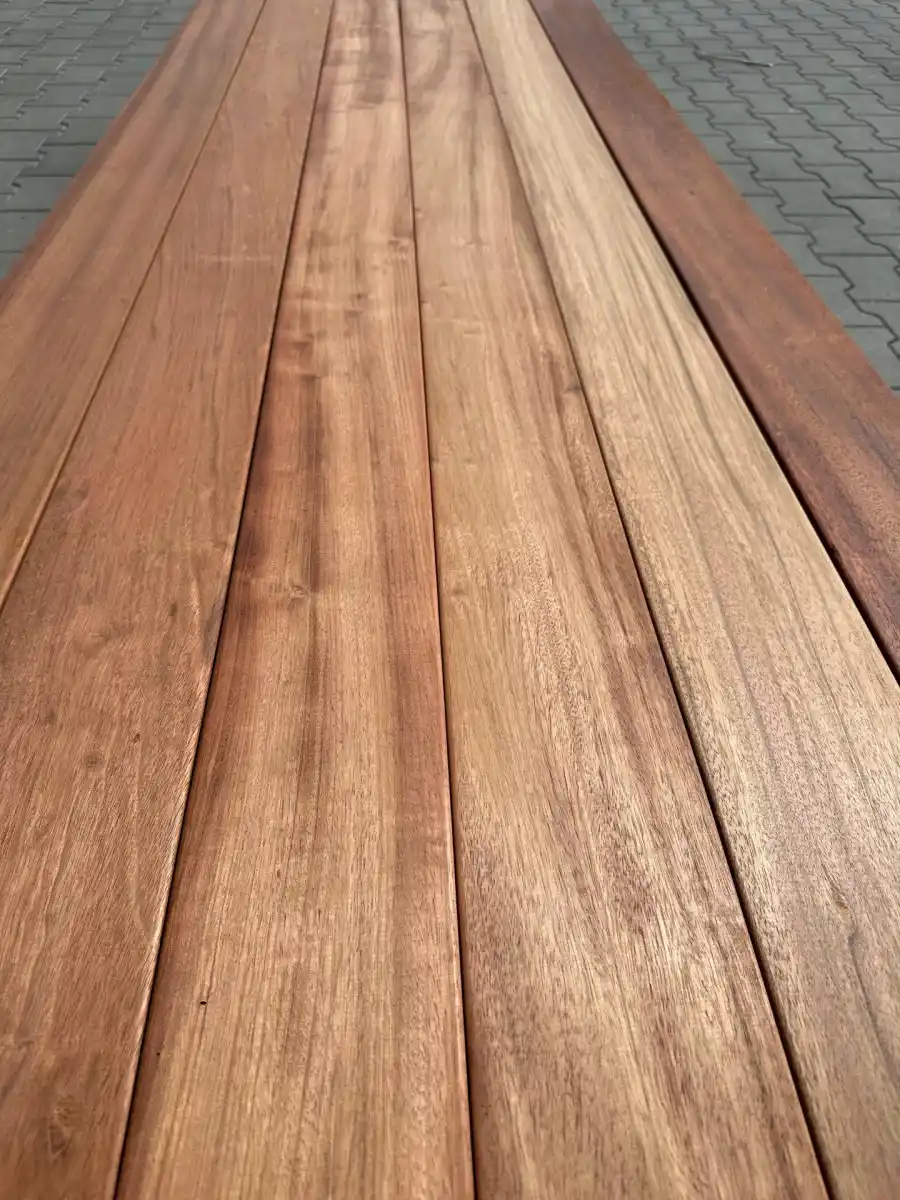
Jatoba (Brazilian Cherry) smooth hardwood decking boards — naturally Durability Class 1 with a 40–60 year service life. The longest lasting decking species available in the UK market, with no preservative treatment required throughout.
How Long Does Each Decking Species Last? — The Numbers
All figures assume correct installation: ventilated softwood subframe, maximum 400mm joist centres, A4 stainless steel fixings, 5–6mm expansion gaps, and minimum 50mm ground clearance. Poor installation reduces the service life of any species. Good installation maximises it.
Species by Species — What Determines the Lifespan
Untreated softwood — 5–10 years
Nordic spruce and similar softwoods are Durability Class 4–5 — they have virtually no natural biological resistance to the decay fungi present in UK outdoor conditions. The lignin and hemicellulose in untreated softwood provide a readily available food source for Basidiomycete fungi once surface moisture content exceeds approximately 20%. In UK above-ground conditions that threshold is regularly exceeded. Without preservative treatment applied annually from year one, structural deterioration begins within 2–3 years. Surface softening, cracking, and biological staining follow within 5 years. Structural failure by year 8–10 is typical for consistently unmaintained softwood decking.
Pressure treated pine — 10–15 years
Pressure treated pine has a preservative forced into the timber cells under vacuum pressure at the factory — typically an ACQ (alkaline copper quaternary) or similar copper-based compound. This provides initial biological resistance that significantly extends service life versus untreated. The treatment does not penetrate uniformly to the centre of each board — site cuts that expose untreated timber must be sealed immediately. Annual oiling is still required to maintain surface integrity and extend the treatment's effectiveness. Without annual oiling, pressure treated decking deteriorates from 10 years. With consistent maintenance, 15 years is achievable. The treatment is not permanent — it degrades over time, which is why annual oiling matters.
Siberian larch — 20–30 years
Siberian larch is naturally Durability Class 3 — its heartwood contains natural resin and extractives that provide moderate biological resistance without any treatment. The 20–30 year service life applies with zero maintenance — no oiling, no treatment, no intervention of any kind. Oiling every 2–3 years maintains colour but does not extend structural service life. The bottom of the range (20 years) applies to highly exposed or coastal positions with maximum moisture cycling. The top of the range (30 years) applies to sheltered, well-drained installations. See our Siberian larch decking guide for full specification detail.
ThermoWood — 25–40 years
ThermoWood is thermally modified Scots pine heated to 190–212°C — the process permanently destroys hemicellulose (the primary food source for decay fungi), reduces equilibrium moisture content to 4–6%, and upgrades durability from Class 4–5 to Class 2. The 25–40 year BRE endorsed service life applies with zero maintenance. The thermal modification is permanent and cannot be reversed or degraded over time — ThermoWood at year 30 has identical biological resistance to ThermoWood at year one. The bottom of the range applies to the most demanding exposures. The top of the range to sheltered, well-drained positions. See our ThermoWood decking complete guide for specification detail.
Hardwood (Yellow Balau and Jatoba) — 40–60 years
Yellow Balau and Jatoba are naturally Durability Class 1 — the highest durability rating under BS EN 350. Their exceptional service life comes from natural density (870–1,060 kg/m³) and natural heartwood extractives that are chemically hostile to decay fungi and wood-boring insects. The 40–60 year service life applies with no preservative treatment required. The same range applies whether boards are oiled or left to weather naturally. The lower end applies to the most exposed coastal and high-UV positions. The upper end to sheltered inland positions. See our hardwood decking buyers guide for the complete species comparison.
Full Service Life Comparison Table
| Species | Durability class | Service life | Treatment needed | Maintenance required | Cost/m² boards |
|---|---|---|---|---|---|
| Untreated Softwood | Class 4–5 | 5–10 years | Annual essential | Annual oiling | £15–£25 |
| Pressure Treated Pine | Class 3–4 (treated) | 10–15 years | Annual essential | Annual oiling | £18–£30 |
| Siberian Larch | Class 3 | 20–30 years | None | None required | £45–£70 |
| ThermoWood | Class 2 | 25–40 years | None | Zero | £55–£85 |
| Yellow Balau / Jatoba | Class 1 | 40–60 years | None | Minimal | £65–£105 |
What Reduces Decking Lifespan — The Five Critical Factors
Species durability class sets the upper limit of service life. Installation quality and ongoing conditions determine where within that range any given deck actually falls. The five factors that most commonly reduce decking lifespan below its potential:
- Insufficient ground clearance: The single most important installation factor. Decking boards within 50mm of the ground — or resting on concrete, soil, or gravel without an air gap — stay wet between rain events, never fully drying out. Continuous moisture drives biological decay regardless of species durability class. Minimum 50mm clear air gap beneath the lowest point of the subframe, always
- Incorrect fixings: Galvanised or standard steel screws corrode in UK outdoor conditions within 3–5 years. Corroded fixings create localised moisture entry points and cause rust staining on hardwood species. A4 stainless steel is the only correct fixing for any exterior timber decking — face-fix or hidden clip
- Insufficient ventilation: Dense planting, walls, or structures on three sides of a deck prevent air movement and slow drying after rain. Good air circulation is the single most effective passive maintenance factor — it keeps boards drier and reduces biological activity regardless of species
- Missed maintenance on softwood: For pressure treated and untreated softwood, a single missed year of oiling creates vulnerability that two years of subsequent treatment cannot fully reverse. Consistent annual maintenance from year one is not optional — it is the condition on which the service life estimate is based
- Inadequate joist spacing: Joists at wider than recommended centres allow board deflection under load. Repeated flexing fatigues fixings and creates gaps at fixing points that allow moisture ingress. Maximum 400mm centres for 21mm boards, maximum 450mm for 25mm boards
For softwood: oil annually from installation without exception — consistency matters more than product choice. For larch, ThermoWood, and hardwood: ensure 50mm+ ground clearance, A4 stainless fixings, and good drainage. Clean every 1–2 years to remove algae. These three installation and maintenance factors will deliver the top end of the service life range for any species. See our decking cleaning guide and our full timber decking cost guide for further detail.
All service life figures in this guide refer to above-ground exterior applications — deck boards on a ventilated subframe with adequate ground clearance. In-ground contact (posts, ground-level bearers in direct soil contact) requires a higher durability class for the same service life. Class 1 hardwood lasts 25+ years in ground contact. Class 3 larch lasts 5–10 years in ground contact. If your subframe includes posts or bearers in direct ground contact, specify UC4 pressure treated timber for those elements regardless of what species the deck boards are.
How long does timber decking last in the UK?
Untreated softwood 5–10 years. Pressure treated pine 10–15 years with annual oiling. Siberian larch 20–30 years, no treatment needed. ThermoWood 25–40 years, zero maintenance. Yellow Balau and Jatoba hardwood 40–60 years, no treatment. All figures assume correct installation with ventilated subframe, A4 stainless fixings, 50mm minimum ground clearance.
How long does softwood decking last in the UK?
Untreated softwood 5–10 years without treatment. Pressure treated pine 10–15 years with annual oiling. Without treatment, deterioration begins within 2–3 years as the boards are Durability Class 4–5 with minimal natural biological resistance.
How long does Siberian larch decking last?
20–30 years with no preservative treatment required. Naturally Durability Class 3. Service life applies whether oiled or left to weather — oiling affects colour only, not structural durability.
How long does ThermoWood decking last?
25–40 years with BRE endorsement. Zero maintenance required. Thermal modification permanently upgrades durability from Class 4–5 to Class 2. Service life applies whether oiled or left to weather.
How long does hardwood decking last in the UK?
40–60 years for Yellow Balau and Jatoba — naturally Durability Class 1 (Very Durable). No preservative treatment required. The longest service life of any decking species available in the UK market.
Decking Boards for Every Budget and Lifespan
We supply softwood, Siberian larch, ThermoWood, and hardwood decking from UK stock. Tell us your deck size, location and budget and we'll recommend the right species. Nationwide delivery 7–14 days. FSC and PEFC certified.