
- For most homeowners planning a deck to last 15+ years — yes. The upfront premium over softwood is recovered within 8–12 years through zero maintenance costs.
- Over 25 years it is cheaper than maintained softwood by approximately £1,800–£4,000 on a 20m² deck.
- The zero maintenance claim is real — no annual oiling, no preservative treatment, no replacement for 25–40 years.
- It is not worth it if: you are on a strict budget and plan to replace the deck within 10 years, or if you specifically want the longest possible service life (choose hardwood instead — 40–60 years).
- The secret fix premium is worth it for any contemporary project where a clean deck face matters — adds only £8–£25/m² over face-fix.
The most honest answer to "is ThermoWood decking worth the money" is: it depends on one thing — how long you plan to keep the deck. For a deck you will replace in 8 years, softwood is probably the more rational upfront choice. For a deck you plan to live with for 20+ years, ThermoWood almost always wins on total cost, and wins decisively on the annoyance of never having to oil, treat, or replace it. This review gives you the numbers, the genuine pros and cons, the cases where ThermoWood is clearly the right choice, the cases where it is not, and what we honestly tell buyers who ask us directly.
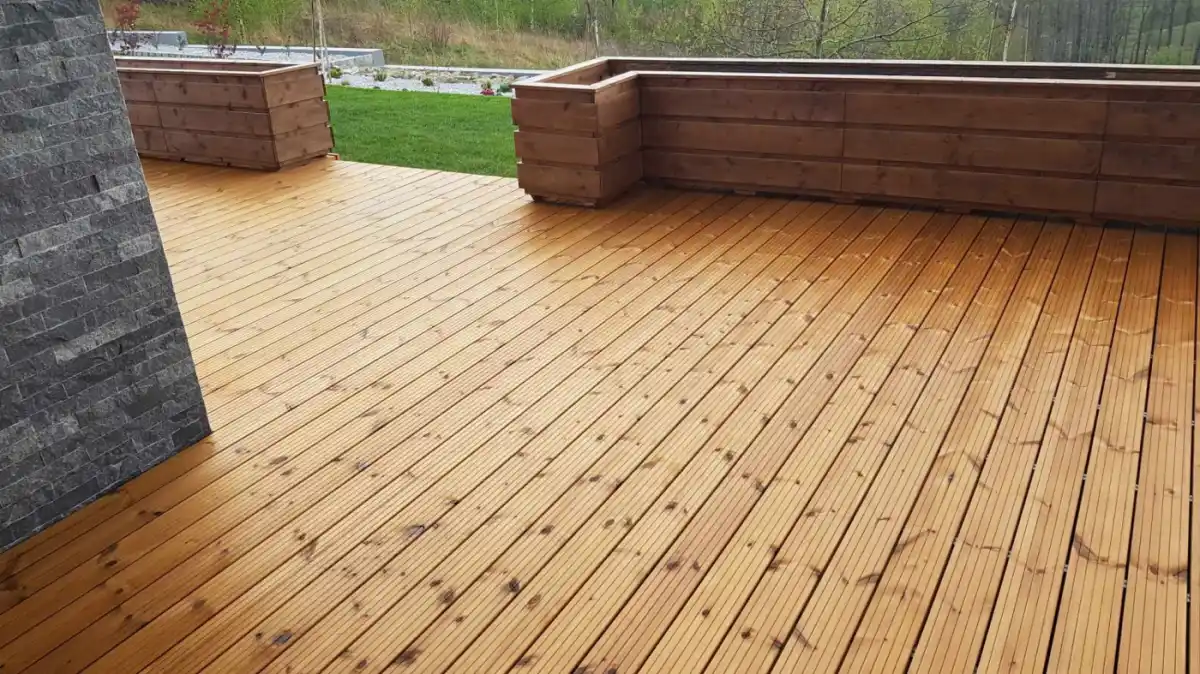
ThermoWood decking boards — thermally modified Scots pine with Durability Class 2 performance, 25–40 year BRE endorsed service life, and genuinely zero maintenance. The question is not whether ThermoWood is good — it is whether the upfront premium is right for your specific project.
The Upfront Verdict — Yes, With One Condition
We sell ThermoWood decking and we believe it is an excellent product. That makes it important for us to be honest about when it is and is not the right specification — because telling every buyer ThermoWood is always worth it regardless of their situation is not useful advice, and it is not how we operate.
ThermoWood decking is worth the money when the deck is planned to last 15 years or more. That is the condition. Below that horizon, the upfront premium does not fully pay back through maintenance savings before replacement. Above that horizon — which describes the overwhelming majority of UK homeowners building a garden deck — it pays back clearly and continues to save money every year thereafter.
- The deck is planned to last 15+ years — the upfront premium recovers within 8–12 years
- You want genuinely zero maintenance — no annual oiling, no treatment, no scaffolding access for elevated deck treatment
- The deck is elevated (above ~1.5m) — where softwood maintenance requires access equipment costing £150–£400 per visit
- A secret fix finish is wanted — ThermoWood is the only naturally durable decking with a hidden fastener option
- The deck is for a garden room, home office, or outdoor space where long-term quality matters
- You value the stability advantage — ThermoWood moves less in UK wet-dry cycling than any other decking species
- Budget is very tight and replacement within 8–10 years is genuinely planned or acceptable
- Maximum possible service life is the priority — choose Class 1 hardwood (40–60 years) instead
- It is a temporary structure — a rental property deck, a deck that will be removed in a development, a short-term garden feature
- You specifically want the cheapest possible deck — pressure treated pine is the rational budget choice if replacement is acceptable
The Numbers — Why ThermoWood Is Cheaper Long-Term
The whole-life cost case for ThermoWood is not a marketing claim — it is straightforward arithmetic. Here it is on a 20m² deck at Midlands/East Anglia labour rates, over 25 years:
| Year | Pressure Treated Pine cumulative cost | ThermoWood (face fix) cumulative cost |
|---|---|---|
| Year 0 — installation | £1,400 (mid estimate) | £2,130 (mid estimate) |
| Year 3 — 3 oilings | £1,670 | £2,130 |
| Year 8 — 8 oilings | £2,070 | £2,130 |
| Year 10 — crossover | £2,270 | £2,130 ← cheaper from here |
| Year 15 — replacement + oiling | £4,070 (new deck + oiling) | £2,130 (still original deck) |
| Year 25 — second deck oiling | £5,070 | £2,130 |
Assumptions: oiling at £90/year (product + 1hr labour); replacement at year 15 at original cost; ThermoWood zero maintenance throughout. The crossover is year 10. By year 25, ThermoWood is approximately £2,940 cheaper on a 20m² deck at mid-range estimates. For elevated decks requiring scaffolding access for oiling (£600–£900 per scaffolding erect), the crossover is year 3–5 and the 25-year saving exceeds £8,000.
For any deck above approximately 1.5m where safe annual oiling requires scaffolding or a tower, ThermoWood pays back its premium within 2–4 years. A single scaffolding erect for oiling costs £600–£900. At annual oiling frequency, that is £600–£900 per year in access costs alone — before buying a drop of oil. ThermoWood at zero maintenance versus that recurring cost is not a close comparison. If your deck is elevated, ThermoWood is almost certainly the most cost-effective specification available.
ThermoWood Decking — Honest Pros and Cons
- Zero maintenance for 25–40 years — no annual oiling, no treatment
- Best dimensional stability of any decking species — moves least in UK wet-dry cycling
- Secret fix available — only naturally durable species with Brofix hidden fastener option
- Cheaper whole-life than softwood from year 10 onwards
- Consistent colour and appearance — natural honey-brown tone, no blotchiness
- Lighter than hardwood — easier to handle and install on site
- European sourced — shorter supply chain than tropical hardwood
- Chemical-free modification — no preservatives at any point in its life
- Higher upfront cost than softwood — 2–3x board price
- Slightly more brittle than untreated timber — pre-drill board ends to avoid splitting
- Shorter service life than hardwood — 25–40 yrs vs 40–60 yrs for Class 1 hardwood
- No secret fix available for hardwood — if hardwood is preferred, face fix only
- Colour darkens compared to natural pine — warm honey-brown, not pale
- Greying over time if not oiled — though most buyers embrace this
The Brittleness Issue — What It Means in Practice
ThermoWood's one genuine installation limitation is worth addressing directly. The thermal modification process that improves durability also removes some of the wood's natural flexibility — ThermoWood boards are slightly more brittle than untreated pine. This manifests in one specific way: driving screws at board ends without pre-drilling can cause the board to split along the grain.
The practical solution is simple: pre-drill all fixing points within 150mm of a board end. This adds approximately 10–15 seconds per board end to installation time and eliminates the splitting risk entirely. For secret fix profiles using Brofix clips, this is not an issue — the fixing method does not involve screwing into board ends. For face-fix profiles, a 3mm pilot drill used at board ends is all that is required. This is a minor installation consideration, not a product defect, and any experienced installer will handle it as standard practice.
ThermoWood vs The Alternatives — Is It the Right Premium?
ThermoWood sits in the premium tier of UK decking alongside hardwood and Siberian larch — all three are zero-maintenance specifications with genuine long service lives. The question "is ThermoWood worth the money" is sometimes better framed as "is ThermoWood the right premium specification for this project":
| If you want... | Best choice | Why |
|---|---|---|
| Zero maintenance + best stability | ThermoWood | Lowest EMC of any species, secret fix available |
| Maximum service life (40–60 yrs) | Hardwood (Balau/Jatoba) | Class 1 durability outlasts ThermoWood by 15–20 years |
| Natural grain, mid budget | Siberian Larch | 20–30 yrs, no treatment, honey-gold colour, £45–£70/m² |
| Lowest upfront cost | Pressure Treated Pine | £18–£30/m² — but annual oiling and replacement needed |
| Hidden fixings (secret fix) | ThermoWood + Brofix | Only naturally durable species with hidden clip fixing |
What We Tell Buyers Who Ask Us Directly
When a homeowner calls us comparing ThermoWood against pressure treated softwood, we ask three questions:
- How long do you plan to keep this deck? Under 10 years — softwood is probably fine. 15 years or more — ThermoWood almost always makes more financial sense over the full period
- Is the deck elevated? If yes — ThermoWood or hardwood are strongly recommended. The annual oiling access cost on an elevated softwood deck makes maintenance-free species clearly better value within a few years
- Do you want hidden fixings? If yes — ThermoWood is the only choice. No other naturally durable decking species offers a hidden clip fixing system
If the answer to all three is yes — long-term, elevated, hidden fix — ThermoWood is the obvious and right choice. If the answer to all three is no — short-term, ground level, visible fixings acceptable — pressure treated pine is a rational budget choice and we will tell the buyer that honestly.
We sell ThermoWood because we believe it is an excellent product for the right application. We also sell softwood and hardwood because we believe different specifications suit different projects. If you want our honest recommendation for your specific deck, contact our team with the details.
The Zero Maintenance Claim — Reality Check
The single most important question about ThermoWood's value proposition is whether the zero maintenance claim is genuinely true. The honest answer: yes, for structural durability — and partly, for appearance.
What zero maintenance means for ThermoWood decking:
- No preservative treatment required — ever. The thermal modification is the treatment, permanent and factory-applied
- No annual oiling required for durability. The Durability Class 2 performance is intrinsic and does not require surface protection
- No replacement required within the 25–40 year service life under above-ground conditions
What zero maintenance does not mean:
- It does not mean the deck never needs cleaning — algae accumulates on any exterior surface. Annual brushing is recommended to maintain appearance, though skipping it does not affect structural performance
- It does not mean colour is permanently maintained — ThermoWood weathers from honey-brown to silver-grey over 18–24 months. Optional oiling every 3–5 years slows this. See our full ThermoWood decking maintenance guide for the complete picture
Is ThermoWood decking worth the money?
Yes for any deck planned to last 15+ years. The upfront premium over softwood is recovered through maintenance savings within 8–12 years on a ground-level deck, sooner on elevated decks. See our full decking cost guide for all species compared. Over 25 years, ThermoWood is approximately £1,800–£4,000 cheaper whole-life than maintained and replaced softwood on a 20m² deck. Not worth it for short-term decks or if maximum service life (40–60 yrs) is the goal — choose Class 1 hardwood instead.
What are the disadvantages of ThermoWood decking?
Three genuine disadvantages: slightly more brittle than untreated timber (pre-drill board ends to avoid splitting); higher upfront cost than softwood (2–3x board price); shorter service life than Class 1 hardwood (25–40 years vs 40–60 years). None are serious limitations for most applications — they are manageable considerations.
How long does ThermoWood decking last?
25–40 years with BRE endorsement, zero maintenance required. The thermal modification permanently upgrades durability from Class 4–5 to Class 2 — this cannot degrade over time. Service life is the same whether oiled, cleaned regularly, or left completely untouched.
Does ThermoWood decking really need no maintenance?
For structural durability — yes, genuinely. No oiling, no treatment, no replacement for 25–40 years. For appearance — cleaning every 1–2 years is recommended to remove algae, and optional oiling every 3–5 years maintains the warm colour. Skipping both has no effect on structural performance or service life.
Is the ThermoWood secret fix worth the extra cost?
Yes for any contemporary project where visual quality matters. The premium over face-fix is only £8–£25/m² — approximately £160–£500 on a 20m² deck. The result is a completely clean deck face with no visible screw heads at any point. For architect-designed outdoor spaces, garden rooms, and high-spec residential decks, this is almost universally considered worth the premium.
ThermoWood Decking — UK Stock, All Profiles, Honest Advice
We supply ThermoWood decking in all profiles from UK stock. If you want our honest recommendation for your specific project — deck size, aspect, budget, and longevity requirement — contact our team. Browse our full Brofix hidden fastener range and read our decking lifespan guide and ThermoWood vs hardwood comparison. We will tell you whether ThermoWood, hardwood, or larch is the right specification. No pressure to buy the most expensive option. Nationwide delivery 7–14 days.