
- Siberian larch is the most widely specified naturally durable timber cladding in the UK — classified as Durability Class 3 with a 20–35 year service life requiring no chemical preservative treatment.
- Available in shadow gap, double shadow gap, rainscreen, shiplap, tongue and groove, and feather edge profiles — the widest profile range of any species we stock.
- Costs £35–£70 per m² for materials — significantly more affordable than ThermoWood while delivering excellent long-term performance.
- Left unfinished, Siberian larch weathers naturally to silver-grey — one of the most popular low-maintenance finishes for UK residential facades.
- All our Siberian larch is FSC and PEFC certified — kiln dried to 18% moisture content, available from UK stock with nationwide delivery in 7–14 days.
Siberian larch cladding is the most widely used naturally durable timber cladding material in the UK. Grown in the extreme cold of Siberia and northern Russia, Siberian larch develops a uniquely dense, resinous grain structure that gives it natural resistance to biological decay without chemical treatment — making it one of the few softwoods genuinely suited to UK exterior cladding applications without the additional cost of thermal modification. This guide covers everything buyers, architects, and specifiers need to know about Siberian larch cladding in the UK — from species characteristics and profile options to installation, finishing, and cost.
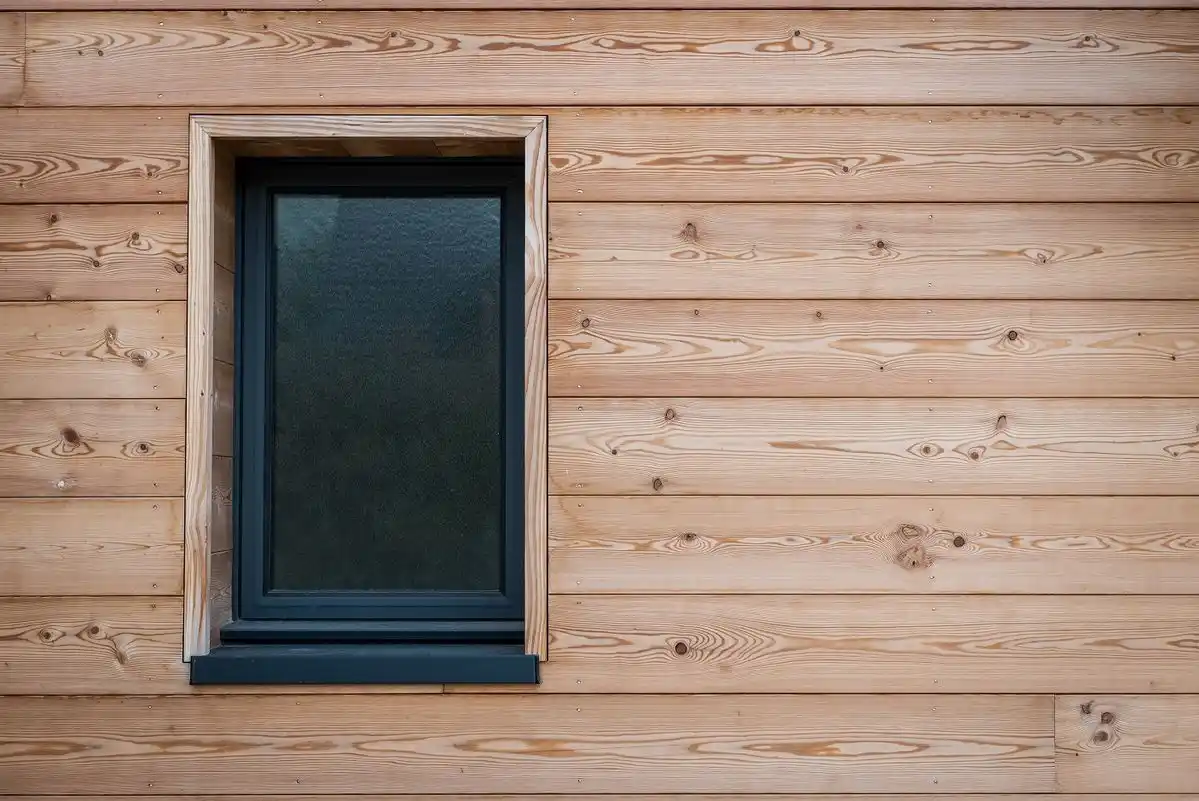
We stock Siberian larch cladding in the widest range of profiles available from any UK specialist supplier — shadow gap, double shadow gap, rainscreen, shiplap, tongue and groove, feather edge, and batten profiles, all from UK stock with nationwide delivery in 7–14 days. All stock is FSC and PEFC certified, kiln dried to 18% moisture content, and available in a range of lengths.
What Is Siberian Larch and Why Is It Used for Cladding?

Siberian larch cladding — the tight annual growth rings, consistent knot structure, and warm straw colour are the result of extremely slow growth in cold Siberian conditions.
Siberian larch grows in the boreal forests of Siberia and northern Russia, where extreme cold and short growing seasons produce a very slow-grown timber with exceptionally tight annual growth rings. This slow growth rate gives Siberian larch a density of approximately 590 kg/m³ — significantly denser than European softwoods grown in milder conditions — and a high natural resin content that provides inherent resistance to biological decay. Classified as Durability Class 3 (BS EN 350), Siberian larch is suitable for above-ground exterior cladding applications without chemical preservative treatment.
Several characteristics make Siberian larch particularly well suited to UK exterior cladding. Its high resin content acts as a natural barrier to moisture absorption and provides the decay resistance needed for above-ground exterior use. Its dense grain structure machines well to precise profile tolerances — important for shadow gap and rainscreen profiles where consistent board dimensions are critical. And its natural appearance — pale golden-yellow fresh, weathering to silver-grey — has made it one of the defining aesthetic choices for contemporary UK residential architecture over the past decade.
Siberian larch should not be confused with European larch (Larix decidua) grown in the UK. European larch has a distinctly different appearance — darker pink-red tone, larger knots that can drop out after drying, and lower density. For exterior cladding applications, Siberian larch is consistently preferred for its lighter, more consistent colour, more stable knots, and superior performance in UK conditions.
Siberian Larch Cladding Profiles — Complete UK Range

Siberian larch rainscreen cladding — the open joint profile creates a bold vertical emphasis and ventilates exceptionally well, making it one of the most specified profiles for contemporary commercial and residential facades.
Siberian larch is available in a wider range of profiles than any other species we stock — giving architects, specifiers, and self-builders maximum flexibility for both contemporary and traditional projects. Here is the full profile range with recommended applications:
How Siberian Larch Weathers — The Silver-Grey Finish

Fully weathered Siberian larch — the silver-grey patina develops consistently across the full facade over 12–24 months and is completely maintenance-free once established.
Siberian larch's natural weathering behaviour is one of its most valued characteristics — and one of the most misunderstood. When left unfinished on a UK exterior elevation, Siberian larch does not degrade or deteriorate in the way untreated softwood does. Instead, it undergoes a gradual photochemical change driven by UV exposure that transitions the pale golden-yellow colour through warm gold to a consistent silver-grey patina over 12–24 months.
This silver-grey weathered finish is completely maintenance-free once established. It does not fade unevenly, does not show UV degradation in the way painted or stained finishes can, and it continues to look considered rather than tired as it ages. It is one of the reasons Siberian larch has become so widely associated with contemporary UK residential architecture — the natural weathered finish requires no ongoing maintenance commitment while continuing to look intentional and attractive for the full service life of the building.
Maintaining the original golden colour
If you prefer to maintain Siberian larch's original warm golden tone rather than allowing natural weathering, apply a quality UV-stable exterior oil within 2–4 weeks of installation — before the initial weathering process begins — and re-apply every 3–5 years depending on exposure. South and west-facing elevations will require more frequent re-application than sheltered or north-facing walls. For specific product recommendations see our fixings and woodcare range, which includes compatible exterior oils proven on Siberian larch.
For most UK projects, the simplest and most cost-effective approach is to leave Siberian larch unfinished and allow natural weathering to silver-grey. The result is attractive, consistent, and genuinely maintenance-free. If a consistent colour is critical — for example on a project with mixed orientation where differential weathering between elevations is a concern — apply a UV-stable oil or SiOO:X treatment from the outset to control the weathering process.
Siberian Larch for Garden Rooms & Garden Offices

Siberian larch on a contemporary UK garden office — one of the most popular species for garden room cladding, combining natural durability, attractive weathering, and accessible cost.
Siberian larch is one of the two most popular timber cladding choices for UK garden rooms and garden offices — alongside ThermoWood. Its combination of natural durability, attractive appearance, and mid-range cost makes it well suited to garden structures where a quality result is wanted without the premium associated with thermally modified timber.
For garden rooms, the shadow gap and double shadow gap profiles in 20x146mm are the most widely specified — they give a contemporary, architectural result that suits the clean lines of modern garden office design. Shiplap in 20x146mm suits more traditional garden buildings and cabin-style structures where a classic horizontal profile is wanted.
A typical 4x3m garden room with approximately 25m² of cladding area costs £875–£1,750 in Siberian larch materials — making it the most cost-effective quality cladding option for garden buildings. For full cost breakdowns by garden room size see our garden room cladding cost guide. For a full comparison of Siberian larch against ThermoWood for garden room applications, see our ThermoWood vs Siberian larch guide.
Black Siberian Larch — Charred and Factory-Stained Options

Black Siberian larch cladding — available in charred (Shou Sugi Ban inspired) and factory-stained finishes, both producing a striking dark exterior with excellent long-term performance.
Black larch cladding is one of the most searched exterior finishes in the UK — and Siberian larch is the primary species used to achieve it. There are two distinct approaches to black larch cladding, each with different characteristics:
Charred larch — Shou Sugi Ban inspired
The Shou Sugi Ban charring technique applies controlled surface charring to Siberian larch boards, creating a carbonised outer layer that provides excellent weather resistance and a deep, rich black finish with visible grain texture. Charred larch requires virtually no ongoing maintenance — the carbonised surface is self-protecting and ages gracefully without intervention. Available in deep char and brushed & stained variants from our charred timber range.
Factory-stained black larch
Factory-applied black stain gives a more uniform, controlled black finish than charring — with consistent colour across all boards and no charred texture. A good choice for projects where a flat, precise black finish is wanted rather than the organic variation of charred timber. Re-application of a compatible stain every 5–8 years maintains the depth of colour on exposed elevations.
Board on Board — Contemporary Vertical Larch Cladding

Siberian larch board-on-board cladding — vertical installation using alternating wide and narrow batten boards creates a strong three-dimensional facade with excellent weather performance and a striking contemporary result.
Board-on-board vertical cladding using Siberian larch battens has become one of the most popular contemporary facade treatments for UK residential extensions, new builds, and garden offices. The profile uses alternating wide and narrow vertical battens fixed over a substrate, creating a three-dimensional shadow effect that is both visually striking and highly weather-resistant — the overlapping battens shed water effectively without a formal joint system.
The most common specification uses Siberian larch PAR battens in two complementary widths — typically 90mm and 45mm — fixed vertically at regular spacing. The wider batten covers the joint between narrower boards, eliminating any potential gap through which wind-driven rain could penetrate. The result is one of the most robust exterior cladding systems available in any material, and one of the most architecturally distinctive.
Siberian Larch Performance Data
| Property | Siberian Larch | Notes |
|---|---|---|
| Durability class | Class 3 — Moderately durable | BS EN 350 — suitable above ground without treatment |
| Service life | 20–35 years above ground | Correctly installed with ventilated cavity |
| Density | 590 kg/m³ (mean) | Range 570–650 kg/m³ — dense for a softwood |
| Moisture content supplied | Kiln dried to 18% | Allow acclimatisation before installation |
| Preservative treatment | ✓ Not required above ground | Natural resin content provides decay resistance |
| Fire rating option | ✓ Euroclass B-s1,d0 available | Via our fire retardant treatment service |
| Certification | ✓ FSC and PEFC | Sustainably sourced — certified chain of custody |
| Natural weathering | Silver-grey patina | 12–24 months on exposed UK elevations |
Installation — Key Requirements
Siberian larch cladding installs in the same way as any other horizontal or vertical exterior cladding profile — over a ventilated batten framework. These are the critical details that determine long-term performance:
- Ventilated cavity — always install over a batten framework with a minimum 25mm clear cavity behind the boards. This is the single most important installation detail — adequate airflow behind the cladding allows moisture to drain and dry, preventing the damp build-up that accelerates decay in any timber species.
- Ground clearance — minimum 150mm between the bottom of the cladding and finished ground level. Ground splash-back is the most common cause of premature failure at the base of larch cladding installations.
- Stainless steel fixings — use A4 stainless steel nails or screws throughout. Standard steel fixings rust within 3–5 years in UK conditions and create staining that is particularly visible on the pale honey-yellow surface of fresh larch. A4 stainless is the correct specification for all exterior timber cladding.
- End grain sealing — apply exterior oil to all cut end grain before installation. End grain absorbs moisture many times faster than face grain and is the most common starting point for decay.
- Acclimatisation — allow Siberian larch boards to acclimatise on site for 5–7 days before installation, stacked with spacers to allow air circulation. This reduces post-installation movement.
The most common cause of premature Siberian larch cladding failure is insufficient cavity ventilation — boards fixed directly to battens without adequate airflow, or with cavity void blocked by insulation or membrane folded across the cavity. Always maintain a clear 25mm minimum air gap behind the cladding face and ensure the cavity is open at the base and top to allow convective airflow. For a full installation and maintenance guide see our timber cladding maintenance guide.
Siberian Larch Cladding Cost UK — 2026 Prices
| Profile | Size | Cost per m² | Typical 25m² garden room |
|---|---|---|---|
| Feather edge | 26x146mm | £35–£50 | £875–£1,250 |
| Shiplap | 20x146mm | £38–£55 | £950–£1,375 |
| Tongue & groove | 20x146mm | £40–£58 | £1,000–£1,450 |
| Shadow gap | 20x146mm | £45–£65 | £1,125–£1,625 |
| Double shadow gap | 24x146mm | £50–£70 | £1,250–£1,750 |
| Rainscreen | 20x90mm | £45–£65 | £1,125–£1,625 |
These are material costs only. Add £10–£15 per m² for battens, membrane, and stainless fixings. Labour typically costs £25–£45 per m² depending on profile and site access. For a full breakdown of total installed costs see our timber cladding cost per m² UK guide.
How long does Siberian larch cladding last in the UK?
Siberian larch cladding has a typical service life of 20–35 years in above-ground UK exterior applications when correctly installed with a ventilated cavity, minimum 150mm ground clearance, and stainless steel fixings. In sheltered positions, correctly installed larch regularly exceeds 35 years. Applying a UV-stable exterior oil every 3–5 years extends the effective service life further.
Does Siberian larch cladding need treating?
No preservative treatment is required for Siberian larch cladding in above-ground UK exterior applications. The timber's natural resin content and dense grain provide sufficient biological decay resistance without chemical treatment. It can be left completely unfinished to weather naturally to silver-grey, or finished with a UV-stable exterior oil every 3–5 years to maintain the original golden-brown colour.
What colour is Siberian larch cladding?
Freshly machined Siberian larch has a pale golden-yellow to warm straw colour with small, lighter-coloured knots. When left unfinished externally, it weathers gradually to a consistent silver-grey patina over 12–24 months. The silver-grey finish is maintenance-free. If you prefer to maintain the original golden tone, apply a UV-stable exterior oil within 2–4 weeks of installation.
What is the difference between Siberian larch and European larch?
Siberian larch grows slower in colder conditions, producing a denser, more resinous timber with tighter growth rings, lighter-coloured knots that remain solid after machining, and a paler straw colour. European larch grown in the UK tends to have a darker pink-red tone, larger knots, and lower density. For exterior cladding, Siberian larch is consistently preferred for its higher density, more stable knots, and more consistent appearance.
How much does Siberian larch cladding cost in the UK?
Siberian larch cladding costs approximately £35–£70 per m² for materials depending on profile. Shadow gap and double shadow gap profiles sit at the upper end. Feather edge and shiplap sit at the lower end. Add £10–£15 per m² for battens, membrane, and fixings, and £25–£45 per m² for installation labour. A typical 50m² house extension costs approximately £2,250–£4,500 fully installed.
Siberian Larch Cladding — Full Profile Range, UK Stock
We stock Siberian larch cladding in shadow gap, double shadow gap, rainscreen, shiplap, tongue and groove, and feather edge profiles — all FSC and PEFC certified with nationwide delivery in 7–14 days. Send us your profile, dimensions, and postcode for a precise quote.