
- Does it need oiling? No — oiling is optional, purely for colour. Zero effect on durability either way.
- Does it need treating? Never — naturally Durability Class 3. No fungicide, no biocide, no preservative ever required.
- Why is it going grey? Normal UV weathering — cosmetic only. Does not affect durability or service life. Self-maintaining once grey.
- How to stop greying: Apply Koopmans Houtolie UV oil every 2–3 years. Slows but does not permanently stop the process.
- Cleaning: Every 1–2 years with stiff brush and mild exterior wood cleaner, along the grain. Rinse thoroughly.
- Service life: 20–30 years. The same whether oiled or left to weather naturally.
The most common question from homeowners with Siberian larch decking is whether it needs oiling — and the answer that matters is that oiling is entirely optional. Siberian larch is naturally Durability Class 3 and requires no preservative treatment, no oiling, and no chemical intervention throughout its 20–30 year above-ground service life. What oiling does — and only this — is slow the natural colour transition from warm honey-gold to silver-grey. If you want to maintain the warm tone, oil every 2–3 years. If you prefer the weathered grey, do nothing. Either way, the structural performance is identical.
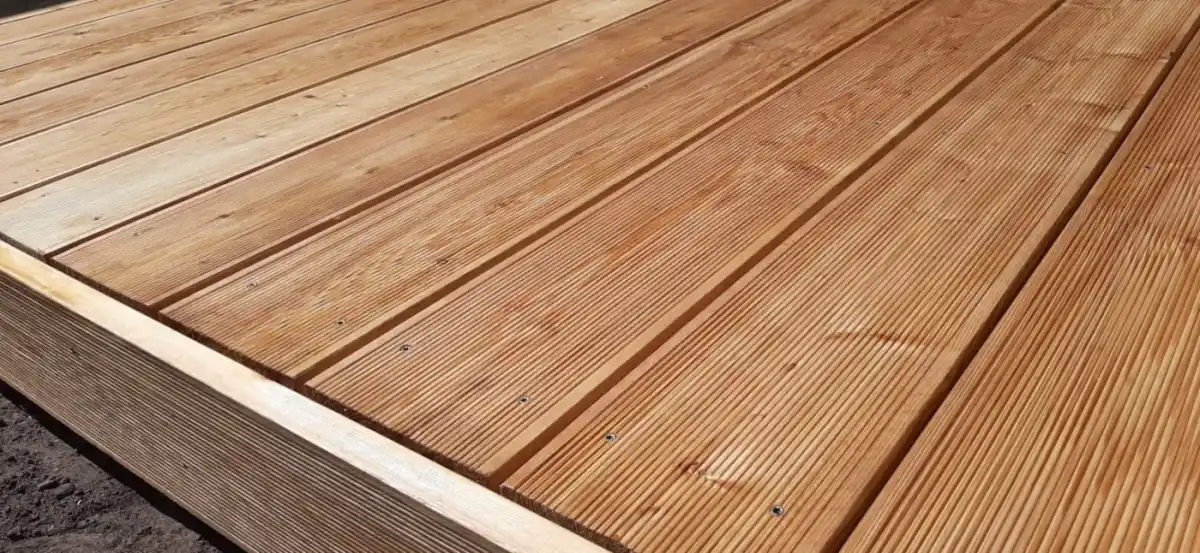
Siberian larch ribbed decking — naturally Durability Class 3, no preservative treatment required, 20–30 year service life. Maintenance is entirely optional and purely cosmetic — oiling maintains the warm honey-gold colour, leaving untreated produces the natural silver-grey patina.
Why Siberian Larch Decking Needs No Treatment
Siberian larch (Larix sibirica) grows in one of the most extreme climates on Earth — the forests of Siberia where temperatures range from −50°C to +35°C and the timber must survive conditions far more demanding than any UK garden. This extreme environment has driven the species to develop high natural resin content and heartwood extractives that provide biological resistance to decay fungi and wood-boring insects without any chemical treatment.
Under BS EN 350, Siberian larch is classified as Durability Class 3 — Moderately Durable — for above-ground exterior use. This means no preservative treatment is required for deck boards in above-ground exterior applications throughout the species' natural 20–30 year service life. The durability is intrinsic to the heartwood chemistry — it cannot be washed out, degraded, or removed. Every larch board you buy has this performance built in.
Larch decking maintenance is entirely cosmetic — it affects how the boards look, not how long they last. Oiling maintains the warm honey-gold colour. Cleaning removes surface deposits and algae. Neither activity has any effect on the timber's Class 3 durability or its 20–30 year service life. A larch deck that has never been touched looks different to a maintained one — it does not perform differently.
Complete Larch Decking Maintenance Schedule
Naturally Durability Class 3 — no fungicide, biocide or preservative ever required above ground. The species provides its own biological resistance throughout its service life.
Paints and varnishes form surface films that trap moisture as larch boards move seasonally. Film failure leads to peeling, moisture ingress, and surface staining. Penetrating oils are the only correct surface product for larch decking.
Only if maintaining the warm honey-gold colour. Apply Koopmans Houtolie after cleaning when boards are fully dry. Zero effect on durability if skipped. South-facing decks: every 2 years. Shaded or north-facing: every 3 years.
Stiff brush and mild exterior wood cleaner along the board grain, top to bottom. Removes algae, surface deposits, and organic matter from board gaps. Purely cosmetic — no effect on service life if skipped.
Check A4 stainless screws are tight. Larch's moderate moisture movement means fixings can work slightly loose over years of seasonal cycling. A periodic check and re-tighten is good practice.
Larch Decking Going Grey — What Is Happening and Is It a Problem?
The greying of Siberian larch decking is the most commonly misunderstood aspect of owning a larch deck. Many homeowners see the colour change and assume something has gone wrong — that the deck is deteriorating or that maintenance has been missed. Neither is the case.
When larch is installed, its surface contains lignin — the natural polymer that gives the timber its warm honey-gold colour. UV radiation from sunlight drives a photochemical reaction that degrades surface lignin over time, bleaching the colour and producing the characteristic silver-grey patina. This process affects only the outermost surface layer — typically 0.3–0.5mm deep — and has zero effect on the structural timber beneath.
The silver-grey of weathered larch is a stable, self-maintaining finish. Once established — typically 12–18 months after installation on a south-facing deck — the colour does not continue to darken or change. The underlying Durability Class 3 timber is completely unaffected. A larch deck that has turned silver-grey is performing exactly as it should with its full 20–30 year service life intact.
Is the greying uneven?
On decks with varying aspects — some boards in full sun, others under a pergola or overhang — greying may initially appear patchy as different sections weather at different rates. This is normal and self-resolving. Within 18–24 months all sections will have reached a consistent silver-grey regardless of initial exposure variation. If uniform colour during this transition period is important, oil the full deck at installation — this evens and slows the greying across all areas simultaneously.
How to Oil Siberian Larch Decking — Step by Step
If you want to maintain the warm honey-gold colour, oiling is the correct approach. The right product applied at the right time makes a significant difference to how well the oil penetrates and how long it lasts.
Clean the full deck with a stiff brush and dilute exterior wood cleaner. Remove all algae, dust, and surface deposits before oiling — oil applied over contaminated surfaces penetrates unevenly and can seal organic matter against the timber. Allow minimum 48 hours drying after cleaning before applying oil.
Oil in dry, overcast conditions at 10–25°C. Not in direct strong sun — oil dries on the surface before penetrating in heat. Not when rain is forecast within 24 hours. Early morning or late afternoon on a dry day is ideal. Avoid oiling in temperatures below 8°C as penetration is significantly reduced.
Apply Koopmans Houtolie by brush along the board grain direction — never across the grain. Work systematically from one end of the deck to the other. Pay particular attention to board ends and any site-cut sections — end grain absorbs oil faster than face grain and benefits from a second coat immediately after the first.
Apply a second coat within 4–6 hours of the first while the surface is still slightly tacky. The second coat penetrates more deeply because the first coat has opened the surface fibres. Two thin coats always outperform one thick coat for penetration depth and longevity.
Keep the deck dry for 24 hours minimum after the final coat. The oil needs time to penetrate and cure fully. Foot traffic before curing is complete will mark the surface and reduce effectiveness.
How to Clean Siberian Larch Decking
Routine cleaning — every 1–2 years
Use a stiff-bristled deck brush and dilute exterior wood cleaner. Work along the board grain direction, scrubbing methodically from one end of the deck to the other. Rinse thoroughly with a hose or watering can from one end to the other — avoid leaving cleaner residue on the boards. Allow 48 hours drying before oiling if oil application follows cleaning.
For algae and green staining
Apply a dilute biocidal exterior wood cleaner — products containing benzalkonium chloride or similar active biocides are effective against the algae species most common on UK garden decking. Apply, leave to dwell for 10–15 minutes, scrub along the grain, and rinse thoroughly. On shaded north-facing decks where algae returns quickly, improving drainage and trimming back overhanging vegetation that keeps the deck wet is more effective than more frequent chemical treatment.
Pressure washing
Acceptable for larch decking — fan-tip nozzle, low-medium pressure, minimum 30cm distance. Work along the board grain. Never use a concentrated jet nozzle which can raise the grain and cause surface fibre damage. After pressure washing, allow 48–72 hours full drying time before any oil application. See our full timber decking cleaning guide for detailed technique. For installation guidance see our how to build a deck guide and does decking add value guide. Compare against hardwood decking maintenance, Koopmans Ecoolie bio oil, best decking for UK weather, and our best wood for decking guide.
Larch Decking vs ThermoWood — Maintenance Comparison
| Maintenance aspect | Siberian Larch | ThermoWood |
|---|---|---|
| Preservative treatment | Never required | Never required |
| Oiling for colour | Optional — every 2–3 years | Optional — every 3–5 years |
| Greying rate | Medium — 12–18 months to grey | Slower — 18–24 months to grey |
| Surface checking | Low–moderate | Low — better moisture stability |
| Cleaning | Every 1–2 years | Every 1–2 years |
| Service life | 20–30 years | 25–40 years |
| 30-yr maintenance cost | £0–£15/m² (optional oil only) | £0/m² |
Does Siberian larch decking need oiling?
No — oiling is optional and purely for colour maintenance. Larch is naturally Durability Class 3 and requires no oiling for structural performance. Oil every 2–3 years to maintain the warm honey-gold colour. If you prefer natural silver-grey, no oiling is ever required throughout the 20–30 year service life.
Does Siberian larch decking need treating?
Never — naturally Durability Class 3, no preservative, fungicide or biocide required at any point above ground. The durability comes from natural resin and heartwood extractives intrinsic to the species.
Why is my larch decking going grey?
Normal UV photochemical weathering — affects only the surface layer (0.3–0.5mm), zero effect on durability or service life. Self-maintaining once grey. To slow it: oil every 2–3 years. To embrace it: do nothing — the weathered silver-grey is attractive and fully stable.
How do I clean Siberian larch decking?
Every 1–2 years — stiff brush and dilute exterior wood cleaner, along the board grain, rinse thoroughly. For algae: dilute biocidal wood cleaner, 10–15 min dwell, scrub along grain, rinse. Pressure washing acceptable with fan-tip nozzle, 30cm minimum distance. Allow 48 hours drying before oiling.
How long does Siberian larch decking last without maintenance?
20–30 years with zero maintenance. The natural Class 3 durability is intrinsic to the species — not dependent on any applied treatment. A never-maintained larch deck looks different to a maintained one (silver-grey vs honey-gold) but performs identically for the same service life.
Siberian Larch Decking — UK Stock, Zero Maintenance
We supply Siberian larch decking in smooth, ribbed, grooved and batten profiles from UK stock. FSC and PEFC certified. We also stock Koopmans Houtolie for colour maintenance. Nationwide delivery 7–14 days.