
- Cost: £20–£42 per m² materials depending on profile — cheapest timber cladding in the UK.
- Treatment: Must be treated before installation and every 2–3 years. Not naturally durable — treatment is essential, not optional.
- Service life: 15–25 years with regular treatment. 5–10 years untreated.
- Profiles: Shiplap, shadow gap, feather edge, loglap, tongue and groove, rainscreen, double shadow gap — all from UK stock.
- Best for: Sheds, outbuildings, garden rooms, budget-sensitive projects, and rear or sheltered elevations where maintenance will be maintained.
- Not ideal for: Projects where ongoing maintenance is unlikely, primary house elevations, or high-exposure coastal locations.
Nordic spruce is the most affordable timber cladding species available in the UK — and when correctly specified, treated, and maintained it delivers a reliable 15–25 year service life at a cost of £20–£42 per m² in materials. The key word is maintained. Unlike Siberian larch or ThermoWood, Nordic spruce is not naturally durable — it requires preservative treatment before installation and every 2–3 years throughout its service life. Get the treatment right and it performs well. Skip it and it will fail within a few years. This guide gives you everything you need to specify, buy, and maintain Nordic spruce cladding correctly for UK conditions in 2026.
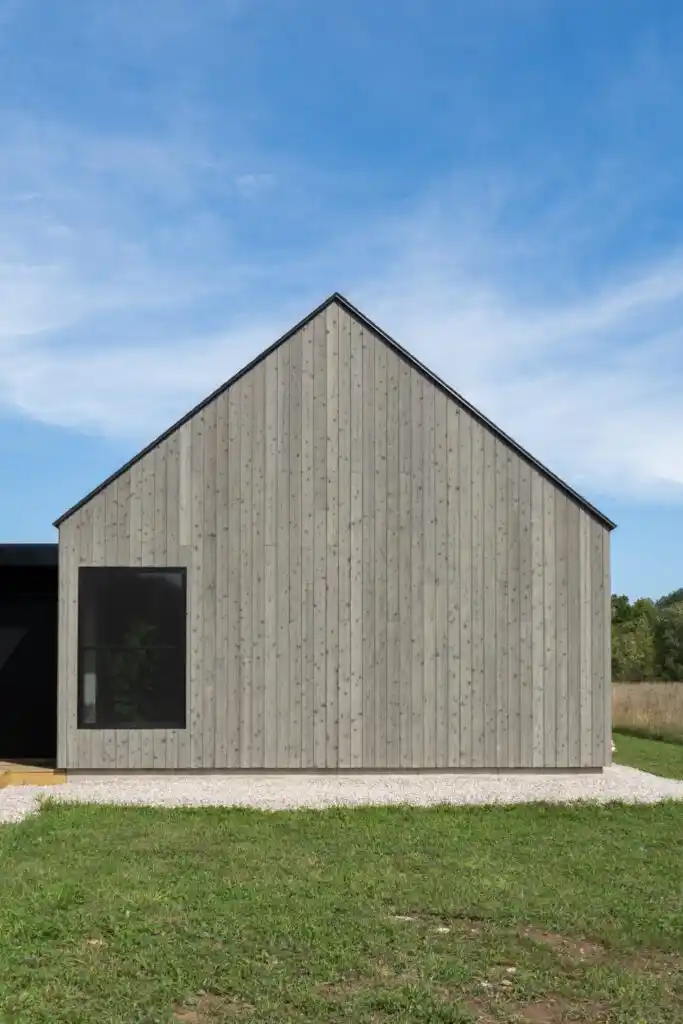
Nordic spruce cladding pre-weathered to silver-grey — left untreated, spruce weathers to a natural silver-grey patina. While this can look attractive, it should only be allowed if the timber has been correctly pre-treated before installation. Natural weathering without initial treatment accelerates deterioration.
What Is Nordic Spruce Cladding?
Nordic spruce cladding is produced from Norway spruce (Picea abies) — the same species used across Scandinavia for construction, interior joinery, and exterior cladding. Grown in the managed forests of Finland, Sweden, and Norway, the cold climate and slow growth rates produce timber with a consistent, fine grain and good dimensional stability. It is one of the most widely produced softwood species in Europe and, as a result, one of the most affordable.
In its natural state, Nordic spruce is a pale cream to light straw colour with minimal resin content compared to pine. It machines cleanly, accepts paint and stain readily, and is easy to work on site — making it a practical choice for self-builders and contractors alike. Its key limitation for exterior use is natural durability — spruce is Durability Class 4–5 under BS EN 350, meaning it has very limited resistance to biological decay and insect attack in above-ground exterior conditions without preservative treatment.
We supply Nordic spruce cladding in the full range of profiles from UK stock — browse our complete Nordic spruce cladding range for all available dimensions and sizes.
Nordic Spruce Cladding Profiles & Costs UK 2026
Clean horizontal or vertical boards with a rebated overlap. Most popular profile for garden rooms, sheds, and residential projects. Suits traditional and contemporary styles.
Contemporary recessed groove profile creating defined shadow lines between boards. The most architecturally refined Nordic spruce profile — suits modern extensions and garden offices.
Cheapest profile in the range — tapered boards with traditional overlapping installation. Ideal for agricultural buildings, sheds, and budget-sensitive projects.
Rounded profile giving a traditional log cabin appearance. Popular for garden rooms, summerhouses, and outbuildings where a cabin aesthetic is wanted.
Two shadow grooves per board for stronger visual rhythm. More architectural than standard shadow gap — suited to contemporary garden rooms and extensions.
Open-joint system for maximum ventilation and a bold vertical or horizontal rhythm. The most affordable entry point into the rainscreen system — regular treatment essential.
How Nordic Spruce Weathers — What to Expect
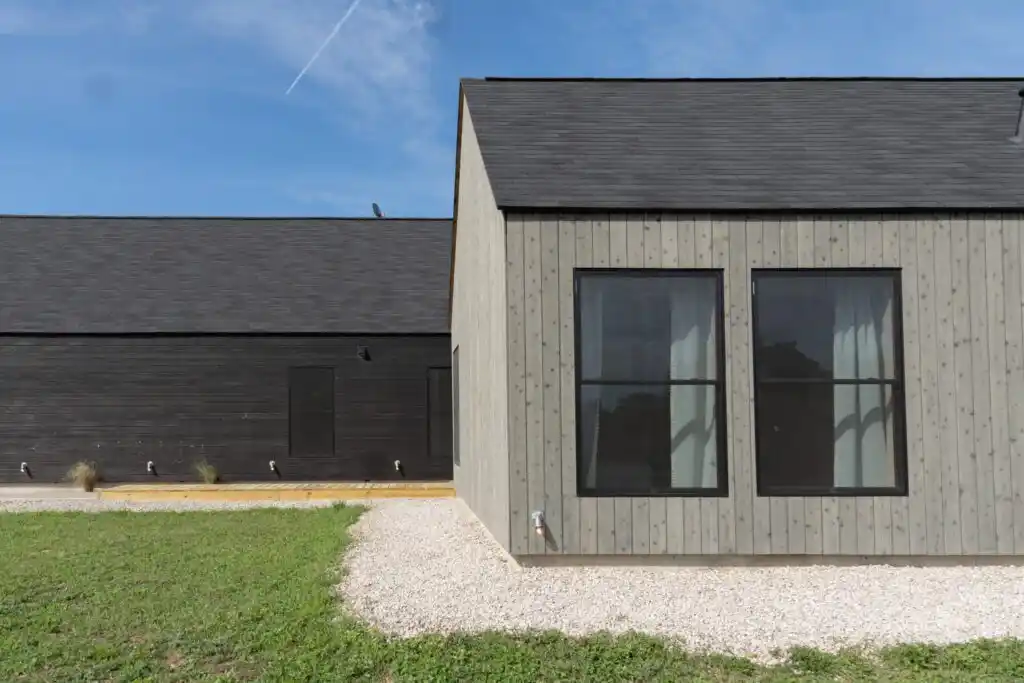
Nordic spruce cladding weathered to silver-grey — when correctly pre-treated and allowed to weather naturally, spruce develops an attractive silver patina. The grey colouration is a surface phenomenon and does not indicate decay — provided the initial treatment was properly applied and the timber is not in contact with soil or standing water.
Untreated Nordic spruce in above-ground exterior use weathers through three phases. In the first 6–12 months the pale cream colour gradually fades and begins to silver. By 1–2 years the surface is fully grey. By 3–5 years, without treatment, biological staining (green algae, blue stain fungi) begins to appear, followed by surface checking and the early stages of wood fibre breakdown. At this point the timber is deteriorating rather than simply weathering.
The difference between attractive silver weathering and damaging deterioration is the initial preservative treatment. Spruce that has been properly treated before installation and re-treated every 2–3 years will weather to an attractive grey while remaining structurally sound. Spruce that has never been treated or has had treatment allowed to lapse will reach biological staining and surface breakdown far sooner.
Treat before installation — not after. Apply a quality microporous preservative or UV-stable wood stain to all four faces and both ends of every board before fixing to the wall. Once boards are installed, the back face and end grain at wall junctions become inaccessible. Untreated back faces in a ventilated cavity can begin showing moisture damage within 2–3 years even if the front face is treated regularly.
Durability & Service Life — The Honest Picture
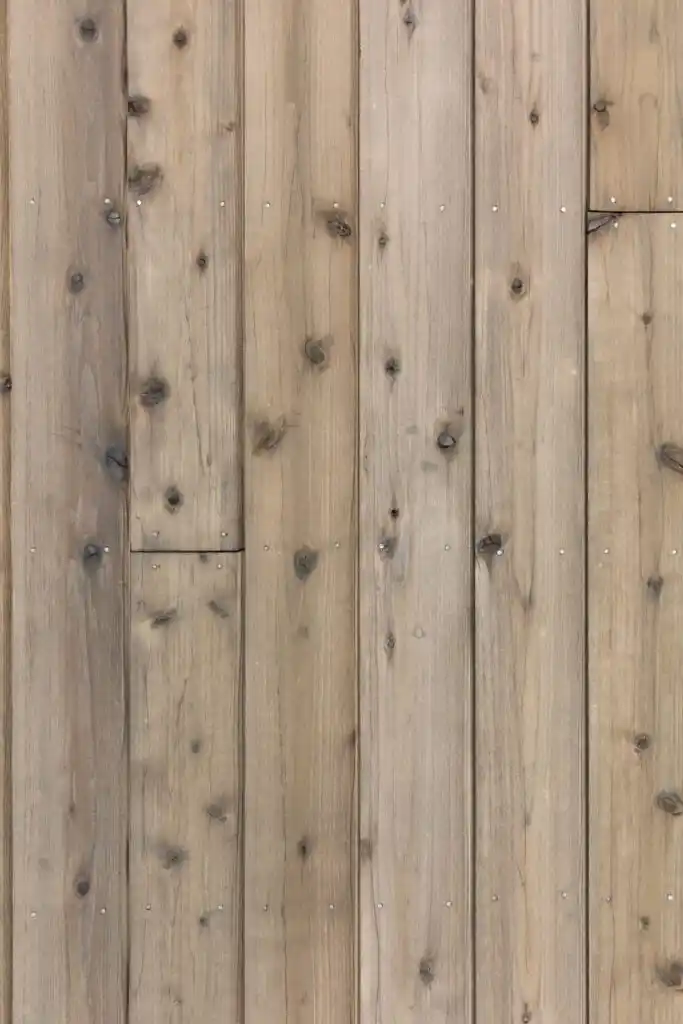
Nordic spruce cladding close-up — the fine, even grain of spruce accepts preservative treatment and stain well, allowing good protection when treatment is correctly applied. The relatively uniform surface also makes recoating straightforward compared to more resinous species.
| Scenario | Expected service life | Notes |
|---|---|---|
| Pre-treated + re-treated every 2 yrs | 20–25 years | Best case — consistent treatment schedule maintained |
| Pre-treated + re-treated every 3 yrs | 15–20 years | Typical — some treatment lapses |
| Pre-treated only — no re-treatment | 8–12 years | Initial treatment buys time but biological decay accelerates |
| No treatment at all | 5–8 years | Not recommended — failure through biological decay |
| Sheltered / north-facing elevation | +3–5 years vs exposed | Reduced UV and moisture cycling extends life |
One important point on durability claims: some suppliers describe Nordic spruce as lasting "25–35 years like Siberian larch." This is misleading. Siberian larch achieves 20–35 years without any treatment due to its natural Durability Class 3 rating. Spruce needs consistent treatment to reach even the lower end of that range. A realistic upper expectation for well-maintained spruce in above-ground UK exterior use is 20–25 years — still a solid service life at the price point, but not comparable to larch on a like-for-like basis.
Nordic Spruce vs Siberian Larch — Which Should You Choose?
| Property | Nordic Spruce | Siberian Larch |
|---|---|---|
| Material cost per m² | £20–£42 | £35–£70 |
| Durability class | Class 4–5 — not durable | Class 3 — moderately durable |
| Treatment required | Yes — every 2–3 years | No — optional only |
| Service life | 15–25 yrs (treated) | 20–35 yrs |
| 30-yr maintenance cost/m² | £45–£75 | £0–£15 |
| 30-yr whole-life cost/m² | £65–£115 | £35–£85 |
| Weathered colour | Silver-grey | Warm silver-grey — richer tone |
| Best for | Budget builds, sheds, rear elevations | Primary elevations, long-term builds |
Choose Nordic spruce if: budget is the primary constraint, the project is a shed or outbuilding, treatment will genuinely be maintained every 2–3 years, or you're cladding rear/sheltered elevations where appearance is secondary. Choose Siberian larch if: the project is a permanent house, extension, or garden room, if maintenance is unlikely to be kept up, or if whole-life cost is more important than upfront cost. A mixed approach — spruce on rear elevations, larch on front — is often the best budget compromise.
Colour Options — Stained, Charred & Natural Finishes
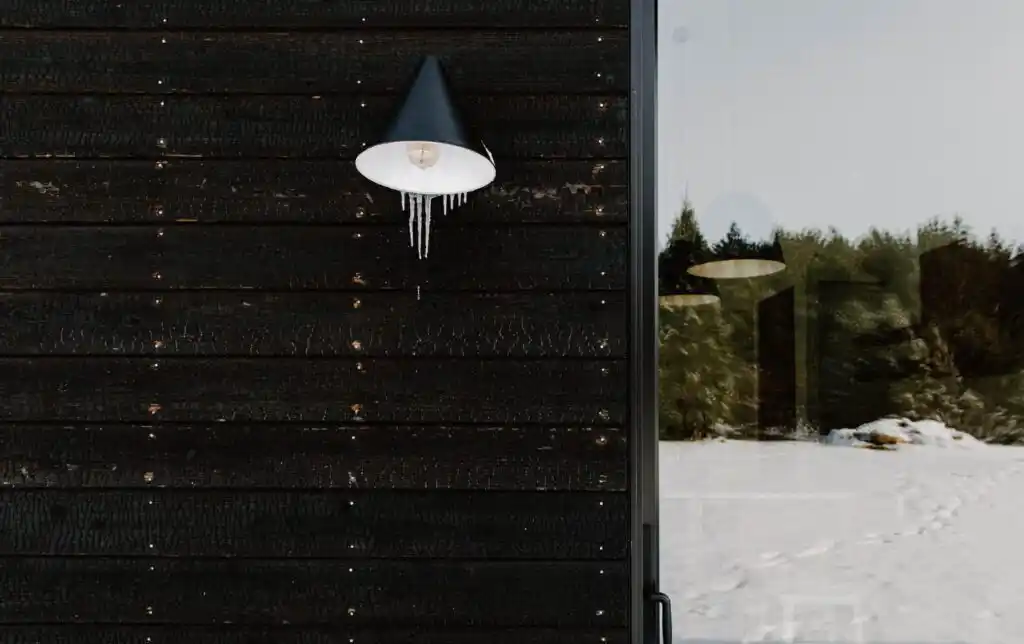
Charred Nordic spruce — the Shou Sugi Ban charring technique applied to spruce produces a smooth, even black finish that eliminates the need for ongoing preservative treatment. Charred spruce has a 15–25 year service life with zero maintenance, making it a compelling alternative to painted black softwood fencing or cladding.
Nordic spruce is highly versatile in terms of colour and finish options. Its pale, low-resin surface accepts paint and stain more readily than pine, and responds well to charring. The main finish routes available are:
- Natural / untreated: Weathers to silver-grey. Requires pre-treatment before installation even if leaving to grey naturally — see treatment section above
- Opaque colour stain: Available in a wide range of colours — grey, black, green, brown, white. Apply before installation and re-coat every 2–3 years. Use a quality microporous exterior stain such as Remmers HK Stain or Koopmans Cover Line
- Transparent or semi-transparent preservative: Maintains the natural wood tone while providing UV and biological protection. Re-treat every 2 years
- Charred / Shou Sugi Ban: The charring process eliminates the need for ongoing preservative treatment and produces a bold black or dark charcoal finish. See our charred timber range for available profiles and finishes
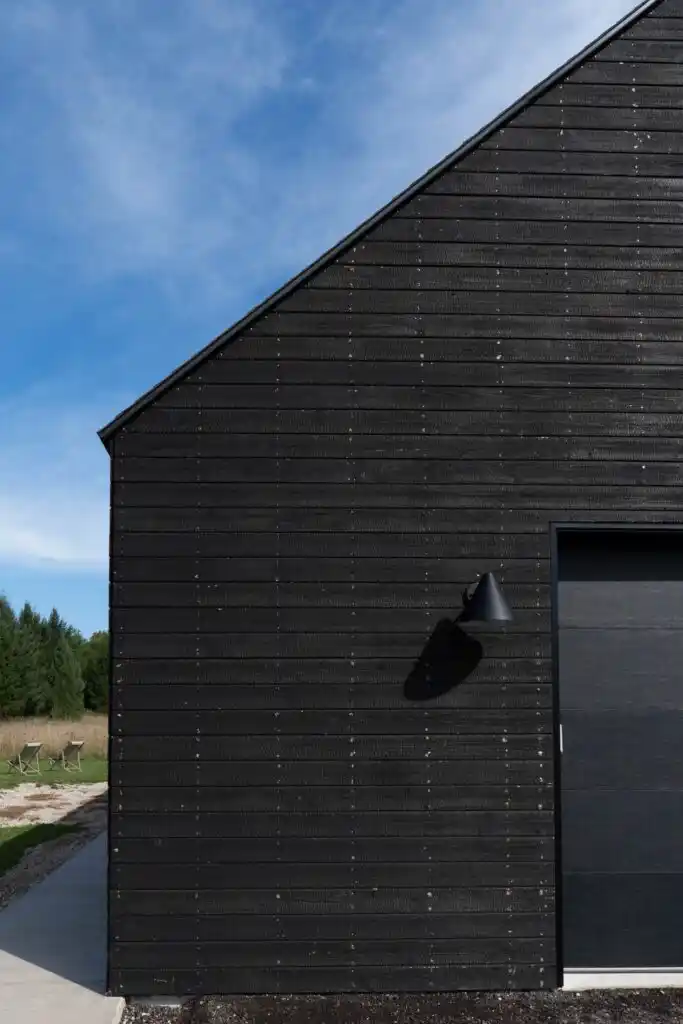
Nordic spruce cladding with opaque black stain — spruce's fine, uniform grain and low resin content make it one of the best species for accepting opaque colour stains. A quality microporous black stain applied before installation and re-coated every 2–3 years produces a consistent, long-lasting result.
Treatment Guide — What to Use and How Often
| Product type | Frequency | Best for | Our stock |
|---|---|---|---|
| Microporous preservative stain | Every 2–3 years | Colour + protection in one — most popular | Remmers HK Stain |
| Wood oil / penetrating oil | Every 1–2 years | Natural look, nourishes wood fibres | Koopmans Houtolie |
| Opaque exterior paint | Every 3–5 years | Full colour coverage, hides grain | Koopmans Cover Line |
| Water repellent / primer | Before installation only | Pre-treatment of all faces before fixing | Owatrol H4 |
Where Nordic Spruce Cladding Works Best
Nordic spruce is the right choice in the right context. It performs well and represents excellent value for money on sheds, agricultural outbuildings, garden rooms, and summerhouses where the lower upfront cost is a meaningful advantage and where the owner is willing to maintain a treatment schedule. It works well on rear or sheltered elevations of houses when combined with larch or ThermoWood on the primary front elevation — the mixed-species approach can reduce total material costs by 20–30% while keeping primary elevations in a naturally durable species.
It is less suitable as the sole cladding species on a permanent house or extension where the treatment obligation is unlikely to be maintained long-term, where the building is in a high-exposure coastal or upland location, or where the project requires a zero-maintenance specification. For those applications, ThermoWood or Siberian larch are the stronger choices.
How much does Nordic spruce cladding cost in the UK?
Nordic spruce cladding costs approximately £20–£42 per m² for materials depending on profile — feather edge and shiplap at the lower end, double shadow gap at the higher end. Add £10–£15 per m² for battens, membrane and fixings, and £25–£45 per m² for professional installation. Preservative treatment every 2–3 years adds approximately £3–£6 per m² per application.
How long does Nordic spruce cladding last?
Nordic spruce lasts 15–25 years in above-ground exterior use when correctly installed and treated every 2–3 years. Without treatment, service life reduces to 5–10 years. Untreated spruce is Durability Class 4–5 and will begin showing biological decay within 3–5 years in UK weather conditions.
Does Nordic spruce cladding need treating?
Yes — Nordic spruce must be treated with exterior preservative before installation and re-treated every 2–3 years. Apply a quality microporous preservative or wood stain to all four faces and both ends before fixing. Treatment is not optional — it is what makes spruce viable for exterior use.
What is the difference between Nordic spruce and Siberian larch cladding?
The key difference is natural durability. Siberian larch is Durability Class 3 — no treatment required, 20–35 year service life, cheaper over 20 years. Nordic spruce is Durability Class 4–5 — must be treated every 2–3 years, 15–25 year service life. Spruce costs £20–£42 per m² versus £35–£70 for larch but the whole-life cost is comparable once treatment costs are included.
What profiles is Nordic spruce cladding available in?
Nordic spruce is available in shiplap (14x120mm, 19x120mm, 19x146mm), shadow gap (14x120mm, 19x120mm, 19x146mm), feather edge (24x146mm), loglap (24x146mm), tongue and groove V-joint (14x120mm, 19x146mm, 28x146mm), double shadow gap (24x146mm), rainscreen (24x68mm), and double tongue and groove (45x146mm). All from UK stock with delivery in 7–14 days.
Nordic Spruce Cladding — All Profiles from UK Stock
We supply Nordic spruce cladding in shiplap, shadow gap, feather edge, loglap, rainscreen, and tongue and groove from UK stock. All FSC and PEFC certified. Nationwide delivery in 7–14 days. Treatment products also available. Contact our team for a precise quantity and price.
;%20?>)