
- ThermoWood wins on: Dimensional stability, weight, secret fix availability, installation ease, and consistency of board appearance. Best for contemporary decks where hidden fixings and tight gap tolerances matter.
- Hardwood wins on: Service life (40–60 yrs vs 25–40 yrs), natural density, hardness, and performance in the most exposed and coastal locations. Best when longevity is the absolute priority.
- Cost: Broadly comparable — ThermoWood £55–£85/m² boards, Balau £65–£90/m², Jatoba £75–£105/m².
- Maintenance: Both zero-maintenance for durability. Neither requires preservative treatment ever.
- The honest verdict: For most UK gardens, ThermoWood is the better all-round specification. For the longest possible service life and the most demanding exposures, hardwood is the stronger choice.
ThermoWood and hardwood decking are the two premium zero-maintenance specifications in the UK market — and they are often directly compared by buyers who have already ruled out softwood and are trying to decide between them. Both require no preservative treatment, both will outlast any softwood deck, and both are available from UK stock. The decision between them comes down to five things: service life, dimensional stability, installation, fixing options, and the specific demands of the project location. This guide gives you the honest, detailed comparison across every criterion — from a supplier who stocks and sells both.
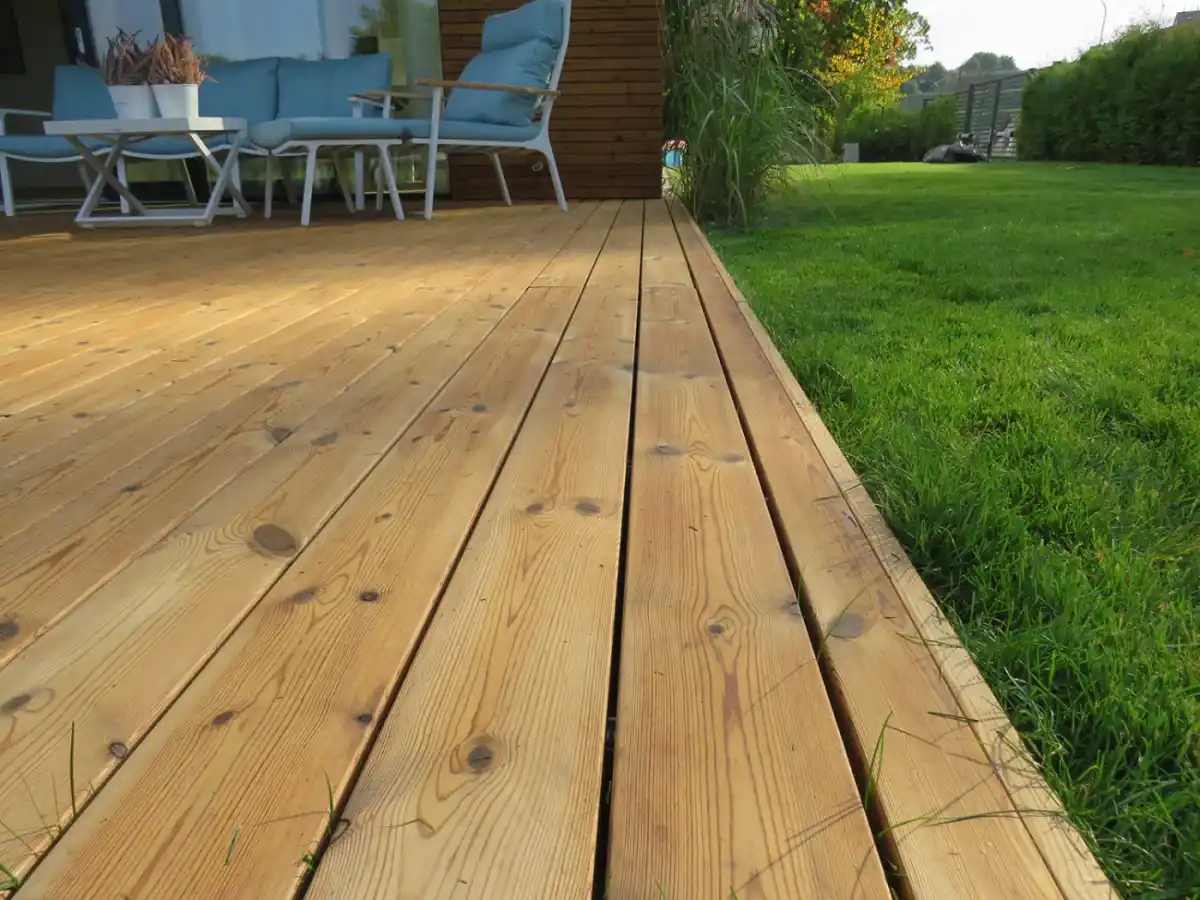
ThermoWood smooth secret fix decking — thermally modified Scots pine with Durability Class 2, 25–40 year BRE endorsed service life, and zero maintenance. Available in face fix and secret fix profiles using the Brofix hidden fastener system.
ThermoWood vs Hardwood — Side by Side
- Durability Class 2 — Durable
- 25–40 year BRE endorsed service life
- Zero maintenance — ever
- EMC 4–6% — best stability of any species
- Light — 430–490 kg/m³
- Secret fix available — Brofix system
- No pre-drilling required
- £55–£85/m² boards
- European sourced
- Durability Class 1 — Very Durable
- 40–60 year service life
- Zero maintenance — ever
- High density — very good stability
- Heavy — 870–1,060 kg/m³
- Face fix only — no secret fix
- Pre-drilling essential
- £65–£105/m² boards
- FSC/PEFC certified tropical source
Head-to-Head — Every Criterion Compared
| Criterion | ThermoWood | Yellow Balau (Hardwood) | Winner |
|---|---|---|---|
| Durability class | Class 2 — Durable | Class 1 — Very Durable | Hardwood |
| Service life | 25–40 years | 40–60 years | Hardwood |
| Maintenance | Zero — ever | Zero — ever | Draw |
| Dimensional stability | Excellent — EMC 4–6% | Very good — high density | ThermoWood |
| Board weight | Light — 430–490 kg/m³ | Heavy — 870–1,050 kg/m³ | ThermoWood |
| Secret fix option | Yes — Brofix system | No — face fix only | ThermoWood |
| Pre-drilling needed | Not required | Essential — always | ThermoWood |
| Surface hardness | Moderate | Very high — 1,000+ lbf Janka | Hardwood |
| Surface checking | Low | Moderate | ThermoWood |
| Board cost/m² | £55–£85 | £65–£90 | ThermoWood |
| Installation speed | Faster — lighter, no pre-drill | Slower — heavy, pre-drill needed | ThermoWood |
| Coastal suitability | Very good | Excellent — Class 1 | Hardwood |
| Colour consistency | Very consistent — modified tone | Natural variation board to board | ThermoWood |
| Sustainability | European sourced, FSC/PEFC | Tropical, FSC/PEFC certified | Draw — both certified |
The Stability Advantage — Why ThermoWood Moves Less
The single most significant technical difference between ThermoWood and hardwood decking is dimensional stability — and ThermoWood wins this comparison convincingly, even over dense tropical hardwoods.
ThermoWood's equilibrium moisture content (EMC) is 4–6% — the moisture level at which the timber stops absorbing or releasing moisture in a given environment. Standard softwood EMC is 12–18%. Yellow Balau EMC is approximately 12–15%. ThermoWood's modified cell structure absorbs substantially less water in a rain event and dries back faster — meaning less swelling, less contraction, tighter gap maintenance, and less surface checking than any competing species.
In practical terms on a UK garden deck, this means:
- Board gaps stay more consistent through winter-summer moisture cycling
- Less cupping and surface distortion over time
- Less surface checking compared to hardwood at equivalent UV exposure
- The secret fix grooved profiles maintain their groove alignment more reliably — important for Brofix clip engagement
For contemporary decks where tight, consistent board gaps and a perfectly flat board surface over years of use are important — particularly secret fix decks and architect-designed outdoor spaces — ThermoWood's superior stability is a meaningful specification advantage.
The Longevity Advantage — Why Hardwood Lasts Longer
Hardwood's 40–60 year service life versus ThermoWood's 25–40 years is not a marginal difference — it is a meaningful one for homeowners building a deck they genuinely want to last a lifetime without replacement. The durability class difference (Class 1 versus Class 2) reflects a genuine performance hierarchy:
- Class 1 (Very Durable): Yellow Balau and Jatoba achieve this through natural density (870–1,060 kg/m³) and natural extractives in the heartwood that are chemically hostile to decay fungi and wood-boring insects. This resistance is independent of any modification or treatment — it is intrinsic to the species
- Class 2 (Durable): ThermoWood achieves this through thermal modification — the destruction of hemicellulose removes the primary food source for decay fungi. This is a factory-applied and permanent change, but it does not provide the same absolute biological resistance as Class 1 natural density
Over 30 years, both specifications will perform without replacement assuming correct installation. The difference becomes meaningful at years 30–40, where ThermoWood may begin to show end-of-service deterioration while hardwood continues performing. For homeowners who plan to stay in their property indefinitely and want a once-in-a-generation installation, hardwood is the rational specification. See our Yellow Balau complete guide and best decking for UK weather guide for further detail.
Secret Fix — ThermoWood's Exclusive Advantage
The most significant practical advantage ThermoWood holds over hardwood decking is the availability of secret fix profiles. The ThermoWood grooved profiles — both the 26x117mm and 26x140mm — are designed to work with the Brofix hidden decking fastener system. The Brofix clips engage in the board groove and fix to the joist with a single screw — each subsequent board locks the previous board's clip in place. The result is a completely clean deck face with no visible fixings at all.
For contemporary architect-designed outdoor spaces, garden rooms with integrated decking, and high-specification residential projects where the clean surface aesthetic is a priority, this is a genuine differentiation. There is currently no secret fix hardwood decking system available in the UK market — all hardwood decking is face fix with visible screws. If hidden fixings matter to the design, ThermoWood is the only naturally durable species that can deliver them.
The Brofix clip system requires the grooved ThermoWood profile specifically — the groove must be precisely positioned in the board edge for the clip to engage correctly. Standard face-fix ThermoWood and all hardwood profiles are not compatible with Brofix. Confirm the grooved profile is specified when ordering if secret fix is the intent.
Installation — ThermoWood Is Significantly Easier on Site
For DIY installers and professional contractors alike, ThermoWood is materially easier to work with than hardwood decking on site. The differences are not minor:
| Installation factor | ThermoWood | Hardwood (Balau/Jatoba) |
|---|---|---|
| Board weight | Light — easy two-person handling | Heavy — physically demanding on site |
| Pre-drilling | Not required — screw direct | Essential — every fixing point |
| Saw blade wear | Normal — standard TCT blade | High — silica content blunts blades fast |
| Drill bit wear | Normal | High — bits dull quickly in dense hardwood |
| Installation speed/m² | Faster — lighter, simpler fixing | Slower — pre-drill adds time per board |
| DIY suitability | Good — manageable for competent DIY | Challenging — pre-drilling, weight, blade changes |
When to Choose ThermoWood — When to Choose Hardwood
Choose ThermoWood when:
- Secret fix (no visible fixings) is important to the design
- Dimensional stability and consistent gap maintenance over time are priorities
- Lighter boards make installation easier — DIY project or access-restricted site
- 25–40 year service life meets the project brief
- Contemporary uniform colour and appearance are preferred over natural hardwood variation
- Budget is towards the lower end of the premium range
Choose hardwood when:
- Maximum service life (40–60 years) is the priority — once-in-a-generation installation
- The project is in a coastal, highly exposed, or high-UV location
- Surface hardness and resistance to impact or heavy use are priorities
- The natural variation and warmth of tropical hardwood grain suits the design intent
- The project requires ribbed or dual ribbed profiles for slip resistance — more profile variety available in Balau than ThermoWood
For the majority of UK residential garden decks — moderate exposure, planned to last 20–30 years, contemporary design intent — ThermoWood is the better all-round specification. Better stability, lighter weight, secret fix option, slightly lower cost. For homeowners building a deck they never want to think about again for 40–60 years, or for the most demanding exposures including coastal and high-UV locations, Yellow Balau or Jatoba hardwood is the stronger long-term choice. Both are genuinely excellent specifications — neither requires maintenance and both will outlast every softwood alternative.
Is ThermoWood better than hardwood decking?
Neither is universally better — they excel in different areas. ThermoWood wins on stability, weight, secret fix, and installation ease. Hardwood wins on service life (40–60 yrs vs 25–40 yrs), surface hardness, and coastal performance. Cost is broadly comparable. For most UK gardens ThermoWood is the better all-round choice. For maximum longevity and exposed locations, hardwood is stronger.
How long does ThermoWood decking last compared to hardwood?
ThermoWood 25–40 years (BRE endorsed). Yellow Balau and Jatoba hardwood 40–60 years. Both are zero-maintenance with no preservative treatment required. Hardwood's longer service life reflects its Durability Class 1 natural resistance versus ThermoWood's Class 2 from thermal modification.
Is ThermoWood or hardwood decking more expensive?
Broadly comparable. ThermoWood £55–£85/m² boards. Yellow Balau £65–£90/m². Jatoba £75–£105/m². ThermoWood installs faster (lighter, no pre-drilling), partially offsetting the board cost difference. Over 30 years both are similar whole-life cost — hardwood's longer service life compensates for slightly higher board price.
Which is better for a coastal garden — ThermoWood or hardwood?
Hardwood is the stronger coastal specification — Durability Class 1 with high natural density provides maximum resistance to salt air, elevated humidity, and wind-driven rain. ThermoWood is a good second choice. A4 stainless steel fixings are non-negotiable in coastal environments regardless of species. Browse our Siberian larch decking and how to build a deck guide for further specification detail.
Can you get secret fix hardwood decking in the UK?
No — there is currently no secret fix hardwood decking system in the UK market. All hardwood decking is face fix with visible screws. If hidden fixings are a design requirement, ThermoWood grooved profiles with the Brofix clip system are the only naturally durable decking specification that can deliver a completely clean deck face.
ThermoWood & Hardwood Decking — Both in Stock, UK Delivery
We supply both ThermoWood and hardwood (Yellow Balau, Jatoba, Angelim) decking from UK stock. FSC and PEFC certified. Tell us your deck dimensions, location and priorities and we'll recommend the right species and profile. Nationwide delivery 7–14 days.