
- What it is: Naturally durable tropical hardwood from South East Asia — also called Bangkirai. Same species, different regional name.
- Durability: Class 1 — Very Durable. No preservative treatment ever required above ground.
- Service life: 40–60 years correctly installed. Outlasts ThermoWood (25–40 yrs) and Siberian larch (20–30 yrs).
- Cost: £65–£90 per m² boards. Smooth and ribbed 21x145mm at the lower end. Dual ribbed 25x145mm at the higher end.
- Profiles: Smooth 21x145mm, ribbed 21x145mm, dual ribbed 25x145mm — all from UK stock.
- Maintenance: None required for durability. Optional oiling every 2–3 years to maintain colour. Cleans easily every 1–2 years.
- Delivery: 7–14 days from UK stock. FSC and PEFC certified.
Yellow Balau — also known as Bangkirai — is the most widely specified tropical hardwood decking in the UK. Dense, naturally Durability Class 1, available in three profiles, and capable of lasting 40–60 years with no preservative treatment, it sits at the premium end of the decking market for buyers who want a deck built to last a lifetime. This guide covers everything you need to know before buying: what Yellow Balau actually is and why Bangkirai is the same thing, the three UK stock profiles compared, accurate 2026 costs, how it weathers, maintenance requirements, and how it compares against ThermoWood and Siberian larch.
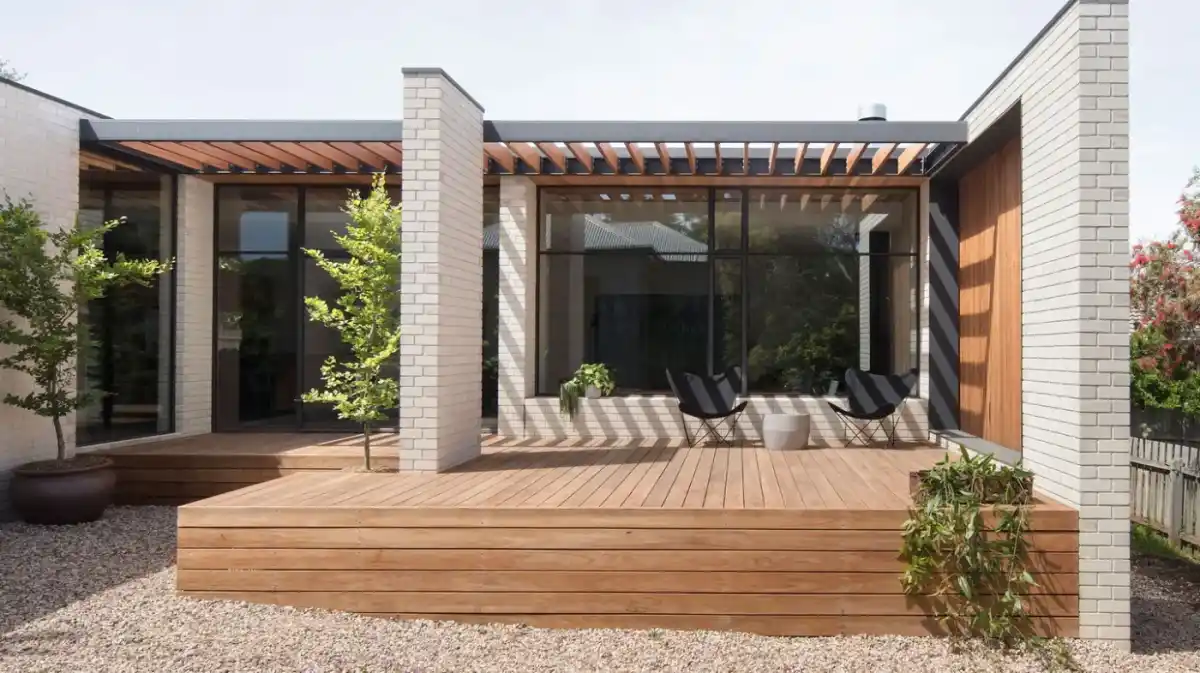
Yellow Balau (Bangkirai) hardwood decking — naturally Durability Class 1, 40–60 year service life, no preservative treatment required. Available in smooth, ribbed and dual ribbed profiles from UK stock with 7–14 day delivery.
What Is Yellow Balau? — And Why Is It Also Called Bangkirai?
Yellow Balau is a tropical hardwood species native to South East Asia — primarily Indonesia, Malaysia, and the Philippines. Botanically it is Shorea laevis, a member of the Dipterocarpaceae family. It grows to significant size in lowland rainforest and produces large, consistent timber sections that make it ideal for decking boards.
The name confusion between Yellow Balau and Bangkirai is one of the most common sources of uncertainty for UK buyers. They are the same species with different regional trade names. Yellow Balau is the international botanical trade name used in the UK, Europe, and in FSC/PEFC certification documentation. Bangkirai is the Indonesian and Malaysian industry name for the same timber, used predominantly by suppliers sourcing directly from those countries. When you see either name in a specification, quote, or product listing, they refer to identical timber with identical performance characteristics. There is no quality hierarchy between the two names.
If a competitor or contractor quotes you on "Bangkirai decking" and you are looking at "Yellow Balau decking" on our site — you are comparing the same material. The only meaningful differences between suppliers are species grade, board dimensions, certification status, and price. Always confirm FSC or PEFC certification regardless of which trade name is used.
Why Yellow Balau Lasts 40–60 Years — The Science
Yellow Balau's exceptional durability comes from its natural composition — not from any chemical treatment or modification process. Three characteristics drive its Class 1 performance:
- Density: At 870–1,050 kg/m³, Yellow Balau is roughly twice the density of ThermoWood (430–490 kg/m³) and significantly denser than European oak (700 kg/m³). High density means fewer void spaces for moisture ingress, fewer pathways for biological attack, and inherently higher mechanical strength
- Natural silica content: Yellow Balau contains naturally occurring silica deposits in its cell structure — one of the mechanisms that contributes to its biological resistance and gives it the characteristic blunting effect on cutting tools that all dense tropical hardwoods share. Pre-drilling is essential precisely because this silica hardness is so high
- Natural extractives: Like all Class 1 hardwoods, Yellow Balau contains natural chemical extractives in the heartwood that are toxic to the fungi and insects responsible for timber decay. These extractives are present throughout the heartwood regardless of surface treatment — which is why no preservative is required
The result is a timber that is biologically hostile to decay without any intervention. Correctly installed above ground with good drainage and ventilation, Yellow Balau decking will outlast the building it serves.
Yellow Balau Profiles UK — Smooth, Ribbed & Dual Ribbed Compared
We stock three Yellow Balau Bangkirai decking profiles from UK stock — all 145mm wide, varying in thickness and surface texture. The choice between them is primarily driven by slip resistance requirements and structural load.
Clean flat face — the contemporary specification where a smooth board surface is the aesthetic priority. Yellow Balau's high natural density provides reasonable grip even on a smooth profile when dry, but caution is required in wet conditions on smooth-faced hardwood. Ideal for covered decks, porches, and sheltered outdoor dining areas. Two screws per joist per board, pre-drilled, countersunk flush.
The standard residential specification — ribbed face surface gives significantly improved slip resistance versus smooth when wet. The ribs run along the board length, channelling surface water away and breaking up the surface plane to improve grip. Same 21mm thickness as smooth profile, same joist spacing requirements. The most widely specified Yellow Balau profile in the UK residential market.
The premium structural profile — 25mm depth for maximum rigidity and dual ribbed face for best-in-range slip resistance. Recommended for commercial applications, pool surrounds, elevated decks, and high-traffic residential areas where the highest structural performance and grip are required. The additional 4mm depth over the 21mm profiles allows up to 450mm joist centres. Heavier to handle on site — factor into installation planning.
Yellow Balau Decking Cost UK 2026 — Full Breakdown
| Profile | Dimensions | Boards/m² | + Subframe & fixings | + Installation | Installed/m² |
|---|---|---|---|---|---|
| Smooth | 21 x 145mm | £65–£78 | £8–£15 | £25–£45 | £98–£138 |
| Ribbed | 21 x 145mm | £65–£80 | £8–£15 | £25–£45 | £98–£140 |
| Dual Ribbed | 25 x 145mm | £72–£90 | £8–£15 | £25–£45 | £105–£150 |
Total cost by deck size
| Deck size | Ribbed 21x145mm installed | Dual ribbed 25x145mm installed |
|---|---|---|
| Small — 10m² | £980–£1,400 | £1,050–£1,500 |
| Typical — 20m² | £1,960–£2,800 | £2,100–£3,000 |
| Large — 30m² | £2,940–£4,200 | £3,150–£4,500 |
| Wraparound — 50m² | £4,900–£7,000 | £5,250–£7,500 |
All figures include boards, C16 treated softwood subframe, joist hangers, A4 stainless fixings, weed membrane and professional installation. Excludes VAT (20% on residential labour), steps, balustrade, and groundworks. London and South East add 25–35% to installation cost. See our full timber decking cost guide for all species compared.
How Yellow Balau Weathers — Colour, Checking & What to Expect
Colour change
Fresh Yellow Balau has a rich golden-yellow to medium warm brown colour — the tone varies slightly board-to-board reflecting natural variation in the species. Like all naturally durable exterior timber, it weathers progressively from its initial golden tone toward silver-grey through UV-driven photochemical degradation of surface lignin. The process takes 12–24 months in UK conditions depending on aspect and exposure. The weathered silver-grey of aged Balau is even, attractive, and fully self-maintaining — it does not worsen over time and requires no intervention.
To maintain the warm golden-brown colour, apply a UV-stable penetrating oil such as Koopmans Houtolie before installation and every 2–3 years thereafter. Work along the board grain with a flat brush. Avoid midsummer direct sun application — oil applied in heat dries on the surface before penetrating. Spring and early autumn are the ideal application seasons.
Surface checking
Yellow Balau develops moderate surface checking as it weathers — fine longitudinal cracks along the grain driven by seasonal moisture cycling. This is entirely cosmetic and has no effect on structural integrity or durability. The checking is more pronounced than ThermoWood (whose thermal modification reduces moisture movement significantly) but less than Douglas Fir. Regular oiling every 2–3 years substantially reduces checking by moderating surface moisture content variation.
Installing Yellow Balau Decking — What You Must Know
Yellow Balau installation follows standard hardwood decking practice with several non-negotiable requirements that differ from softwood installation:
- Pre-drill every fixing point: Yellow Balau's density (870–1,050 kg/m³) will split boards and shear screws if you attempt to drive without pre-drilling. Use a 4mm pilot drill for 5mm screws throughout, countersink with a countersink bit before driving. This is the single most important installation rule for any tropical hardwood
- A4 stainless steel fixings only: The natural tannins and extractives in Yellow Balau cause rapid corrosion of standard steel and galvanised fixings. Within 2–3 years, corroded fixings produce black tannin-rust staining at every fixing point that is impossible to remove without replacing boards. A4 stainless is the only acceptable specification — two screws per joist per board
- Joist spacing: Maximum 400mm centres for 21mm profiles. Up to 450mm centres for the 25mm dual ribbed profile. Never exceed these spacings — hardwood boards at excessive spans will flex under load in ways that accelerate fixing fatigue
- Heart side down: Install boards heart-side down. Hardwood boards cup away from the heart side as they dry — heart-side down means edges curve upward (self-draining) rather than downward (water-pooling)
- 5–6mm expansion gaps: Leave consistent 5–6mm gaps between boards. Tropical hardwoods move less than softwood but seasonal expansion still occurs — consistent gaps prevent board contact and buckling in warm humid periods
- End grain sealing: Apply exterior oil or end grain sealer to every site-cut end immediately after sawing — end grain is the primary moisture entry point in any timber
- 50mm minimum ground clearance: Clear air gap between joist bottom and ground level is essential for ventilation and biological performance regardless of species durability class
Yellow Balau's silica content blunts saw blades and drill bits significantly faster than softwood or ThermoWood. TCT (tungsten carbide tipped) circular saw blades are strongly recommended over standard steel blades. Have spare drill bits available — pilot drill bits will dull after 30–40 fixings in dense Balau. Plan your cuts to minimise waste before sawing, as each cut costs more tool wear than equivalent softwood work.
Yellow Balau vs ThermoWood vs Siberian Larch
| Yellow Balau | ThermoWood | Siberian Larch | |
|---|---|---|---|
| Durability class | Class 1 — Very Durable | Class 2 — Durable | Class 3 — Mod. Durable |
| Service life | 40–60 years | 25–40 years | 20–30 years |
| Treatment needed | None | None | None |
| Dimensional stability | Good | Excellent | Good |
| Secret fix available | No — face fix only | Yes — Brofix system | No — face fix only |
| Board cost/m² | £65–£90 | £55–£85 | £45–£70 |
| Weight | Heavy — 870–1,050 kg/m³ | Light — 430–490 kg/m³ | Medium — 550–650 kg/m³ |
| Pre-drilling required | Yes — essential | No | Recommended |
| Surface checking | Moderate | Low | Low–moderate |
Choose Yellow Balau when maximum service life is the priority — at 40–60 years it outlasts ThermoWood (25–40 years) by a meaningful margin for anyone building a deck they want to last decades without thought. Choose ThermoWood when secret fix (no visible fixings) is important, when the lighter board weight simplifies installation, or when superior dimensional stability in variable conditions is needed. For a full head-to-head see our hardwood decking buyers guide.
Yellow Balau Decking Maintenance — The Honest Guide
- Preservative treatment: Never required — Class 1 durability means no fungicide or biocide is needed at any point
- Cleaning: Every 1–2 years with a stiff brush and dilute exterior wood cleaner, working along the board grain — see our timber decking cleaning guide. Removes surface algae, biological deposits and organic matter from board gaps. Rinse thoroughly
- Oiling: Optional — every 2–3 years to maintain golden-brown colour and reduce surface checking. Koopmans Houtolie applied after cleaning when fully dry. If you prefer the natural silver-grey weathered appearance, no oiling is ever needed and the boards perform identically
- Fixing inspection: Every 5–10 years — check A4 stainless screws are tight. Dense hardwood holds fixings extremely well but a periodic check is good practice on any exterior structure
What is Yellow Balau decking?
Yellow Balau is a naturally durable tropical hardwood (Shorea laevis) from South East Asia, also known as Bangkirai. Durability Class 1 — Very Durable — with a 40–60 year above-ground service life and no preservative treatment required. Available in smooth, ribbed and dual ribbed profiles at £65–£90/m² boards from UK stock.
Is Yellow Balau the same as Bangkirai?
Yes — identical species (Shorea laevis). Yellow Balau is the international botanical trade name used in the UK and Europe. Bangkirai is the Indonesian/Malaysian industry name. Same timber, same performance, no quality difference between names.
How long does Yellow Balau decking last?
40–60 years above ground with correct installation — A4 stainless fixings, ventilated subframe, 50mm ground clearance. Naturally Durability Class 1 under BS EN 350. No preservative treatment required throughout this service life.
How much does Yellow Balau Bangkirai decking cost in the UK?
£65–£90/m² boards in 2026. Smooth and ribbed 21x145mm £65–£80/m², dual ribbed 25x145mm £72–£90/m². Total installed cost for a 20m² deck approximately £1,960–£3,000 including subframe, fixings, membrane and professional installation.
Does Yellow Balau decking need treating?
No — Durability Class 1, no preservative treatment ever required above ground. Optional oiling every 2–3 years maintains the golden-brown colour and reduces surface checking but has no effect on structural durability or service life.
Which is better — ribbed or smooth Yellow Balau decking?
Ribbed is better for most residential garden decks — the ribbed surface gives significantly improved slip resistance when wet versus smooth. Smooth is the right choice for covered decks and sheltered areas where the clean surface aesthetic is the priority and wet-surface slip is less of a concern. Both profiles have identical durability and service life.
Yellow Balau Bangkirai Decking — UK Stock, 7–14 Day Delivery
We supply Yellow Balau Bangkirai decking in smooth, ribbed and dual ribbed profiles from UK stock. FSC and PEFC certified. Tell us your deck dimensions for a precise board quantity and full material list. Nationwide delivery 7–14 days.