- Who needs it: Buildings with ACM (polyethylene core), HPE cladding, or any external wall system that fails EWS1 assessment. Also older buildings where cladding has deteriorated or no longer meets current Building Regulations.
- Height rules: Under 11m — standard building regs apply. 11–18m — Approved Document B fire performance requirements. Over 18m — full BR135 system testing required, non-combustible cladding strongly preferred.
- Can timber replace it? Yes — fire rated timber (EuroClass B / Class 0) is a compliant replacement on buildings under 18m. Above 18m requires a complete system test including cavity barriers and insulation.
- Cost: £80–150/m² supply and install for fire rated timber replacement under 18m. £120–250/m² for full system replacement on taller buildings.
- EWS1: Replacement cladding must be specified to achieve the required EWS1 rating — confirm with your fire engineer before specifying materials.
- TCS can supply: Fire treated Siberian larch, ThermoWood, and fire rated boards for cladding replacement projects nationwide. Supply only or supply and install.
External cladding replacement is one of the most significant challenges facing UK building owners, housing associations, local authorities, and developers in the post-Grenfell era. Hundreds of thousands of square metres of ACM, HPE, and non-compliant cladding remain on UK buildings — and the remediation programme is ongoing. This guide covers everything building owners, contractors, and specifiers need to know about cladding replacement in the UK — which buildings are affected, what the height-based rules require, whether fire rated timber is a compliant replacement option, what it costs, and how to specify correctly for EWS1 compliance.
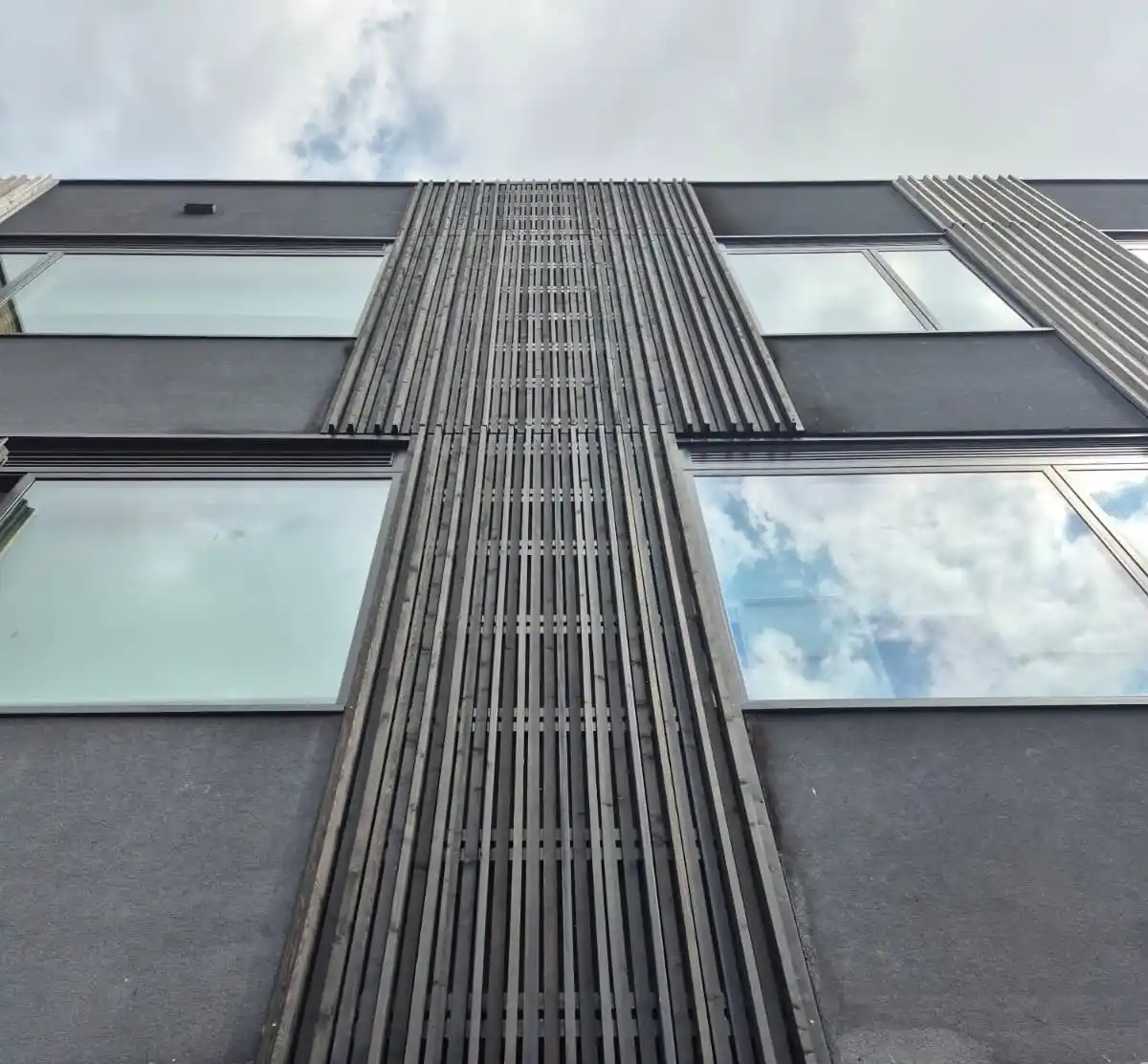
Fire rated timber cladding on Oasis Academy Hadley — a completed cladding replacement project by Timber Cladding Specialists. Fire treated timber cladding achieving EuroClass B performance was specified for this education building, replacing the previous external wall system and meeting current Approved Document B requirements for buildings of this height and use class.
Why External Cladding Replacement Is Needed UK
The Grenfell Tower fire in 2017 triggered the most significant review of external wall systems in UK construction history. The subsequent Hackitt Review, the Building Safety Act 2022, and updated Approved Document B have together created a regulatory framework that requires many existing buildings to replace their external cladding — and applies significantly more stringent requirements to new construction. The three main drivers of cladding replacement in the UK:
- ACM cladding with polyethylene core: The primary cladding type identified in the Grenfell inquiry. ACM with a polyethylene (PE) or fire retardant (FR) core is present on hundreds of buildings across the UK. Government programmes have funded replacement on social housing above 18m, but private sector buildings and lower-rise social housing face a more complex remediation pathway
- High pressure laminate (HPL) cladding: A second category of combustible cladding identified as a risk — HPL panels with combustible cores have been identified on buildings across the country and are subject to the same remediation pressure as ACM
- General non-compliance and deterioration: Beyond the ACM and HPL categories, many buildings have external cladding systems that pre-date current Building Regulations, have deteriorated beyond repair, or have been found to contain missing or inadequate cavity barriers — all of which trigger replacement requirements under current fire safety legislation

Fire reaction testing for external cladding — the large-scale room burn test is used to classify the fire performance of cladding materials. EuroClass B (Class 0 under the UK national classification) is the fire performance benchmark for external cladding on buildings over 11m in England. Fire treated timber can achieve EuroClass B, making it a compliant replacement cladding option for buildings in this height band under Approved Document B.
Cladding Replacement Building Height UK — Rules by Height Band
Standard Approved Document B applies. No specific requirement for limited combustibility cladding — fire treated or naturally durable timber is a straightforward replacement specification.
Replacement cladding must achieve EuroClass B (Class 0) fire performance. Fire treated timber — Siberian larch or ThermoWood treated with our fire redundant treatment service — achieves this classification. EWS1 assessment likely required if flats above 11m.
The complete external wall system — cladding, insulation, cavity barriers, and substrate — must be tested to BS 8414 and assessed to BR135. Non-combustible materials (A1/A2) are strongly preferred and are effectively the default specification above 18m on residential buildings.
The height thresholds and requirements above reflect Approved Document B for England. Scotland, Wales, and Northern Ireland have separate building regulations. Requirements also vary by building use class (residential, commercial, education, healthcare). Always confirm your specific compliance requirements with a qualified fire engineer before specifying replacement cladding materials.
Can Timber Cladding Replace ACM or HPL UK?
Fire rated timber cladding on a commercial building — natural timber is an increasingly popular replacement specification for ACM and HPL cladding on buildings under 18m, where fire treated boards achieving EuroClass B provide compliant fire performance alongside the warmth, character and sustainability credentials of natural timber.
Fire rated timber cladding is a compliant replacement option for external cladding on many UK buildings — and is increasingly specified on education, healthcare, commercial, and residential buildings where natural material character is valued alongside fire safety compliance. The key considerations:
- Buildings under 18m: Fire treated timber achieving EuroClass B (Class 0) is a fully compliant replacement for ACM or HPL cladding under Approved Document B. Our fire redundant treatment service applies a tested, certified fire retardant treatment to Siberian larch, ThermoWood, and Nordic spruce boards — providing a tested EuroClass B classification certificate for specification and building control submission
- Cavity barriers: The replacement external wall system must include correctly installed and fire-rated cavity barriers at floor levels, around openings, and at the top and bottom of the cladding zone — regardless of building height. Missing or inadequate cavity barriers are one of the most commonly identified deficiencies in existing external wall systems and must be addressed as part of any cladding replacement programme. See our building regulations guide and fire redundant treatment guide for the full compliance picture
- Insulation compatibility: Where existing insulation is being retained, confirm its fire classification and compatibility with the new cladding system. Where insulation is being replaced, specify mineral wool or PIR boards with appropriate fire classification — never expanded polystyrene (EPS) in external wall systems on buildings over 11m
- Buildings over 18m: Above 18m, the complete system must be tested. Fire treated timber above 18m is technically possible but requires a full BS 8414 large-scale fire test of the specific system — cladding, insulation, cavity barrier, and substrate. This is a significant cost and programme commitment. Most replacement specifications above 18m use non-combustible A1 or A2 materials. Contact us to discuss options if timber is a priority on a taller building. See also our social housing cladding guide and our schools cladding guide for sector-specific specification detail.
Fire Rated Timber Cladding for Replacement Projects UK
Siberian larch fire rated cladding on a commercial building — the natural warmth and character of timber makes fire treated larch an increasingly popular specification for cladding replacement on education, healthcare and commercial buildings, where the building owner wants both code compliance and a high-quality natural aesthetic to replace the previous system.
Timber Cladding Specialists supply fire treated cladding boards for replacement projects across the UK — Siberian larch, ThermoWood, and Nordic spruce in all standard profiles, treated to achieve EuroClass B fire performance:
- Fire treatment process: Boards are treated with our proprietary fire redundant treatment — a pressure-applied, tested retardant that achieves EuroClass B (Class 0) classification. The treatment is applied to finished, machined boards at our March facility and is supplied with a full test certificate for building control submission. See our fire redundant treatment service page for the full specification
- Profiles available: Shadow gap, shiplap, feather edge, rainscreen, and log lap in Siberian larch and Nordic spruce. ThermoWood shadow gap, half lap, double shadow gap, and triple shadow gap. All profiles available with fire treatment. See our fire rated cladding shop for current stock and availability
- Supply lead time: 10–21 days for fire treated boards — allow for treatment cure time on top of standard board lead times. For urgent replacement programmes, contact us to discuss stock availability and programme requirements
- Supply and install: We offer supply and install services for cladding replacement projects across the UK — boards, batten system, breather membrane, cavity barriers, fixings, and installation by our own teams. Contact us with project details and programme requirements for a full tender response
EWS1 and Cladding Replacement UK
EWS1 (External Wall Survey) certificates are required by mortgage lenders on many multi-storey buildings before they will lend against flats in the building. The certificate confirms that a qualified professional has assessed the external wall system and found it to be safe — or has identified what remediation is required. For cladding replacement projects on residential buildings where EWS1 is required:
- Engage a fire engineer early: The EWS1 assessor must confirm the proposed replacement specification is capable of achieving the required rating (A1, A2, or B1) before work begins — not after. Specifying without this confirmation risks completing a replacement that still cannot achieve the EWS1 rating required by lenders
- A1 rating: Requires all external wall materials to be of limited combustibility — effectively non-combustible. Timber is not A1. Not achievable with any timber cladding specification
- A2 rating: Requires the external wall system to have passed appropriate large-scale fire testing with materials of limited combustibility. Timber is generally not compatible with A2 unless the complete system has been tested
- B1 rating: Achieved where the external wall system poses a low risk — typically where EuroClass B cladding is specified with compliant cavity barriers and insulation. Fire treated timber achieving EuroClass B can contribute to a B1 EWS1 rating on buildings where this is the appropriate assessment outcome. Always confirm with the EWS1 assessor
For more detail on fire rating classifications and Approved Document B compliance, see our full fire rated timber cladding commercial guide, our EuroClass B and Class 0 guide, and our Approved Document B timber cladding guide.
Cladding Replacement Cost UK — 2026 Estimates
Fire rated timber cladding installation on a commercial build — cladding replacement cost varies significantly by building height, size, access complexity, existing wall system condition, and replacement specification. The figures below represent supply and install costs for fire treated timber cladding replacement under 18m; buildings over 18m involve additional system testing and compliance costs not reflected in these estimates.
| Cost element | Typical range | Notes |
|---|---|---|
| Scaffold (per week) | £2,000–8,000/wk | Major cost on multi-storey buildings — programme management critical to control scaffold hire duration |
| Strip existing cladding | £8–20/m² | Higher for ACM with adhesive fixing systems or complex sub-frame removal |
| Asbestos survey / disposal | £500–5,000 | Required on pre-2000 buildings before any cladding removal work begins |
| Cavity barrier installation | £15–35/lm | Per linear metre of cavity barrier at floor levels and around openings |
| Breather membrane | £4–8/m² | Supply and fix — included in most supply-and-install packages |
| Batten system (counter + support) | £12–20/m² | Treated softwood counter and support battens, masonry fixings |
| Fire rated timber boards (supply) | £55–80/m² | EuroClass B fire treated Siberian larch or ThermoWood — ex VAT. Add 15% waste |
| Installation labour (boards) | £20–35/m² | Board fixing labour only — excludes batten system and membrane |
| Fire engineer / EWS1 | £2,000–8,000 | Per project — fire engineer review of specification and EWS1 assessment (where required) |
| Total supply & install (under 18m) | £110–180/m² | All in excluding scaffold, asbestos, and professional fees — typical fire rated timber replacement |
Scaffold. On a multi-storey building, scaffold can represent 25–40% of total project cost — and every week of programme overrun adds thousands. The single most effective cost control measure on a cladding replacement programme is tight programme management: have materials on site and ready before scaffold goes up, sequence the work efficiently, and strip and replace one elevation at a time to minimise the scaffold footprint at any one point. We can supply fire rated boards to programme with 10–21 day lead times — contact us to discuss your project timeline and we will confirm availability and lead times upfront.
How much does cladding replacement cost UK?
Fire rated timber cladding replacement under 18m typically costs £110–180/m² supply and install, excluding scaffold, asbestos survey, fire engineer fees, and EWS1 assessment. Scaffold adds £2,000–8,000/week depending on building size. A typical 3-storey residential block with 400m² of elevation area costs £44,000–72,000 for the cladding replacement work alone, plus £8,000–20,000 for scaffold and professional fees.
Can timber cladding be used for cladding replacement UK?
Yes — on buildings under 18m, fire treated timber achieving EuroClass B (Class 0) is a compliant replacement specification under Approved Document B. Above 18m, the complete system requires BS 8414 large-scale fire testing. Always confirm compliance with a fire engineer before specifying.
What is EWS1 and how does it affect cladding replacement UK?
EWS1 is an External Wall Survey certificate required by mortgage lenders on multi-storey buildings. It confirms the external wall system is safe or identifies what remediation is needed. Replacement cladding must be specified to achieve the required EWS1 rating — engage a fire engineer early to confirm the specification before materials are ordered.
What replaces ACM cladding UK?
On buildings over 18m, ACM is typically replaced with non-combustible A1 or A2 rated materials — mineral fibre panels, fibre cement, or aluminium with non-combustible cores. On buildings under 18m, fire rated timber achieving EuroClass B is a compliant and increasingly popular replacement — providing both code compliance and natural material character.
Who pays for cladding replacement UK?
Government funding has been provided for ACM replacement on social housing over 18m. For private sector buildings and lower-rise social housing, funding varies — some developers have accepted responsibility under the Building Safety Act 2022; others have not. The Building Safety Fund and developer remediation contract cover some buildings. Leaseholders on qualifying buildings cannot be charged for cladding remediation costs. Check the UK Government Building Safety website for current funding schemes and eligibility. See our commercial cladding guide and healthcare cladding guide for sector-specific replacement guidance.
Fire Rated Cladding Supply for Replacement Projects — UK Wide
We supply fire treated Siberian larch, ThermoWood, and Nordic spruce cladding boards for replacement programmes across the UK. EuroClass B fire treatment with test certificate. All profiles, 10–21 day lead time. Supply only or supply and install. Contact us with your project details and programme requirements.