
- Routine clean: Stiff brush + water or dilute deck cleaner. Work along the grain. Rinse thoroughly.
- Green algae: Apply biocidal deck cleaner, leave 10–15 mins to dwell, scrub and rinse. Repeat if heavy.
- Pressure washing: Fan-tip nozzle only, low-medium pressure, 30cm+ distance, work with the grain — never across it.
- After cleaning: Allow 48hrs to dry fully before applying any oil or treatment.
- ThermoWood: Clean once or twice a year with mild cleaner. No oiling needed unless maintaining colour.
- Treated softwood: Clean then re-oil annually. The oil is the maintenance that determines service life.
- How often: Once or twice a year — spring and autumn. More frequently in shaded locations.
Cleaning timber decking is the most important maintenance task for the majority of UK garden decks — and the one most commonly done either too infrequently or with the wrong technique. Whether you have ThermoWood, Siberian larch, or treated softwood decking, the same principles apply: remove organic matter before it causes problems, treat algae before it becomes a slip hazard, and understand whether your species needs oiling after cleaning or not. This guide covers the full process for every species — from routine cleaning through to heavy algae treatment — with the right products and the right technique for UK conditions.
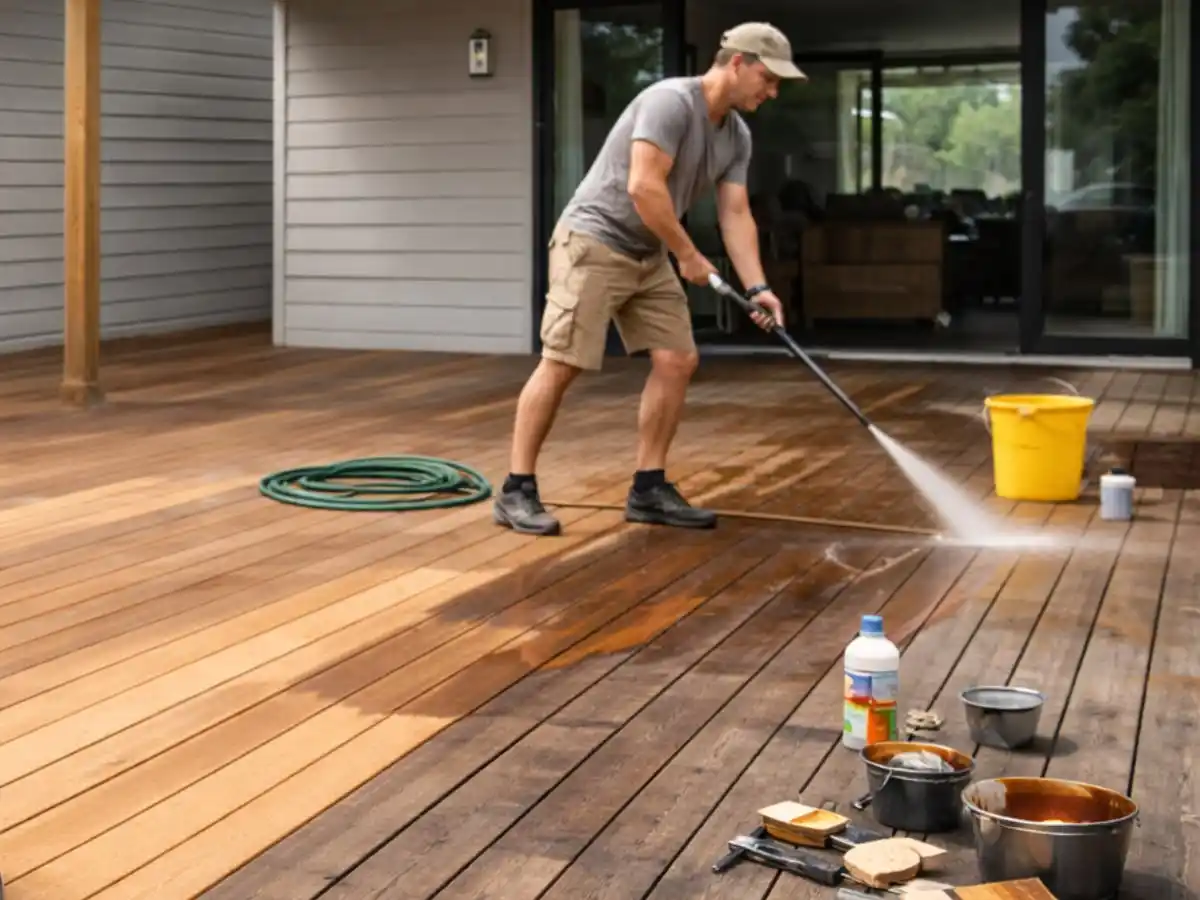
Cleaning timber decking — a thorough wash-down with a stiff brush and deck cleaner, followed by a thorough rinse, removes the year's accumulation of organic matter, algae, and surface staining. For most decks this annual clean is all that is needed to keep the surface in good condition.
How Often Should You Clean Timber Decking?
For most UK garden decks in a standard exposed location, once or twice a year is the right cleaning frequency — typically in spring before the deck season starts, and in autumn to clear leaf debris and organic matter before winter. This schedule prevents the accumulation of organic material that provides the moisture and nutrients for algae and surface mould growth.
Decks in shaded or north-facing locations with limited direct sunlight and poor air circulation will benefit from more frequent cleaning — three or four times a year — because the surface stays damp longer and algae establishes more quickly. A deck beneath a tree may need sweeping weekly during leaf fall to prevent the wet leaf mat that accelerates biological growth and staining.
| Location | Recommended cleaning frequency | Main risk |
|---|---|---|
| Full sun, open location | Once a year — spring | Minimal — UV kills surface organisms |
| Partial sun, standard garden | Once or twice a year | Moderate algae in autumn/winter |
| Shaded, north-facing | 3–4 times a year | Persistent algae, slip hazard |
| Beneath trees | Weekly sweep, thorough clean twice a year | Leaf mat, tannin staining, heavy algae |
How to Clean Timber Decking — Step by Step
Remove all furniture, planters, and obstacles. Sweep thoroughly with a stiff brush — paying particular attention to the gaps between boards where leaf litter and organic debris accumulate. This debris retains moisture and is the primary starting point for algae growth and biological decay in the board gaps.
Use a gap clearing tool, an old bread knife, or a flat-head screwdriver to scrape compacted debris from between the boards. This is the most labour-intensive step but the most important — impacted debris in board gaps holds moisture against the board edges and the joist tops, causing more damage than surface contamination.
For decks with visible green algae, black mould, or biological staining, apply a specialist biocidal deck cleaner diluted according to the manufacturer's instructions. Apply generously with a brush or watering can, and allow to dwell for 10–15 minutes. This breaks down the biological deposits before mechanical cleaning. Do not let it dry on the surface.
Scrub the surface with a stiff deck brush — always working along the board grain, not across it. Scrubbing across the grain raises the surface fibres and leaves the deck rougher than before cleaning. Work methodically from one end to the other. Rinse thoroughly with clean water from a hose or bucket as you go.
For a deeper clean or for decks with heavy surface contamination, a pressure washer is highly effective. Use a fan-tip nozzle — never a concentrated jet nozzle. Maintain at least 30cm distance from the board surface. Work along the board grain at consistent speed — hovering in one spot raises the grain. Low to medium pressure is sufficient — high pressure at close range damages the timber surface.
Rinse the entire deck thoroughly with clean water to remove all cleaning product residue. Allow to dry completely — minimum 48 hours in dry weather before applying any oil or treatment. Applying oil to damp timber traps moisture, causes uneven penetration, and can promote surface mould growth under the oil film.
Once fully dry: for ThermoWood — oiling is optional, only for colour maintenance. For Siberian larch — oiling is optional, every 2–3 years if maintaining colour. For pressure treated softwood — apply preservative decking oil annually once dry. This is the maintenance step that directly determines how long treated softwood lasts. Browse our full woodcare and fixings range for all cleaning and treatment products.
Oiling After Cleaning — What You Need to Know by Species
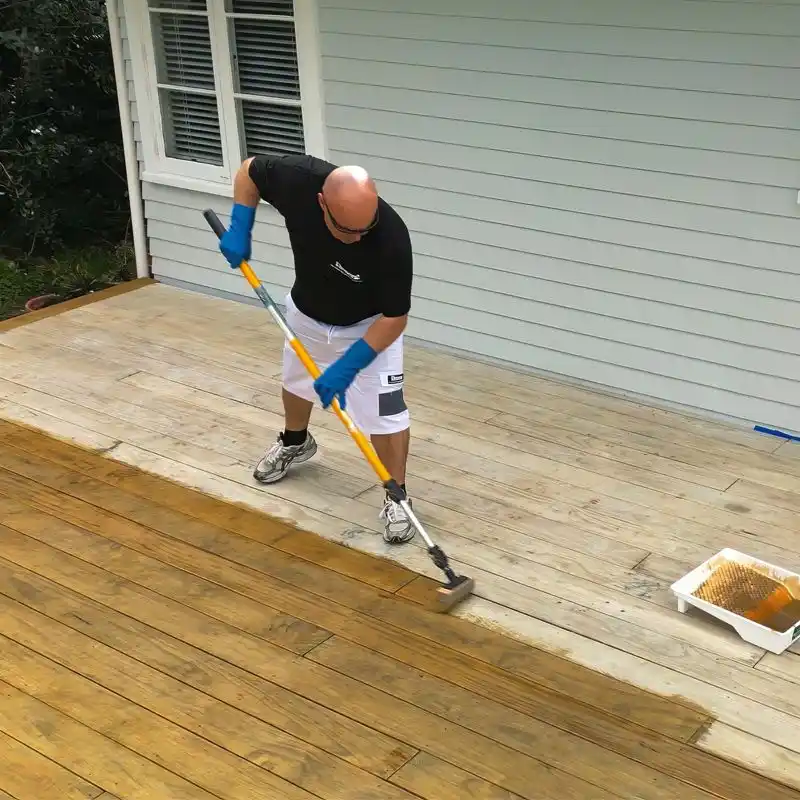
Applying decking oil after cleaning — the clean, dry surface absorbs oil evenly and the colour restores dramatically after a fresh coat. Always apply along the grain with a brush or roller, and never apply to damp timber. The difference between a freshly oiled deck and an untreated one is immediately visible and significantly extends the life of treated softwood.
| Species | Oil needed after cleaning? | Frequency | Recommended product |
|---|---|---|---|
| ThermoWood | Optional — colour only | Every 3–5 yrs if wanted | Koopmans Houtolie |
| Siberian Larch | Optional — colour only | Every 2–3 yrs if wanted | Koopmans Houtolie |
| Pressure Treated Softwood | Essential — durability | Annually or when previous coat wears | Remmers HK Stain |
| Composite decking | Not applicable | Never — clean only | Specialist composite cleaner |
Cleaning by Species — What's Different
ThermoWood decking
ThermoWood's thermal modification reduces its susceptibility to biological growth compared to standard softwood — but in UK conditions, particularly in shaded locations, surface algae can still accumulate. Clean with a mild deck cleaner — avoid harsh acid-based cleaners which can react with ThermoWood's modified surface and cause uneven discolouration. A dilute solution of a pH-neutral wood cleaner works well. For the full ThermoWood maintenance guide, and see our ThermoWood vs composite decking guide, including the zero-maintenance case and optional colour maintenance, see our dedicated article.
Siberian larch decking
Siberian larch is Durability Class 3 and naturally resistant to biological decay — but its resin content can cause surface tannin staining on adjacent surfaces (walls, paving) as it weathers. A thorough annual clean keeps the surface clear of organic matter and maintains its appearance. Larch weathers to a silver-grey if left untreated — this is cosmetically harmless and many owners prefer it. If you want to maintain the warm gold colour, clean and oil every 2–3 years.
Pressure treated softwood decking
This is the species where cleaning matters most in terms of actual durability, not just appearance. Pressure treated softwood requires annual oiling to maintain the surface protection that determines service life. The cleaning step is the prerequisite — oiling over a dirty, contaminated surface traps organic matter and reduces penetration. Clean thoroughly, allow to dry for 48 hours minimum, then apply preservative decking oil. Never skip the oil on treated softwood — a missed year significantly accelerates surface breakdown and biological vulnerability.
Never use undiluted bleach — it damages timber fibres, causes discolouration, and creates an uneven surface. Never use a jet nozzle on a pressure washer — concentrated jets at close range split and raise the grain irreparably. Never oil damp timber — wait 48 hours after washing before applying any oil or treatment. Never clean across the grain — always work along the board length with both brush and pressure washer.
The fundamental difference between maintaining ThermoWood decking and treated softwood is that ThermoWood's cleaning is purely cosmetic — it improves appearance and prevents surface algae accumulation, but missing a clean does not reduce service life. Treated softwood's oiling programme directly determines service life — miss two consecutive years and the surface protection begins to fail. If you want a deck that stays in excellent condition without an annual maintenance obligation, ThermoWood decking removes the risk of maintenance neglect affecting structural performance.
How do I remove green algae from timber decking?
Apply a biocidal deck cleaner, leave to dwell 10–15 minutes, scrub with a stiff brush along the grain, then rinse thoroughly. For heavy algae on shaded decks, a second application may be needed. After cleaning, ensure good air circulation below the deck and trim overhanging vegetation to prevent recurrence.
Can I pressure wash timber decking?
Yes — use a fan-tip nozzle, low-medium pressure, 30cm+ distance, working along the board grain. Never use a concentrated jet nozzle at close range — it raises and splits the grain irreparably. After pressure washing, allow to dry fully before applying any oil or treatment.
How often should I clean timber decking?
Once or twice a year for most decks — spring and autumn. Shaded or north-facing decks benefit from 3–4 times a year. Decks beneath trees need weekly sweeping during leaf fall plus thorough cleaning twice yearly. Regular sweeping throughout the year reduces the need for intensive seasonal cleans.
What is the best cleaner for timber decking UK?
For routine cleaning, dilute deck cleaner or exterior wood cleaner with a stiff brush. For algae and biological staining, a biocidal deck cleaner containing quaternary ammonium compounds removes green deposits effectively. Avoid undiluted household bleach — it damages timber fibres and causes discolouration. For ThermoWood specifically, use a mild pH-neutral cleaner.
Do I need to oil decking after cleaning?
It depends on the species. ThermoWood — optional, colour only, every 3–5 years. Siberian larch — optional, every 2–3 years for colour. Pressure treated softwood — yes, annually, this is the maintenance that directly determines service life. Always allow 48 hours drying time after cleaning before applying any oil.
Decking Oils and Treatments — UK Stock
We stock Koopmans Houtolie for ThermoWood and larch and Remmers HK Stain for treated softwood — the right product for every decking species. Browse our full woodcare range or contact our team for advice on the right treatment for your deck.