
- What it is: Picea abies — Norway spruce grown in Scandinavia. The most widely used softwood cladding species in Northern Europe. Straight grain, pale cream colour, competitive cost.
- Durability: Class 4 — Slightly Durable. Requires surface treatment every 2–4 years. Not naturally durable like larch or ThermoWood.
- Service life: 15–25 years with consistent maintenance. 5–10 years without.
- Cost: £18–£45/m² boards depending on profile — the most affordable UK cladding timber available.
- Profiles: Shadow gap, double shadow gap, tongue & groove V-joint, shiplap, loglap, rainscreen, feather edge — the widest profile range of any cladding species.
- Best use: Budget-conscious residential projects, garden buildings, outbuildings, and as a base for charred (Shou Sugi Ban) finishes.
- vs Larch / ThermoWood: Cheaper upfront, higher whole-life maintenance cost. Larch and ThermoWood are stronger specifications for any project where longevity and low maintenance matter.
Nordic spruce cladding is the most widely stocked and most affordable exterior timber cladding in the UK market. Grown in the boreal forests of Scandinavia and the Nordic countries, Picea abies (Norway spruce) produces consistently straight-grained, pale-toned timber available across a wider range of profiles than any other cladding species. It is the go-to budget cladding specification for garden buildings, outbuildings, and residential projects where cost is the primary driver — and it is also the most popular base timber for charred cladding (Shou Sugi Ban) finishes in the UK. This guide covers everything: what Nordic spruce cladding is, all available profiles and their costs, how long it lasts, what maintenance it needs, how it compares against Siberian larch and ThermoWood, and when it is the right specification for your project.
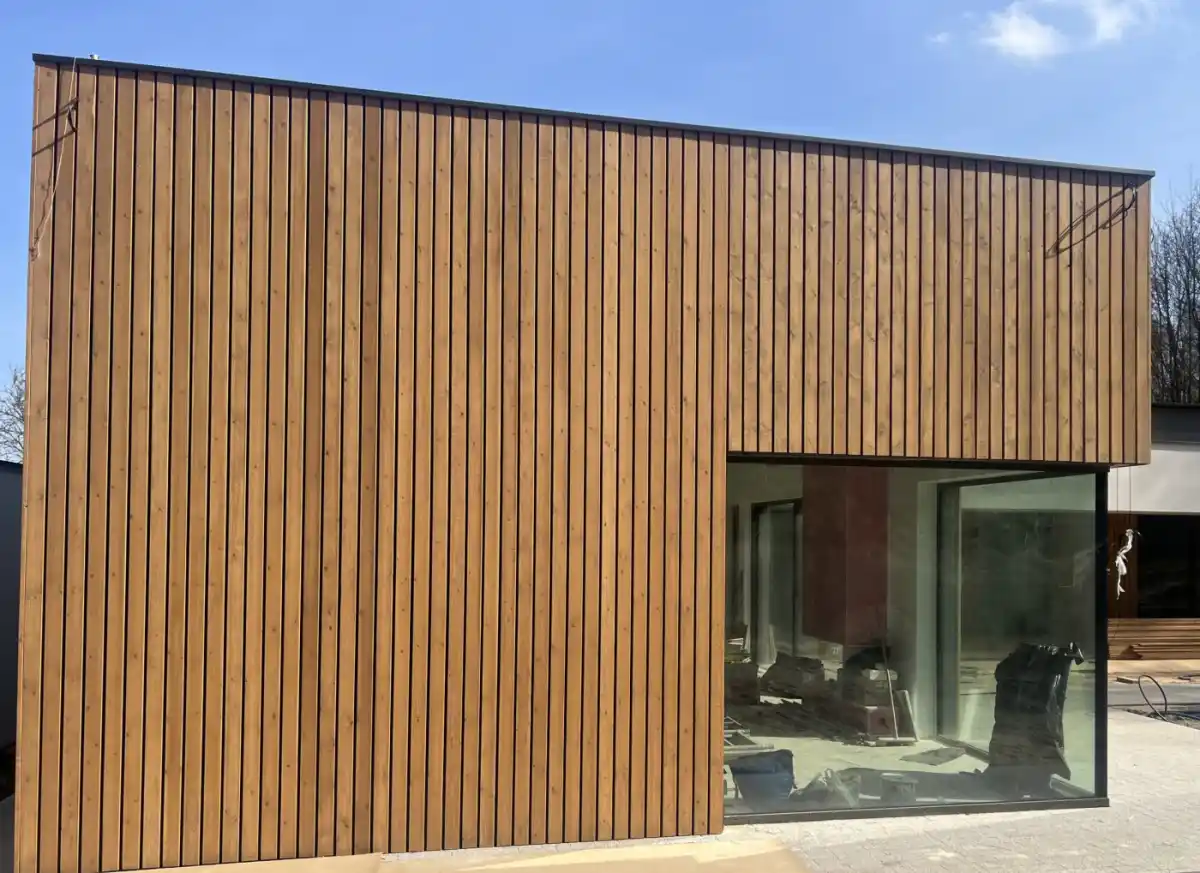
Nordic spruce external cladding — shadow gap profile on a UK residential elevation. The pale cream tone and clean straight grain of Nordic spruce accepts stained and natural finishes equally well. Treatment every 2–4 years is required to maintain performance and appearance.
What Is Nordic Spruce Cladding?
Nordic spruce — botanically Picea abies, commonly called Norway spruce — is the dominant softwood species of the Scandinavian and Nordic boreal forests. It grows in vast, sustainably managed plantations across Norway, Sweden, Finland, and the Baltic states, where the cold climate produces slow, even growth rings that give the timber its characteristic straight, tight grain and consistent appearance.
In the UK cladding market, "Nordic spruce" specifically refers to timber sourced from these Northern European forests — not from lower-latitude spruce plantations where faster growth produces wider, less consistent grain. The Nordic origin matters because the cold climate growth produces denser, tighter-grained boards with less resin variation than spruce from warmer origins — a meaningfully better substrate for any surface finish, whether natural oil, stain, or charring.
Nordic spruce is FSC and PEFC certified from all our suppliers — a requirement for any project where sustainability credentials are part of the specification. It is grown from renewable plantation stock and has one of the lowest embodied carbon footprints of any UK cladding material.
Why Nordic spruce needs treatment — the durability reality
Nordic spruce is Durability Class 4 under BS EN 350 — Slightly Durable. This is the honest, important fact that every buyer needs to understand before purchasing. Unlike Siberian larch (Class 3), ThermoWood (Class 2), or hardwood (Class 1), Nordic spruce has minimal natural biological resistance to the decay fungi and wood-boring insects present in UK outdoor conditions. Untreated Nordic spruce cladding on a UK exterior will begin to deteriorate within 2–5 years.
This does not make it a bad product — it makes it a product that performs well when maintained correctly and performs poorly when it is not. The service life figures of 15–25 years assume consistent oiling or staining every 2–4 years, correct installation with a ventilated batten system, and good detailing at junctions and openings. Meet those conditions and Nordic spruce is a cost-effective, attractive, and widely available cladding specification. Neglect the maintenance and it fails faster than any naturally durable alternative.
Nordic Spruce Cladding Profiles UK — All Options Compared
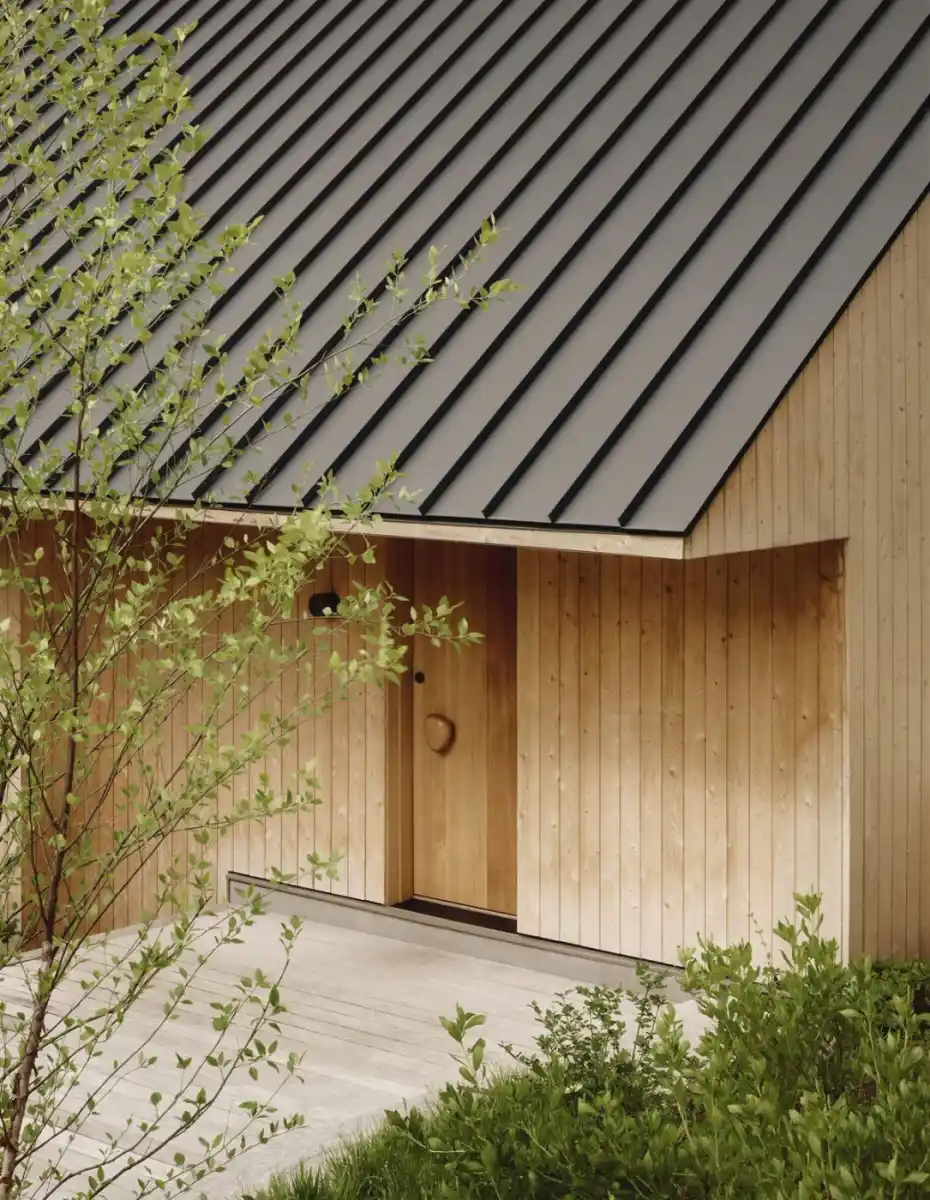
Nordic spruce tongue and groove cladding — one of the most versatile profiles available, suitable for both interior lining and exterior use with appropriate treatment. The interlocking joint creates a weather-tight face without visible fixing points at each board joint.
Nordic spruce has the widest profile range of any cladding species we stock — 8 distinct profile categories covering every cladding application from contemporary residential to rural outbuildings.
The most popular Nordic spruce profile for contemporary UK homes and garden rooms. The rebated board face creates a recessed joint that reads as a strong horizontal shadow line. Works particularly well with black or grey stained finishes and as a base for charred (Shou Sugi Ban) treatment.
Wider board with a deeper double rebate — creates a bolder, more architectural shadow line than the standard shadow gap. The thicker 24mm depth adds rigidity. Best for larger residential facades and commercial projects where a more prominent horizontal rhythm is wanted.
The interlocking tongue and groove joint with a V-shaped chamfer at each board face creates a clean, traditional cladding face. Suitable for both exterior cladding (with treatment) and interior timber lining. The widest size range of any profile — 14mm through 28mm depth.
The standard shed and outbuilding cladding profile — overlapping boards with a rebated lower edge. Shed cladding at its most affordable. The most widely used Nordic spruce profile for garden buildings, workshops, log stores, and any structure where budget is the primary driver.
Tapered board fixed in an overlapping pattern — the classic agricultural and rural cladding profile. Authentic vernacular character for barn conversions, rural outbuildings, and garden structures where a traditional aesthetic is wanted. Particularly effective in black stained or natural weathered finishes.
Narrow open-joint rainscreen batten — the profile used in our Shou Sugi Ban charred Nordic spruce range. The narrow batten and open joint create maximum shadow depth between boards. Also available in natural for contemporary open-joint facades.
Convex face profile that mimics the appearance of horizontal log construction. Distinctive rounded face texture — popular for cabin-style garden rooms, glamping structures, and rural residential projects where a natural, handcrafted aesthetic is the intent.
Heavy structural tongue and groove board — 45mm depth makes this a structural boarding product as much as a cladding profile. Used for heavy-duty enclosures, structural wall boarding, and applications where maximum board thickness is required.
Does Nordic Spruce Cladding Need Treating? — The Honest Answer
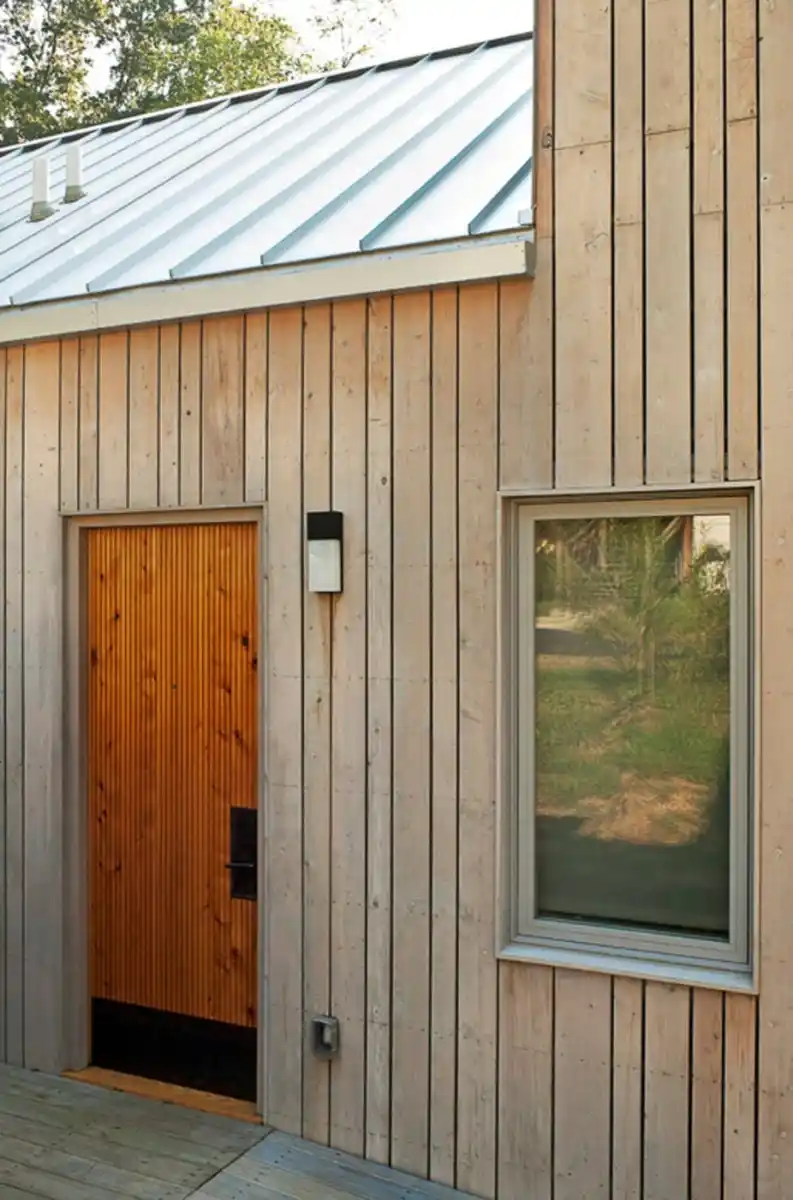
Nordic spruce cladding with exterior stain applied — the treatment penetrates the grain and provides both colour and biological protection. Consistent re-application every 2–4 years is essential to maintain both appearance and structural performance on Nordic spruce.
Yes — and this is non-negotiable. Nordic spruce is Durability Class 4. Without surface treatment it will begin to deteriorate within 2–5 years on a UK exterior. The treatment programme for Nordic spruce cladding has three stages:
Before installation — end grain sealing
Apply a penetrating exterior oil or end grain sealer to all board ends before installation. End grain is the primary moisture entry point in any softwood — sealing ends before fixing dramatically reduces the risk of end-checking and moisture ingress at the most vulnerable point of each board.
At installation — first coat
Apply the first coat of exterior oil or stain to all board faces and edges before installation where possible — back-priming boards before fixing ensures all surfaces are protected, including the hidden face against the batten. Products such as Remmers HK Stain Premium or Koopmans Houtolie are suitable penetrating finishes. Apply a second coat to the board face after installation when the first coat has cured.
Ongoing — every 2–4 years
Re-apply the same exterior stain or oil product every 2–4 years depending on exposure. South and west-facing elevations in high UV and high rainfall environments will need re-treatment at the shorter 2-year interval. North-facing sheltered elevations can extend to 4 years. Clean the surface thoroughly before each re-treatment — accumulated algae and surface deposits prevent proper product penetration. See our how to oil timber cladding guide for the full technique.
Unlike Siberian larch or ThermoWood where missing a maintenance cycle affects appearance but not structural integrity, missing treatment cycles on Nordic spruce has structural consequences. A single missed cycle on a heavily exposed south-facing elevation can allow moisture content to rise above the 20% decay threshold for extended periods. Surface greying and checking appear within 12 months of missed treatment. Surface softening and decay can follow within 2–3 years on untreated spruce in high-exposure positions. Annual inspection and consistent maintenance from year one is essential, not optional.
Nordic Spruce Cladding Cost UK 2026 — All Profiles
| Profile | Size | Boards/m² | + Battens, fixings, membrane | + Installation | Installed/m² |
|---|---|---|---|---|---|
| Shadow gap | 19×146mm | £28–£38 | £8–£15 | £20–£40 | £56–£93 |
| Double shadow gap | 24×146mm | £32–£45 | £8–£15 | £20–£40 | £60–£100 |
| Tongue & groove V-joint | 19×146mm | £20–£32 | £8–£15 | £20–£40 | £48–£87 |
| Shiplap | 19×146mm | £18–£28 | £8–£15 | £20–£40 | £46–£83 |
| Feather edge | 24×146mm | £22–£32 | £8–£15 | £20–£40 | £50–£87 |
| Rainscreen | 24×68mm | £25–£35 | £8–£15 | £20–£40 | £53–£90 |
| Loglap | 24×146mm | £24–£34 | £8–£15 | £20–£40 | £52–£89 |
All installed costs include treated softwood counter battens and horizontal battens, A4 stainless steel fixings, breather membrane, and professional installation. They exclude VAT (20% on residential labour), windows and door reveals, and scaffolding. For a full UK cladding cost comparison across all species see our timber cladding cost guide 2026.
Nordic Spruce Cladding on a UK Exterior — Design Applications
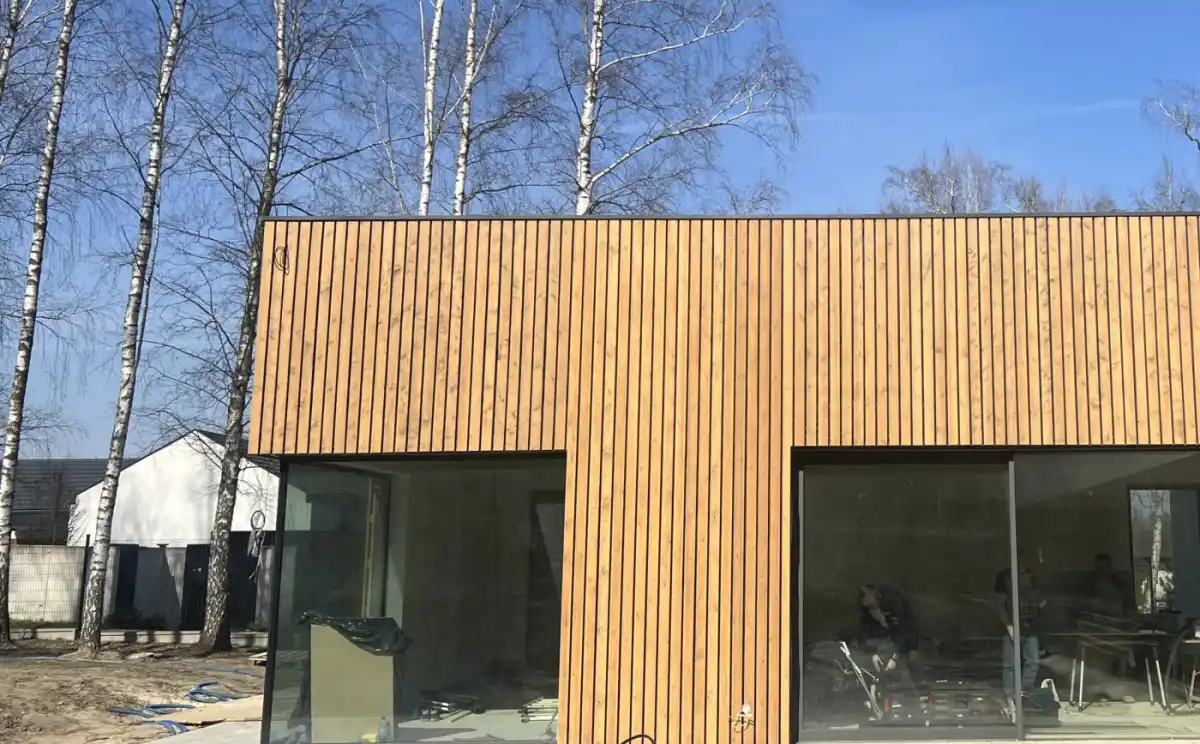
Nordic spruce external cladding elevation — the clean, pale-toned grain of Nordic spruce accepts a wide range of finishes from natural through stained to charred black. Correct batten spacing and ventilation behind the boards is essential for performance on any exterior application.
Natural and stained finishes
In its natural state, Nordic spruce has a pale cream to light straw colour — brighter and more neutral than Siberian larch (honey gold) or ThermoWood (warm brown). This makes it an excellent substrate for coloured stain finishes including grey, black, green, and white — the pale base colour allows pigments to read clearly. For natural finishes, UV-stable exterior oil maintains the pale tone; left untreated it weathers to silver-grey within 12–18 months.
Charred finishes — Nordic spruce as a Shou Sugi Ban base
Nordic spruce is one of the most popular base timbers for charred cladding (Shou Sugi Ban) in the UK. Its straight, consistent grain chars evenly, and the absence of the pronounced resin pockets of some softwood species produces a cleaner, more controllable char depth. Our Nordic spruce charred brushed stained black and charred brushed stained larch are factory-produced charred finishes on Nordic spruce substrate — available in multiple colourways.
Garden buildings and outbuildings
Nordic spruce shiplap and feather edge are the dominant cladding species for garden sheds, workshops, and outbuildings in the UK. The cost advantage over larch or ThermoWood is significant at this scale — a 20m² garden building clad in Nordic spruce shiplap costs approximately £360–£860 installed versus £900–£1,800 in Siberian larch. For a structure where replacement in 15–20 years is planned and accepted, spruce is a rational budget choice. See our shiplap shed cladding guide for the full specification.
Nordic Spruce Tongue & Groove — Profile Detail
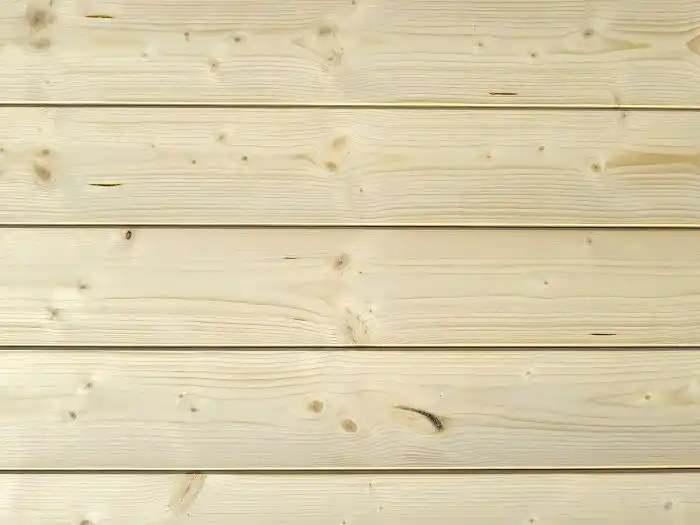
Nordic spruce tongue and groove V-joint close-up — the chamfered V at each board junction creates a visible joint line across the face without a full shadow gap. Suitable for both exterior cladding with treatment and interior timber lining applications.
The tongue and groove V-joint is the most versatile Nordic spruce profile — the only cladding profile that works as both an exterior wall cladding and an interior timber lining without modification. The interlocking joint provides weather resistance without relying on an overlapping board edge, and the chamfered V-groove at each joint face creates a subtle decorative line across the cladding face.
Available in three depths — 14x120mm for lightweight interior or sheltered exterior, 19x146mm for standard exterior, and 28x146mm for maximum depth exterior applications where board rigidity and robustness are priorities.
Nordic Spruce vs Siberian Larch vs ThermoWood — Which to Choose?
| Nordic Spruce | Siberian Larch | ThermoWood | |
|---|---|---|---|
| Durability class | Class 4 — Slightly Durable | Class 3 — Moderately Durable | Class 2 — Durable |
| Service life | 15–25 yrs (maintained) | 20–30 yrs (no treatment) | 25–40 yrs (no treatment) |
| Treatment needed | Yes — every 2–4 yrs | No — optional oil only | No — zero maintenance |
| Board cost/m² | £18–£45 | £35–£75 | £45–£90 |
| Whole-life cost/m² (20yr) | £70–£150 (inc. maintenance) | £35–£75 | £45–£90 |
| Charred finish base | Excellent — most used base | Excellent | Not typically charred |
| Profile range | Widest — 8 profile types | Wide — 7 profile types | Good — 6 profile types |
| Colour | Pale cream — neutral base | Honey gold — warm | Honey brown — warm |
| Best for | Budget projects, garden buildings, charred base | Residential — natural, low maintenance | Residential — contemporary, zero maintenance |
Nordic spruce is the right specification when upfront cost is the primary driver, maintenance is a commitment you will keep, and the project is a garden building, outbuilding, or budget residential scheme where replacement in 15–20 years is planned. It is also the right base for charred cladding finishes where the charring process significantly extends the service life of the spruce substrate. It is not the right specification for any project where annual treatment is unlikely to happen consistently — for those projects, Siberian larch or ThermoWood are the correct zero-maintenance alternatives regardless of cost.
Installing Nordic Spruce Cladding — Key Requirements
- Ventilated batten system — mandatory: Nordic spruce must be installed on a counter batten and horizontal batten system that provides a minimum 25mm clear ventilated cavity behind the boards. Boards fixed direct to masonry or sheathing without a ventilated cavity will deteriorate significantly faster than the service life figures quoted — typically failing within 5–10 years regardless of treatment frequency
- Breather membrane: Install a vapour-permeable breather membrane behind the batten system on all wall types. Allows moisture vapour to escape from the wall construction while preventing wind-driven rain penetration
- A4 stainless fixings: A4 stainless steel screws only — standard steel or galvanised fixings will corrode visibly on a Nordic spruce facade within 3–5 years, causing rust staining on pale-coloured or natural-finish boards. One screw per board per batten, countersunk flush
- Back prime all boards: Apply a coat of exterior oil or stain to all board faces, edges, and ends before installation. The hidden face of the board (against the batten) is the face most likely to accumulate moisture — treating before installation protects the surface that cannot be treated after
- Minimum 150mm ground clearance: The bottom of the cladding must be at least 150mm above finished ground level — significantly more than decking (50mm) because wall cladding is more vulnerable to ground splash moisture than boards on a ventilated deck
- Head and sill detailing: Carefully detail all horizontal projections — window heads, sills, and eaves — with correct overhang and drip edges. Water tracking back across horizontal surfaces is the primary cause of premature cladding deterioration at junctions. See our timber cladding installation guide for junction detail drawings
What is Nordic spruce cladding?
Nordic spruce cladding is exterior timber cladding made from Picea abies (Norway spruce) grown in Scandinavia. It is the most widely used and most affordable exterior timber cladding in the UK, available in shadow gap, tongue and groove, shiplap, loglap, feather edge, rainscreen and structural profiles. Durability Class 4 — requires treatment every 2–4 years. Service life 15–25 years maintained.
Does Nordic spruce cladding need treating?
Yes — Durability Class 4, no natural biological resistance. Without treatment deteriorates within 2–5 years in UK exterior conditions. Back prime before installation, apply exterior oil or stain at installation, re-treat every 2–4 years depending on exposure. Annual inspection recommended.
How long does Nordic spruce cladding last in the UK?
15–25 years with consistent maintenance on a well-detailed ventilated facade. 5–10 years without maintenance. Service life depends on exposure, aspect, and maintenance consistency. South and west-facing elevations in high rainfall regions need the most frequent treatment and will fall toward the lower end of the range.
How much does Nordic spruce cladding cost in the UK?
£18–£45/m² for boards depending on profile in 2026. Shiplap and T&G at the lower end (£18–£28/m²), shadow gap and double shadow gap at the higher end (£28–£45/m²). Total installed 20m² elevation approximately £920–£2,000 including battens, fixings, membrane and professional installation.
Is Nordic spruce better than Siberian larch for cladding?
No — Siberian larch is significantly more durable (Class 3 vs Class 4), lasts longer (20–30 years vs 15–25 years), and requires no preservative treatment. Nordic spruce costs less upfront but has higher whole-life maintenance costs. Larch is the better whole-life specification for most UK exterior projects. Nordic spruce is the right choice when upfront cost is the priority and consistent maintenance is guaranteed.
What is the best Nordic spruce cladding profile for a UK house?
Shadow gap (19x146mm) is the most popular for contemporary UK homes — clean horizontal rhythm, works well with natural, stained, or charred finishes. Double shadow gap for bolder facades. Tongue and groove V-joint for the most versatile profile (interior and exterior). Shiplap and feather edge for garden buildings, outbuildings, and rural projects.
Nordic Spruce Cladding — All Profiles from UK Stock
We supply Nordic spruce cladding in shadow gap, double shadow gap, tongue and groove, shiplap, loglap, feather edge, and rainscreen profiles from UK stock. FSC and PEFC certified. Nationwide delivery 7–14 days. Tell us your elevation dimensions for a precise board quantity and full material list.