
- ThermoWood Pine is the stronger choice for sauna interior walls and ceilings — lower thermal conductivity, better dimensional stability, and longer lifespan under repeated heat and humidity cycles.
- Western Red Cedar is a good alternative — lighter, aromatic, and well suited to sauna benching and exterior cladding on traditional cabin-style builds.
- ThermoWood Pine typically costs £55–£75 per m² for sauna tongue and groove; Western Red Cedar equivalent profiles typically cost £60–£90 per m².
- Neither timber requires chemical preservative treatment inside or outside a sauna — both are naturally suitable for the conditions involved.
- For the exterior of a UK garden sauna, ThermoWood triple shadow gap outperforms Cedar shiplap in long-term stability and weather resistance.
ThermoWood and Western Red Cedar are the two timbers most commonly compared when specifying a garden sauna in the UK. Both have strong credentials — both handle heat and humidity well, both are used extensively in Scandinavian and North American sauna construction, and both are available in the UK from specialist timber suppliers. But they perform differently in the specific conditions of a sauna, age differently over time, and suit different project types and budgets.
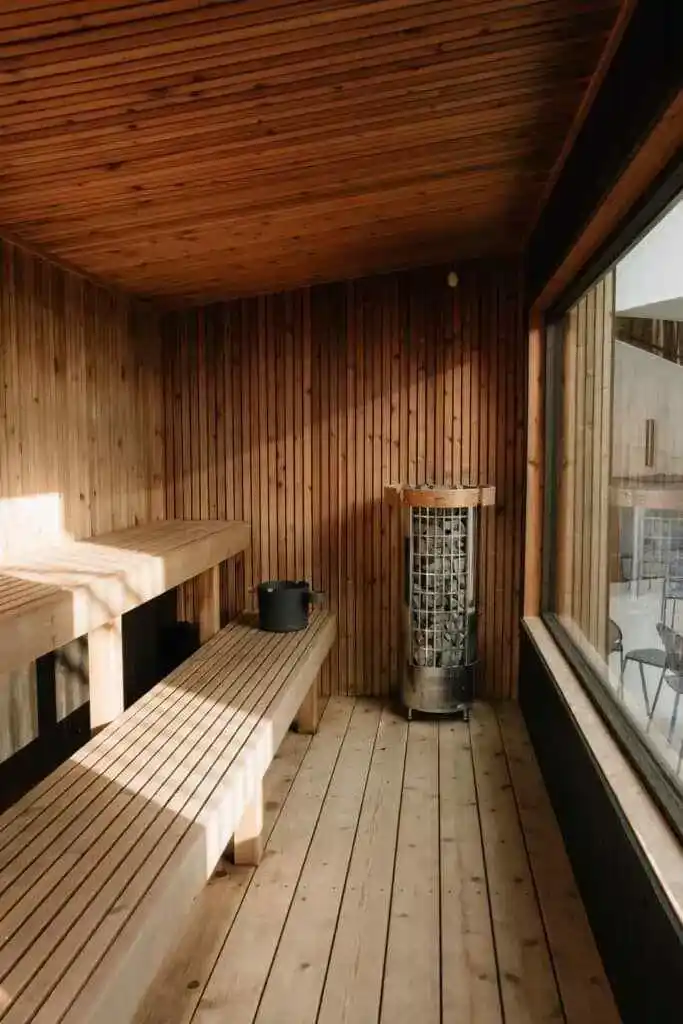
This guide provides a direct, honest comparison of ThermoWood and Western Red Cedar for UK garden sauna construction — covering interior performance, exterior durability, maintenance, cost, and the specific scenarios where each timber is the stronger choice. If you have already decided on ThermoWood and want to know which profiles to specify, see our ThermoWood profile guide for garden saunas. For a broader comparison of all sauna timber options, see our guide to the best wood to use for a sauna.
How Each Timber Handles Sauna Conditions
A Finnish-style dry sauna operates at 80–100°C with humidity that swings from very high during a session to very low between uses. The timber must withstand these extremes repeatedly without warping, cracking, releasing resins, or degrading structurally. It must also feel comfortable against skin at high temperatures — which rules out dense hardwoods and high-conductivity softwoods. The two materials that best meet all these requirements in UK garden saunas are ThermoWood Pine and Western Red Cedar.
ThermoWood Pine in a sauna
ThermoWood Pine's key advantage in sauna use is its permanently reduced moisture absorption. The thermal modification process changes the cell structure of the pine so that it absorbs significantly less moisture than untreated timber — typically 40–50% less. This means the boards move less as humidity swings between sessions, joints stay tighter over time, and the surface stays flatter and more consistent.
Its reduced thermal conductivity is equally important. ThermoWood Pine conducts heat less readily than untreated softwood, meaning the surface of the boards feels cooler to the touch at any given ambient temperature. This is a practical comfort advantage when skin is in contact with walls and benches during a session.
ThermoWood also does not resin bleed at sauna temperatures. Untreated pine is unsuitable for saunas precisely because it releases sticky resins when heated — the modification process eliminates this entirely by breaking down the resin compounds during treatment.
Western Red Cedar in a sauna
Western Red Cedar has been used for sauna construction in North America for decades. Its natural oils provide decay resistance in the humid sauna environment, and its low density gives it good thermal insulation properties — the surface feels relatively cool against skin even at high temperatures. It is also lighter than most softwoods, making it easier to work with on large interior surfaces.
Cedar's distinctive aromatic scent intensifies at sauna temperatures. Many users find this pleasant and part of the sauna experience — though some find it overpowering in an enclosed space, and individuals with respiratory sensitivities may react to the aromatic compounds released at high heat. This is worth considering when specifying Cedar for a sauna intended for regular use by multiple people.
For sauna interior walls and ceilings, tongue and groove is the standard profile across the UK and Scandinavia. The ThermoWood tongue and groove 19x140mm is the most widely specified option for UK garden sauna interiors — the interlocking joint creates a flush, smooth surface with no sharp edges or protruding fixings, and accommodates the small degree of board movement that occurs with temperature and humidity changes.
Head to Head Comparison — Interior Performance
| Property | ThermoWood Pine | Western Red Cedar |
|---|---|---|
| Thermal conductivity | Very low — cool to touch | Low — comfortable against skin |
| Moisture absorption | 40–50% lower than untreated timber | Low — natural oils resist moisture |
| Dimensional stability | Excellent — minimal movement | Good — low movement in service |
| Resin bleed at heat | ✓ None — resins eliminated in process | ✓ None — Cedar is resin-free |
| Scent at sauna temperature | Neutral — no strong aroma | Aromatic — pleasant to most, strong |
| Long-term durability | Very high — modification permanent | High — oils deplete slowly over time |
| Weight / ease of install | Moderate | Lightweight — easiest to work with |
| Typical interior cost per m² | £55–£75 | £60–£90 |
Exterior Performance — Which Weathers Better on a UK Garden Sauna?
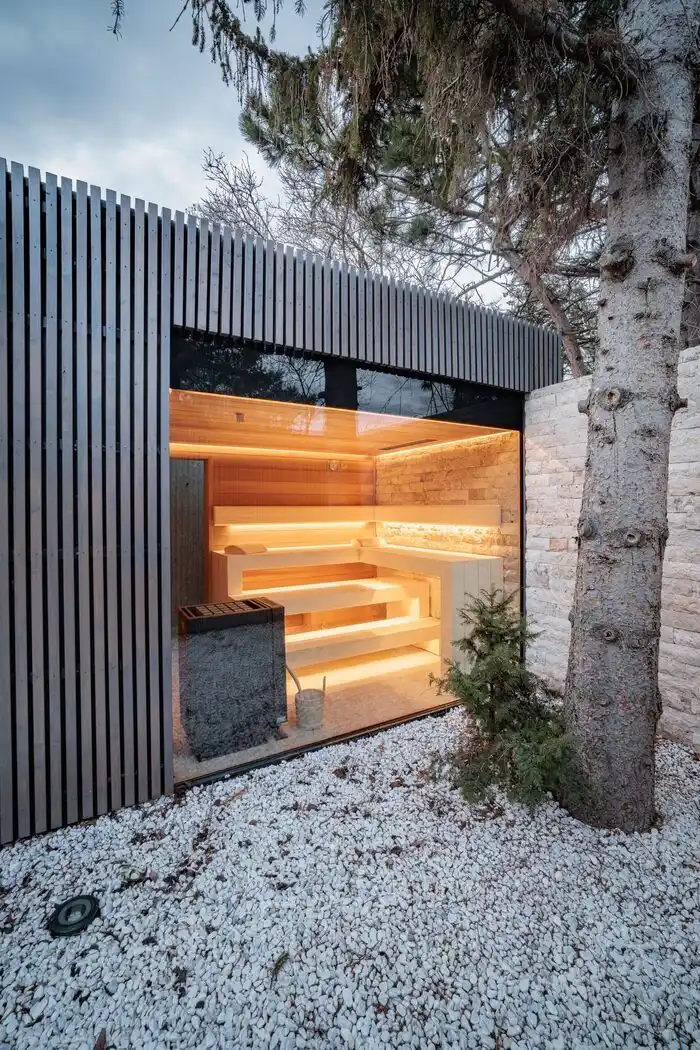
Garden sauna exterior — ThermoWood outperforms Western Red Cedar on exposed UK elevations due to its lower moisture absorption and greater dimensional stability.
For the exterior of a UK garden sauna, ThermoWood has a clear advantage over Western Red Cedar. The UK's wet climate — high annual rainfall, frequent wet-dry cycles, and persistent low temperatures — places exterior timber under sustained pressure. ThermoWood's significantly reduced moisture absorption gives it a measurable advantage in these conditions, limiting the swelling, shrinkage, and surface checking that drive long-term deterioration on exposed elevations.
Western Red Cedar performs well on exterior applications in drier climates — it is widely used for cladding and roofing in Canada and the Pacific Northwest US. In the UK's wetter conditions, its lower density and higher moisture sensitivity mean it generally requires more regular maintenance to maintain performance, particularly on exposed south and west-facing elevations.
For the exterior of a contemporary UK garden sauna, our recommendation is ThermoWood triple shadow gap 26x92mm — it performs reliably in UK weather, suits the clean contemporary aesthetic of most modern garden sauna designs, and requires minimal ongoing maintenance. For a traditional cabin-style sauna where a more textured appearance is preferred, ThermoWood shiplap 19x140mm is a strong alternative to Cedar shiplap with better long-term weather resistance.
Which Should You Choose? Project-by-Project Guide
- You want the best long-term performance inside a UK garden sauna
- Your sauna is in an exposed location — south or west facing
- You prefer a neutral, non-aromatic interior environment
- Your design calls for contemporary exterior profiles (shadow gap, rainscreen)
- You want the lowest possible maintenance over 20+ years
- Budget is a consideration — ThermoWood is generally lower cost
- You specifically want the aromatic sauna experience Cedar provides
- Your sauna has a traditional Scandinavian or cabin aesthetic
- The exterior uses shiplap or board-on-board profiles
- The sauna is in a sheltered position with limited weather exposure
- You are prioritising lightweight materials for a large interior surface
- You are using Cedar for benching specifically where aroma is an asset
For most UK garden saunas, ThermoWood Pine is the better all-round choice — particularly for interior walls, ceilings, and exterior cladding. Cedar remains a genuine option for sauna benching where its aroma and lightweight feel are valued. The two timbers can also be combined effectively — ThermoWood for the structure and exterior, Cedar for the bench slats.
Finishing and Maintenance Inside and Outside
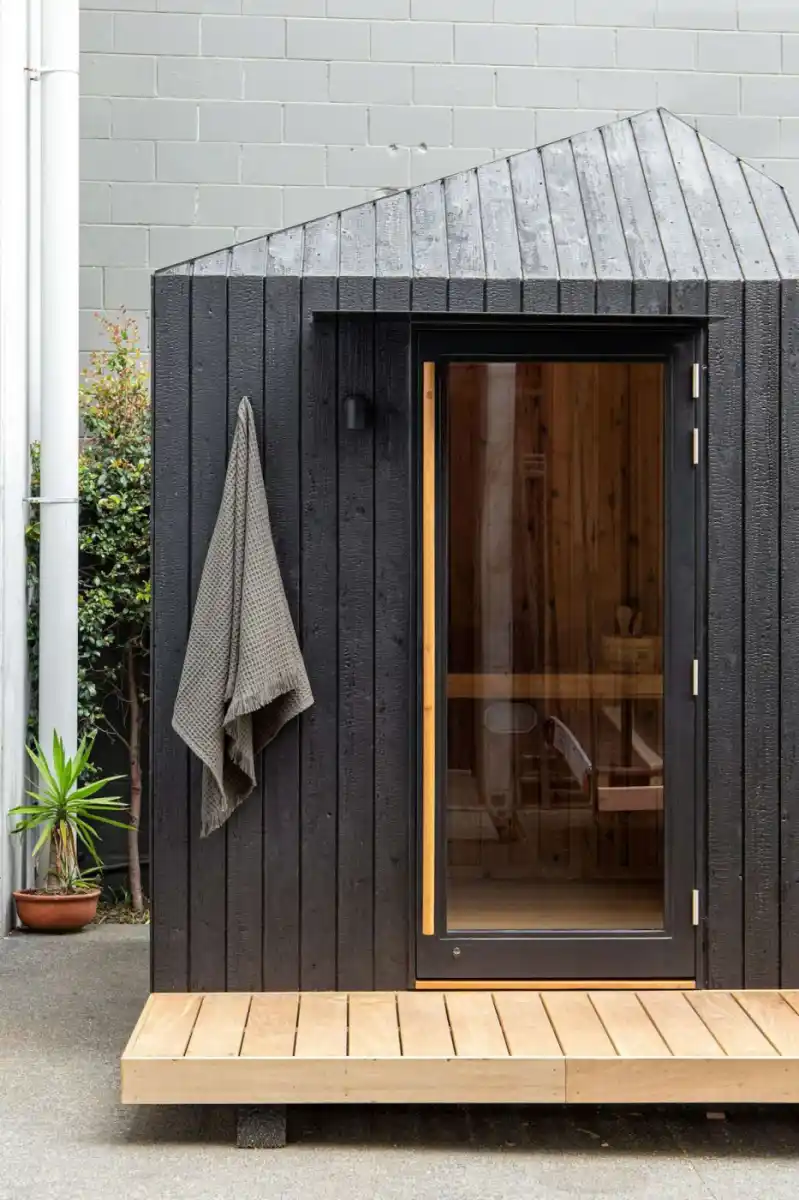
Garden sauna exterior — black charred timber is an increasingly popular low-maintenance alternative to stained or painted finishes on UK sauna builds.
Neither ThermoWood nor Western Red Cedar requires preservative treatment for sauna use — indoors or out. Both are naturally suited to the conditions involved without chemical intervention.
Interior: Both timbers should be left unfinished or finished with a sauna-specific oil only. Paint, varnish, and standard exterior oils are not safe at sauna temperatures and will blister, peel, and potentially release volatile compounds. If you want to apply a finish to either species on interior sauna surfaces, use only a product specifically rated for sauna use above 100°C.
Exterior: On the exterior, both species can be left to weather naturally to silver-grey or maintained with a UV-stable exterior oil applied every 2–4 years. ThermoWood requires slightly less maintenance than Cedar on exposed UK elevations due to its lower moisture absorption. For full exterior maintenance guidance see our timber cladding maintenance guide.
Never use standard exterior wood oils, paints, or varnishes on sauna interior surfaces — ThermoWood or Cedar. At sauna temperatures these products can release harmful compounds and will fail rapidly. Interior sauna surfaces should be left natural or finished with a product specifically certified for sauna use.
Both are excellent choices for sauna interiors, but ThermoWood Pine has a slight edge for UK garden saunas. Its thermal modification process reduces moisture absorption and lowers thermal conductivity, keeping surfaces cooler to the touch at high temperatures. It is also more dimensionally stable under repeated heat and humidity cycles than untreated Western Red Cedar. Cedar remains a strong option — particularly if you prefer its distinctive aroma and slightly lighter weight.
Yes — Western Red Cedar has a distinctive aromatic scent produced by its natural oils. At sauna temperatures, this scent becomes more pronounced. Many sauna users find it pleasant and relaxing. However, some people find the strong aroma overpowering in an enclosed sauna environment, and there is a small possibility of sensitivity reactions in individuals with respiratory conditions. ThermoWood Pine has a much more neutral scent at sauna temperatures.
ThermoWood Pine is generally considered more durable than Western Red Cedar in the demanding conditions of a sauna interior. Its thermal modification process permanently improves resistance to moisture and biological decay, whereas Cedar relies on its natural oils which gradually deplete over time in sustained high-heat environments. In practice, both materials will last many years in a well-maintained sauna — ThermoWood's advantage becomes more apparent over a 15–25 year horizon.
Yes. A common approach is using ThermoWood Pine for interior walls and ceilings (where thermal performance and stability matter most) and Western Red Cedar for benching (where its aroma and lightweight feel are appreciated). The two timbers can also be used on different elevations of the exterior — ThermoWood for the main facade and Cedar for accent features or soffits. Using both on the same interior wall surface is generally not recommended as they weather and age differently.
ThermoWood Pine is generally less expensive than Western Red Cedar for sauna applications in the UK. ThermoWood tongue and groove for sauna interiors typically costs £55–£75 per m², while Western Red Cedar equivalent profiles typically cost £60–£90 per m². The difference widens on larger saunas. For exterior cladding, ThermoWood triple shadow gap at £55–£75 per m² compares favourably to Cedar shiplap at £60–£85 per m².
ThermoWood for Garden Saunas — UK Stock, Nationwide Delivery
We supply ThermoWood tongue and groove for sauna interiors and ThermoWood exterior cladding profiles for garden sauna builds across the UK, from stock. FSC and PEFC certified. Delivery in 7–14 days. Not sure which profile suits your sauna design? Contact our team for advice and a free quote.