ThermoWood cladding is the highest-performing natural timber cladding specification for UK exterior use — Class 2 durable, zero maintenance, 25–40 year service life, and the most dimensionally stable timber cladding profile available to UK architects, developers, and homeowners. This complete 2026 guide covers how ThermoWood performs in UK weather, every profile with its real price, where it is used, how it weathers, how it compares to Siberian larch, and how to install it correctly.
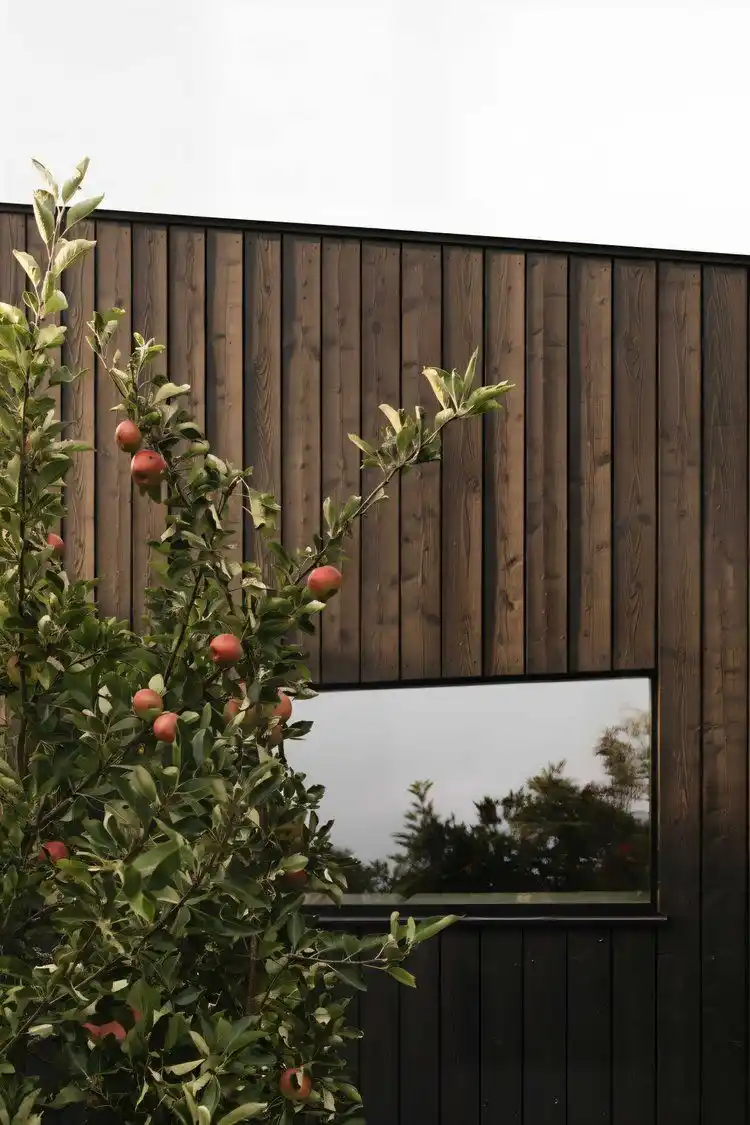
ThermoWood cladding on a contemporary UK house — Class 2 durable, zero maintenance, 25–40 year service life. The warm honey-brown of fresh ThermoWood on installation, before the natural weathering to silver-grey begins over the first 2–4 years.
What Is ThermoWood Cladding UK — How the Process Works
ThermoWood is timber permanently modified through exposure to 185–215°C in a controlled low-oxygen environment using only heat and steam — no chemicals, no preservatives, no biocides. The thermal modification makes three irreversible changes:
- Eliminates hemicellulose: The component most responsible for moisture absorption is broken down during modification — ThermoWood absorbs up to 50% less moisture than untreated softwood and moves dramatically less in response to UK seasonal wet-dry cycles
- Upgrades biological durability to Class 2: The modification makes the timber inhospitable to the fungi and insects responsible for biological decay — upgrading standard pine from Class 4–5 (non-durable) to Class 2 (Durable). The same classification as Western red cedar, achieved chemically-free
- Changes colour permanently: The heat caramelises sugars in the wood producing the characteristic warm honey-brown. This gradually silvers with UV exposure over 2–4 years — a natural, predictable process that does not affect structural performance
For the full technical background see our thermally modified timber guide and our Thermo-D vs Thermo-S comparison.
ThermoWood Cladding Profiles UK — All Sizes & Real Prices

ThermoWood shadow gap cladding — the most widely specified profile on contemporary UK buildings. The machined rebate creates a clean recessed horizontal shadow line between boards with no visible overlap joint. Available in single, double, and triple shadow gap sizes.
All prices below are ex VAT, supply only, FSC and PEFC certified, 7–14 day UK delivery from stock.
ThermoWood Cladding Performance in UK Weather
ThermoWood cladding weathered to silver-grey on a UK house — the greying is more even and consistent than Siberian larch, making ThermoWood the preferred specification on multi-elevation buildings where colour consistency across all aspects is important.
ThermoWood's performance advantage over standard softwood comes from the 50% reduction in moisture absorption. In practice:
- Significantly less movement: Standard softwood expands when wet, contracts when dry — causing boards to cup, twist, and work fixings loose over time. ThermoWood's reduced moisture uptake dramatically limits this, producing flatter, more stable boards across all UK seasons and all profile types
- Zero treatment required: Class 2 biological durability means no preservative treatment is ever needed above ground — the most valuable credential on buildings where maintenance access is difficult or expensive
- More consistent grey weathering: ThermoWood's weathered grey is more even across different elevations than Siberian larch — particularly important on complex multi-aspect buildings where south-facing and north-facing elevations receive dramatically different UV exposure
- Coastal performance: Performs well in exposed coastal UK locations. See our coastal cladding guide for the full exposed-site specification
Where ThermoWood Cladding Is Used UK
Shadow gap and double shadow gap on contemporary UK houses and rear extensions. See our extension cladding guide.
The premium garden room cladding choice — zero maintenance suits buildings where annual oiling is impractical. See our garden room guide.
Offices, retail, and leisure — zero-maintenance credentials suit commercial buildings where whole-life maintenance cost matters. See our commercial guide.
Schools and colleges — durable, low-maintenance, FSC certified. See our schools cladding guide.
Multi-unit residential — where maintenance access is costly, Class 2 zero-maintenance durability is the decisive specification factor.
Interior sauna cladding — ThermoWood's heat and humidity resistance. See our ThermoWood sauna guide.
ThermoWood cladding on a garden office — the premium garden room specification in the UK. Class 2 durability, zero maintenance, natural grey weathering. For specifiers and homeowners who want a cladding that simply performs without any ongoing obligation.
ThermoWood Cladding Lifespan UK — How Long Does It Last?
ThermoWood achieves 25–40 years of service life in UK conditions — the longest achievable from any natural softwood-based cladding without chemical preservative treatment. The BRE endorses a 30-year service life for ThermoWood in above-ground exterior applications.
| Species | Durability class | Service life UK | Maintenance | Cost ex VAT |
|---|---|---|---|---|
| Nordic Spruce (untreated) | Class 4–5 | 10–20 yrs | Treat every 2–4 yrs | £21–39/m² |
| Siberian Larch | Class 3 | 20–30 yrs | Low — optional oil | £50.39–63.35/m² |
| ThermoWood | Class 2 | 25–40 yrs | Zero — never | £50.39–64.99/m² |
| Western Red Cedar | Class 2 | 25–35 yrs | Low — optional oil | £60–90/m² |
| Charred SSB (larch-based) | Enhanced | 25–40 yrs | Minimal | £60.39–86.99/m² |
The two factors that most determine ThermoWood lifespan are moisture management (ventilated cavity, ground clearance, open base detail) and end-grain protection (sealing all cut ends). See our ThermoWood maintenance guide and our cladding lifespan by species guide.
How ThermoWood Cladding Weathers UK
ThermoWood cladding fully weathered to silver-grey — the natural end-state of untreated ThermoWood in UK conditions. Even, consistent, architecturally popular. Many architects specify ThermoWood specifically for this weathered end-state rather than the fresh honey-brown starting point.
- Fresh installation: Warm honey-brown, smooth surface. Some colour variation between boards — this evens out within the first season of weathering
- Year 1–2: UV exposure begins the greying process — initially patchy as different board faces receive different UV levels. South and west elevations grey faster than north and east
- Year 2–4: Greying stabilises into an even silver-grey — more consistent than Siberian larch on multi-elevation buildings
- Year 4 onwards: Silver-grey deepens slightly. Structurally and aesthetically stable. No maintenance required
- To maintain honey-brown: Apply UV-stable exterior oil (Koopmans Houtolie or equivalent) on installation, re-apply every 2–3 years. Delays but does not permanently prevent natural greying
Charred Timber — The Bold Alternative to ThermoWood
Shou Sugi Ban charred timber cladding on a UK house — deep charred black boards alongside natural timber create a bold, contemporary exterior. Charred larch-based SSB (£86.99/m²) achieves 25–40 years of zero-maintenance service life — the premium complement to ThermoWood where a black elevation is the design intent.
For projects calling for a dark or black exterior, our Shou Sugi Ban charred cladding range delivers bold character alongside genuine durability:
- Charred SSB — Standard finish (spruce-based) — £60.39/m²: Nordic spruce with deep charring and brushed finish. Bold black textured surface, 15–25 year service life. Best value charred specification for residential projects
- Charred SSB — Premium finish (larch-based) — £86.99/m²: Siberian larch substrate — Class 3 durability combined with charred surface protection gives 25–40 year zero-maintenance service life. The premium specification for commercial, high-specification residential, and projects where maximum charred lifespan is required
See our charred cladding guide and our black timber cladding guide for the full specification.
ThermoWood Cladding Installation UK — Key Requirements
- Ventilated cavity: Minimum 25mm clear cavity between board back and breather membrane. Never fix directly to the wall
- Pre-drill all fixings: ThermoWood is more brittle than untreated softwood — pre-drill within 50mm of all ends and 30mm of all edges to prevent splitting
- A4 stainless fixings only: ThermoWood's tannins corrode non-stainless fixings rapidly. See our PFS+ C2 A4 stainless fixings
- Minimum 3mm board gap: Less expansion than untreated softwood — do not pack boards tight
- End grain sealing: Seal all cut ends immediately after cutting
- 150mm ground clearance: Between base of lowest board and finished ground level
See our ThermoWood installation guide, how to fix timber cladding guide, and corner details guide for the complete installation specification.
The upfront cost of ThermoWood is comparable to Siberian larch — but zero maintenance over 25–40 years produces significant whole-life savings. A larch installation oiled every 3 years at £8–12/m² accumulates £65–100/m² in maintenance costs over 25 years, before scaffold costs on upper elevations. ThermoWood has no equivalent cost. For building owners who think in whole-life terms — housing associations, commercial landlords, developers — ThermoWood's Class 2 zero-maintenance performance is the commercially rational specification at every scale.
How long does ThermoWood cladding last UK?
25–40 years in UK conditions — the longest achievable from any natural softwood-based cladding without chemical treatment. Class 2 Durable, zero maintenance above ground. BRE endorses a 30-year service life. Exposed south/west coastal elevations at the lower end; sheltered inland aspects exceeding 40 years.
Does ThermoWood cladding need treating UK?
No — Class 2 durability, zero treatment required. Oiling is optional and purely aesthetic — it maintains the warm brown colour longer and delays the natural greying. Left untreated, ThermoWood weathers to an even silver-grey over 2–4 years. The grey is permanent and maintenance-free.
How much does ThermoWood cladding cost UK?
£50.39–£64.99/m² ex VAT supply only. Shadow gap 19x117mm: £50.39/m². Half lap 19x144mm: £50.39/m². Double shadow gap 26x142mm: £59.99/m². Triple shadow gap (both sizes): £64.99/m². All prices from Timber Cladding Specialists, 7–14 day UK delivery. See our ThermoWood cost guide for the full breakdown.
Is ThermoWood better than Siberian larch for cladding UK?
ThermoWood is Class 2, larch is Class 3 — ThermoWood has higher durability and longer expected service life. Both are zero treatment above ground. ThermoWood weathers more consistently grey — better for commercial and multi-elevation buildings. Larch weathers to a warmer grey and is slightly less expensive at entry level. For commercial, apartments, maintenance-critical: ThermoWood. For residential where occasional oiling is acceptable: larch. See our full comparison.
What is the best ThermoWood profile UK?
Shadow gap 19x117mm for most contemporary residential projects — clean, most widely specified, £50.39/m². Double shadow gap 26x142mm for larger elevations and commercial where a bolder shadow line is preferred. Triple shadow gap 32x140mm for maximum architectural impact. Half lap 19x144mm for traditional or rural character. All profiles are equally durable — the choice is aesthetic.
ThermoWood Cladding — In Stock, UK Wide, 7–14 Days
All profiles in stock — shadow gap, double shadow gap, triple shadow gap, half lap, and rainscreen. FSC and PEFC certified. Nationwide delivery 7–14 days. Free samples available. Not sure which profile? Call us or send your project details and we will advise.