- Most specified species: Siberian larch — Class 3 durability, no treatment, 20–30 years, FSC/PEFC certified for BREEAM credits.
- Zero maintenance alternative: ThermoWood — Class 2, 25–40 years, no treatment. Ideal for school buildings where maintenance access disrupts operations.
- Fire performance: EuroClass B (B-s1-d0) available on all species via factory FR treatment — frequently required on education projects regardless of building height.
- BREEAM: FSC/PEFC certified timber cladding contributes to Mat 01 and Mat 03 credits on BREEAM Education assessments.
- Live site experience: We have completed timber cladding installation on two live occupied school sites — during term time, with full CDM compliance.
- Supply and install: We work directly with main contractors as specialist cladding subcontractor — full documentation package, nationwide.
See our commercial timber cladding guide for the full sector overview. Education is the single most active sector for commercial timber cladding in the UK — new school buildings, academy refurbishments, sixth form centres, sports facilities, and university developments all regularly specify natural timber facades, driven by BREEAM requirements, planning preferences for natural materials, and the genuine lifecycle cost advantage of naturally durable species on buildings that will be maintained by local authority or trust estates teams with limited budgets. This guide covers the specific specification requirements for timber cladding on UK school buildings — species, fire performance, BREEAM, installation on live sites, and the documentation requirements that education main contractors need from a specialist cladding subcontractor.
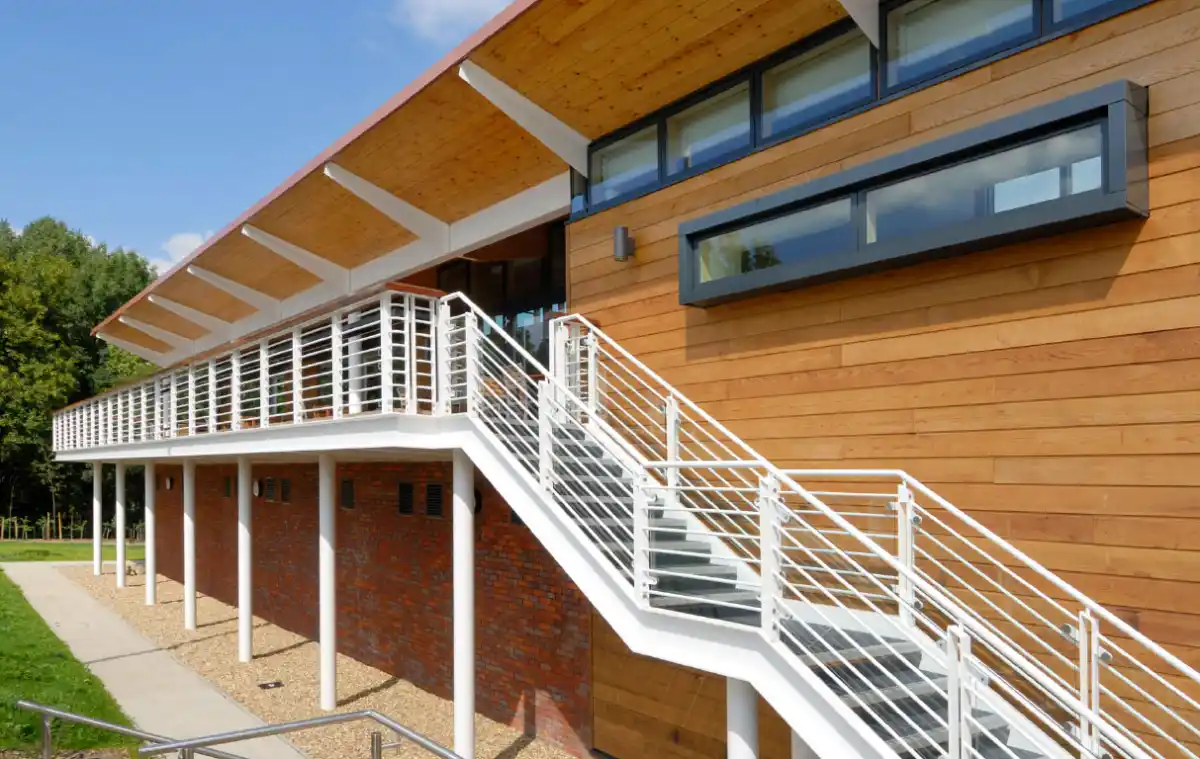
Merchant Taylors' School sports and cricket pavilion, Northwood — Siberian larch shadow gap 20x146mm supplied and installed by TCS working as specialist subcontractor to Boom Construction. The Julian Hill Cricket Centre, opened April 2024 by Sir Andrew Strauss OBE, is now the pre-season training base for Middlesex County Cricket Club.
Why Timber Cladding Is Widely Specified on UK School Buildings
Timber cladding has become the dominant natural facade material on UK school buildings over the past fifteen years, and the reasons are practical rather than purely aesthetic. School buildings are procured under cost pressure, maintained by stretched estates teams, and expected to perform for 25–40 years without significant facade intervention. The specification decisions made at design stage directly determine whether that expectation is realistic.
Naturally durable timber cladding — Siberian larch or ThermoWood — satisfies that requirement in a way that most alternatives do not. No preservative treatment is required throughout the service life, no repainting programme, no sealant renewal. The estates team can focus resources elsewhere. BREEAM credits are achieved through FSC/PEFC certification rather than additional specification complexity. Planning authorities respond positively to natural materials on school buildings in both urban and rural contexts. And the visual character of natural timber — warm, honest, genuinely material rather than manufactured — creates school buildings that read as considered and welcoming rather than institutional.
Key Specification Requirements for School Cladding
Siberian larch (Class 3) or ThermoWood (Class 2). No Class 4 softwood on unprotected external school elevations — the maintenance obligation cannot be reliably met.
B-s1-d0 via factory FR treatment on all species. Frequently specified on education projects regardless of building height — confirm with building control and the client's fire strategy.
FSC and PEFC chain of custody certification on all TCS timber. CoC number and species documentation provided with every order for BREEAM assessor submission.
RAMS, method statements, and CDM-compliant documentation produced before mobilisation. PASMA-qualified operatives for elevated installation. Live site protocol as standard.
No preservative treatment required on naturally durable species. Specify zero-maintenance species to remove the maintenance obligation from the school's estates programme entirely.
Profiled/flat sheet cladding/covering/siding. We provide H92-format specification text for any TCS product on request — contact our commercial team.
Which Species for School Cladding — Larch, ThermoWood or Spruce?
| Species | Durability | Service life | Maintenance | Fire rating | BREEAM | School suitability |
|---|---|---|---|---|---|---|
| Siberian Larch | Class 3 | 20–30 yrs | None | EuroClass B | FSC/PEFC | Recommended — most widely specified on UK school buildings |
| ThermoWood | Class 2 | 25–40 yrs | Zero | EuroClass B | FSC/PEFC | Premium — maximum service life, zero maintenance, ideal for LA and trust estates |
| Nordic Spruce | Class 4 | 15–20 yrs | Every 2–4 yrs | EuroClass B | FSC/PEFC | Not recommended for main school elevations — treatment obligation cannot be reliably met by school estates teams |
Nordic spruce is Durability Class 4 — it requires preservative treatment every 2–4 years to maintain structural performance. On a residential project where the homeowner is motivated to maintain their own facade, this is manageable. On a school building maintained by an overstretched LA or academy trust estates team, consistent 2–4 year treatment cycles are rarely realistic. When treatment is missed — which it will be — structural deterioration begins. The cost of treatment, access equipment, and disruption over a 25-year school building service life typically exceeds the initial saving on board cost. Specify larch or ThermoWood on school buildings and remove the maintenance obligation entirely.
Fire Performance on School Cladding — What You Need to Know

EuroClass B fire-rated Siberian larch cladding at Oasis Academy Hadley, Enfield — factory FR treated to B-s1-d0, replacing fire-damaged cladding on a 1,600-pupil school. Fire-rated timber cladding is available on all species and is increasingly specified as standard on education projects regardless of building height.
Fire performance requirements on school cladding have tightened significantly following the Building Safety Act 2022, and many education clients — particularly local authority schools and multi-academy trusts — now specify EuroClass B fire performance as a minimum on external cladding regardless of whether the building height technically requires it. The rationale is straightforward: schools contain children, fire risk is taken seriously, and the marginal cost of factory FR treatment to EuroClass B is small relative to the total project cost.
The regulatory position:
- School buildings over 18m: External wall systems must achieve Class A2-s1,d0 or better — standard timber cladding does not meet this threshold and is not appropriate as the primary cladding material at this height
- School buildings 11–18m: External wall system assessment required under the Building Safety Act. EuroClass B timber cladding is appropriate subject to the full EWS assessment of the wall build-up
- School buildings under 11m: No automatic regulatory requirement, but many LA and trust specifications require EuroClass B as standard. Always confirm with the client's fire consultant and building control
We supply factory FR treated timber cladding to EuroClass B (B-s1-d0) on all species — Siberian larch, ThermoWood, and Nordic spruce. The KUPRAFUNG flame retardant treatment is applied in factory conditions with full certification documentation. See our Approved Document B guide for the full regulatory framework. See our fire rated timber cladding guide and fire rated cladding guide for extensions, our EuroClass B guide, and the Oasis Academy Hadley case study below for a completed school fire rated cladding reference.
Installing Timber Cladding on Live School Sites
Timber cladding installation in progress at Merchant Taylors' School — a live occupied independent school with the full academic programme running throughout the construction period. Delivery timing, working hours, and access routes were coordinated with Boom Construction and the school throughout the installation programme.
Live school site installation is a distinct operational challenge from an empty new-build site, and it is where specialist subcontractors most commonly underperform. The specific requirements that matter on a live school site:
- Working hours: Installation activities that generate noise, dust, or obstruct access routes must be scheduled around the school day — often meaning restricted hours during assembly, break times, and school arrival and departure periods
- Delivery management: Deliveries must be timed to avoid school arrival and departure traffic. Large vehicle access routes, turning circles, and unloading areas must be agreed with the school and site manager before any delivery is scheduled
- Safeguarding: All TCS personnel working on live school sites hold current DBS checks where required by the school or main contractor, and operate in line with the school's visitor and contractor protocols
- Site separation: Clear hoarding and exclusion zones around the installation area, maintained throughout the programme. No TCS operative enters non-construction areas of the school site without escort
- Communication: Regular programme updates to the main contractor and school site manager — not just at crisis points. Live school sites require proactive communication, not reactive
Completed School Timber Cladding Projects
Supply and install of approximately 1,000m² of Siberian larch shadow gap on a prestige school sports facility. Live independent school environment throughout. Delivered on programme, opened by Sir Andrew Strauss OBE. Now the pre-season training base for Middlesex County Cricket Club.
Read full case studyFire-damaged first and second floor cladding replaced with factory FR treated Siberian larch to B-s1-d0. Survey, manufacture drawings, bespoke panel fabrication, steel frame, and crane installation on a live 1,600-pupil academy in Enfield. The replacement specification was an upgrade on the original cladding.
Read full case studyDocumentation for Education Timber Cladding Projects
Education main contractors and framework managers consistently report that documentation is the area where specialist subcontractors most frequently create problems — either producing it late, producing generic rather than project-specific documents, or failing to produce it at all until chased. Our documentation position on education projects:
- Project-specific RAMS: Produced before mobilisation, covering the specific installation sequence, site-specific hazards (live school environment, working at height, delivery management), control measures, and emergency procedures
- FSC/PEFC chain of custody certificates: Provided with order confirmation — not on request before practical completion. CoC certificate number and species documentation included for BREEAM assessor submission
- Fire treatment certification: Where EuroClass B is specified, KUPRAFUNG FR treatment certification is provided with the material — not sourced retrospectively
- Fixing schedule: Batten centres, fixing specification, board fixing pattern and expansion allowances — produced pre-construction, available for building control submission
- Technical submittals: Species data sheets, durability class references, BRE/BBA citations, profile drawings — provided for the contractor's technical submission package
- O&M contribution: Maintenance schedule, product data, and warranty information for inclusion in the building's O&M file — provided at practical completion. See our timber cladding maintenance guide for the full care programme
What is the best timber cladding for schools UK?
Siberian larch — Class 3 durability, no treatment required, 20–30 years, FSC/PEFC certified for BREEAM. ThermoWood for zero maintenance and 25–40 year service life. Nordic spruce is not recommended for main school elevations as the treatment requirement cannot be reliably met by school estates teams.
Does timber cladding on schools need to be fire rated?
It depends on height and the client's specification. Buildings over 11m need EWS assessment. Many LA and trust specifications require EuroClass B regardless of height. We supply factory FR treated timber cladding to EuroClass B (B-s1-d0) with full certification. Always confirm with building control and the fire consultant on each project.
Does timber cladding on schools qualify for BREEAM credits?
Yes — FSC and PEFC certified timber cladding contributes to BREEAM Education Mat 01 and Mat 03 credits. All TCS timber is FSC and PEFC chain of custody certified. We provide the CoC certificate number and species documentation with every order for BREEAM assessor submission.
Can you install timber cladding on a live school site?
Yes — we have completed cladding installation on two live occupied school sites, including Merchant Taylors' School (1,000m² during term time) and Oasis Academy Hadley (fire rated replacement on a 1,600-pupil school in operation). DBS checked where required, live site protocols as standard, proactive delivery and programme coordination throughout.
Timber Cladding for Schools — Specialist Subcontractor, Nationwide
We supply and install timber cladding on school and education projects across the UK — Siberian larch, ThermoWood, EuroClass B fire rated where required. Full documentation package including RAMS, FSC/PEFC certificates, fire certification, and fixing schedules. Live site experience. Contact our commercial team for budget pricing, technical submittals, or tender returns — 24–48 hour response.