
Yakisugi and Shou Sugi Ban are the same technique — two different names for the Japanese practice of charring timber for preservation and aesthetics. Yakisugi is the correct Japanese term. Shou Sugi Ban is a Westernised phonetic version that became widely used in design media. In the UK both terms are used interchangeably.
If you have been researching charred timber cladding for a UK project you will have encountered both yakisugi and Shou Sugi Ban — sometimes used as if they are different products or techniques, sometimes used interchangeably. The confusion is understandable but the answer is straightforward: they describe the same thing. This guide explains where both terms come from, what they actually mean, how the charring technique works, and what the real distinctions are in UK charred timber cladding — which are about finish level and timber species, not terminology.
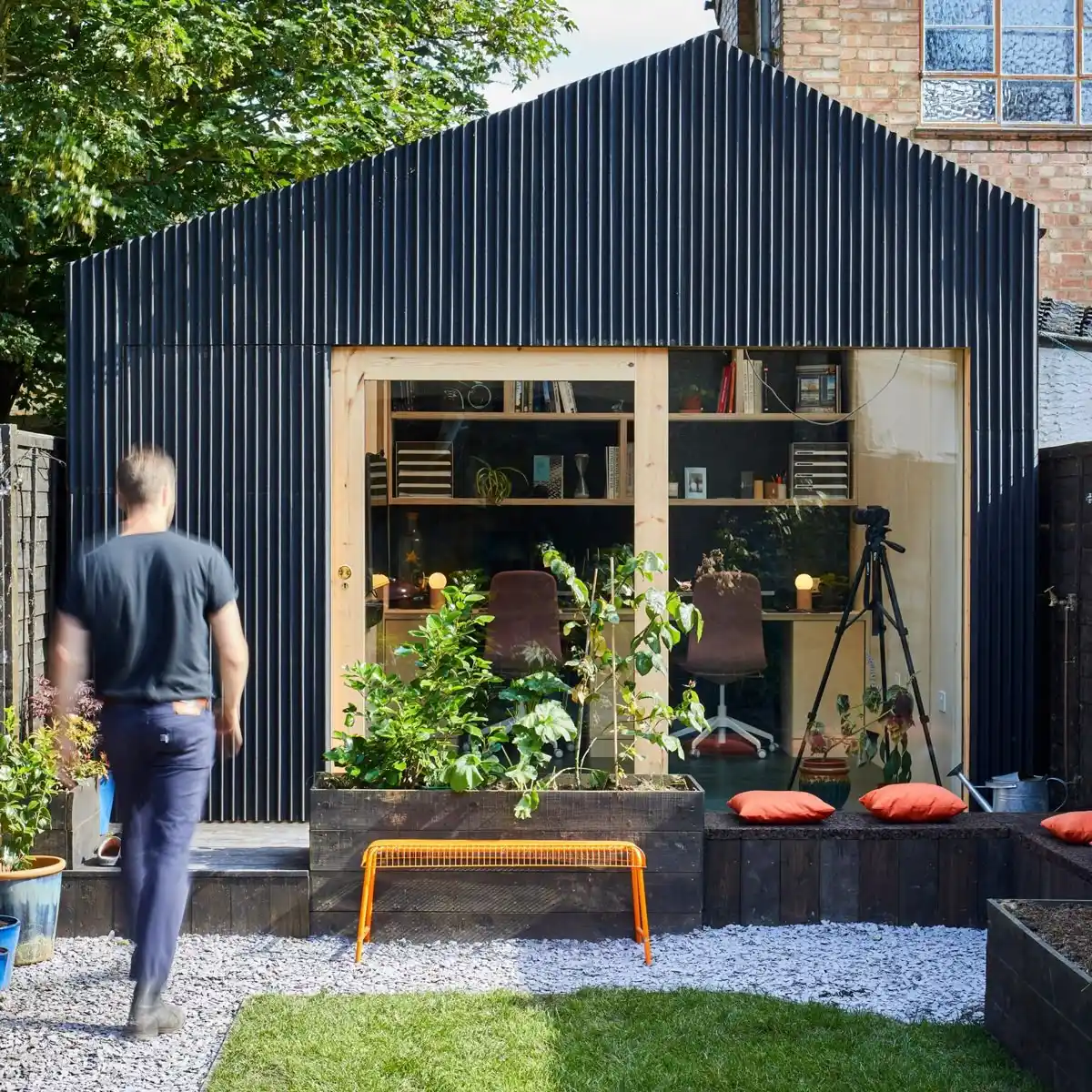
Charred timber cladding — inspired by the traditional Japanese yakisugi technique — on a contemporary UK garden room. Whether called yakisugi or Shou Sugi Ban, the charring process and the result are identical.
Where the Terms Come From
Yakisugi (焼杉) is a compound Japanese word. Yaki (焼き) means burned or grilled — the same character used in yakitori (grilled chicken) and yakiniku (grilled meat). Sugi (杉) is Japanese cedar — the species Cryptomeria japonica, a tall conifer native to Japan and widely used in traditional Japanese construction. So yakisugi literally translates as burned cedar. The technique involves charring the surface of sugi boards with fire to create a protective carbonised layer, dramatically improving durability and weather resistance. Yakisugi has been used in Japanese building construction for centuries, particularly in the Kinki region around Osaka and Nara.
Shou Sugi Ban is a romanisation of the Japanese characters for yakisugi that became widely used in Western architectural and design media — particularly in the United States — from around 2010 onwards. It is not a term used in Japan itself, where the product is always called yakisugi. The exact origin of the Shou Sugi Ban romanisation is unclear, but it spread rapidly through US design blogs and architecture publications before reaching the UK, where it became the more commonly recognised search term among architects and homeowners. Some UK architects now use both terms, while others use only one or the other.
The practical upshot is that if you search for yakisugi or Shou Sugi Ban cladding in the UK, you will find the same products. No UK supplier makes a meaningful distinction between the two terms in their product range — they refer to the same charred timber technique applied to the same species, producing the same results.
Is There Any Real Difference?
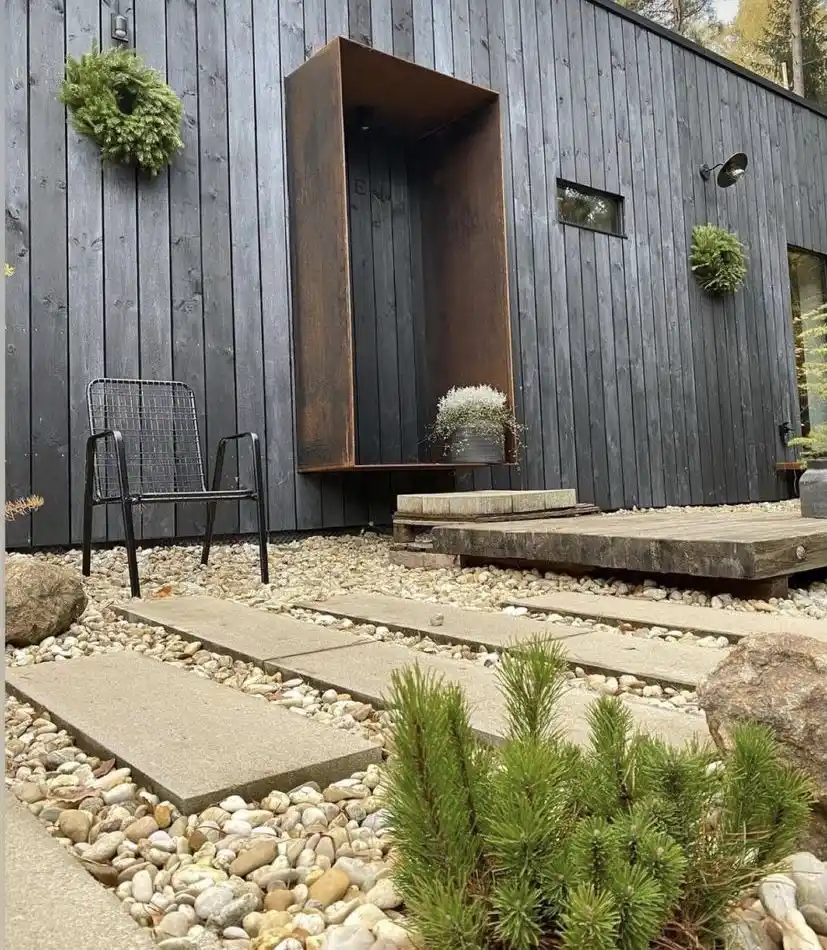
Charred timber garden office — the warm interior contrasting with a deep black exterior is one of the most powerful design combinations in contemporary UK garden building, whether described as yakisugi or Shou Sugi Ban.
Some purists do draw a distinction — arguing that authentic yakisugi should use only Japanese sugi cedar, and that Shou Sugi Ban has become a broader term covering the charring technique applied to any timber species. Under this view, a charred Siberian larch board might be called Shou Sugi Ban inspired but not strictly yakisugi.
In practice this distinction has little relevance to UK buyers and specifiers. Authentic sugi cedar from Japan is occasionally available as an import product but at significant cost and lead time premiums that make it impractical for most UK projects. The domestically produced charred cladding available from UK suppliers — primarily Siberian larch and Nordic spruce — applies the same charring technique, achieves the same visual result, and in many performance characteristics outperforms authentic sugi cedar due to the superior natural durability of larch.
| Factor | Yakisugi (authentic) | Shou Sugi Ban / charred timber UK |
|---|---|---|
| Term origin | Japanese — the original name | Western phonetic romanisation |
| Species | Traditionally sugi cedar (Cryptomeria japonica) | Siberian larch, Nordic spruce, pine |
| Technique | Charring by fire | Same — charring by fire |
| Visual result | Black, textured, charred surface | Same — black, textured, charred surface |
| Performance | Good — sugi is a stable, durable species | Larch arguably superior — higher natural durability class |
| UK availability | Import only — 6–12 week lead time | UK stock — 7–21 day delivery |
| Cost | High — import premium applies | More accessible — from £90–£130 per m² |
How the Charring Technique Works

Charred cladding — the deep carbonised surface layer is the result of a controlled burning process. The carbon layer protects the timber beneath from moisture, UV, biological decay, and insects for 25–40 years without chemical treatment.
The yakisugi technique — regardless of species or terminology — involves applying controlled heat to the surface of timber boards until a carbonised layer forms. In traditional Japanese practice, three sugi boards were bundled together in a triangular arrangement and stood vertically while fire was drawn up through the interior by the chimney effect. In modern commercial production, the charring is applied using gas torches or industrial kilns that allow precise control of char depth and consistency across production runs.
The charring process achieves several things simultaneously. The carbon layer it creates is chemically inert — bacteria, fungi, insects, and UV light all struggle to degrade it, which is why charred timber performs so well in exterior exposure without chemical preservatives. The heat also drives moisture from the surface of the timber and partially closes the pore structure, reducing the rate at which the board absorbs and releases moisture — improving dimensional stability in the cycling humidity conditions of a UK exterior. And the black carbon surface — which absorbs rather than reflects UV — weathers more slowly and more evenly than an untreated timber surface.
The Real Distinctions — Finish Levels, Not Terminology
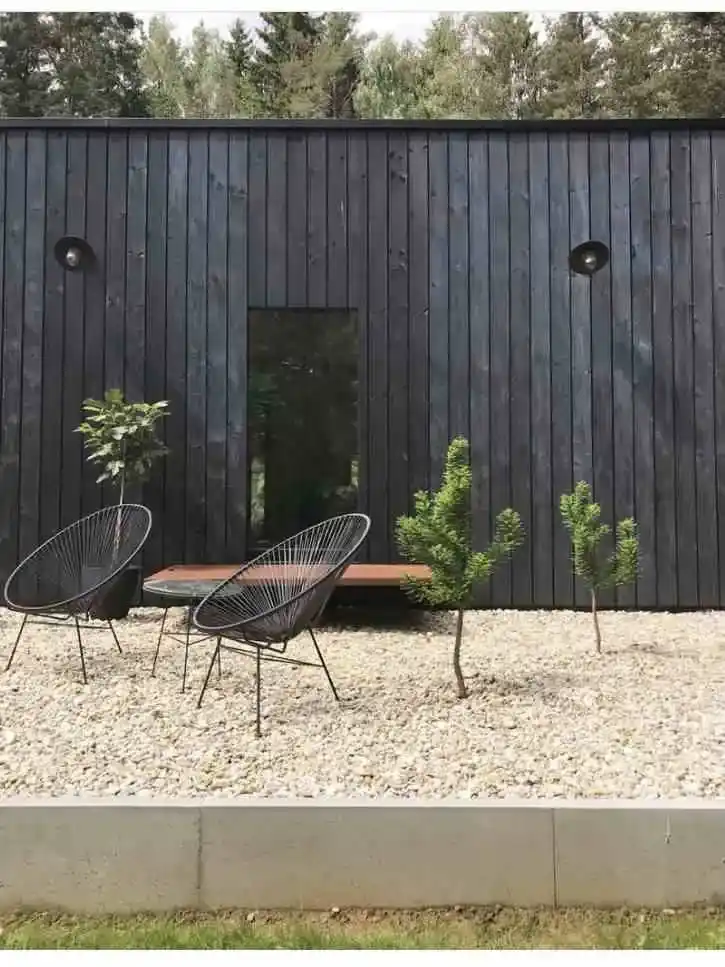
Brushed and stained charred cladding — the char is applied then wire brushed back to reveal the timber grain beneath, before a stain or oil is applied. This creates a finer, smoother surface than deep charred and is available in a range of colours beyond pure black.
While the yakisugi vs Shou Sugi Ban distinction is primarily one of terminology, the distinctions between finish levels within charred timber cladding are real and significant. The three main finish levels are:
- 2–3mm carbonised layer
- Bold alligator-skin texture
- Deep matte black colour
- Zero maintenance required
- 25–40 year service life
- Best: Siberian larch
- Light char, wire brushed back
- Smooth surface — grain visible
- Multiple colours available
- Re-oil every 3–5 years
- More refined appearance
- Both larch and spruce
- Medium char depth
- Oil seal applied over char
- Consistent colour retention
- Reduces surface rub-off
- Periodic re-oiling needed
- Both larch and spruce
For a full guide to deep charred cladding specifically see our deep charred cladding guide, and for the complete range of charred finishes see our charred timber cladding UK guide.
Timber Species for Yakisugi / Shou Sugi Ban in the UK
Since authentic Japanese sugi cedar is rarely practical for UK projects, charred cladding in the UK is produced using domestically available species. The two most widely used are Siberian larch and Nordic spruce:
Siberian larch is the premium UK choice for charred cladding — particularly for deep charred applications. Its dense, resinous grain produces the most pronounced alligator-skin texture when deeply charred, and its natural Durability Class 3 rating means the timber beneath the char layer has inherent decay resistance as a secondary line of defence. Our deep charred larch is produced using the yakisugi inspired charring technique from UK stock. For full species details see our Siberian larch buyers guide.
Nordic spruce produces a finer, more uniform char that suits brushed and stained finishes. Available in a range of finishes from deep black to larch-toned and sand-beige stains — browse our charred brushed stained black, charred brushed stained grey, and charred brushed stained nut finishes. Our full charred timber range covers all available species, finishes, and profiles.
What to Specify for a UK Project
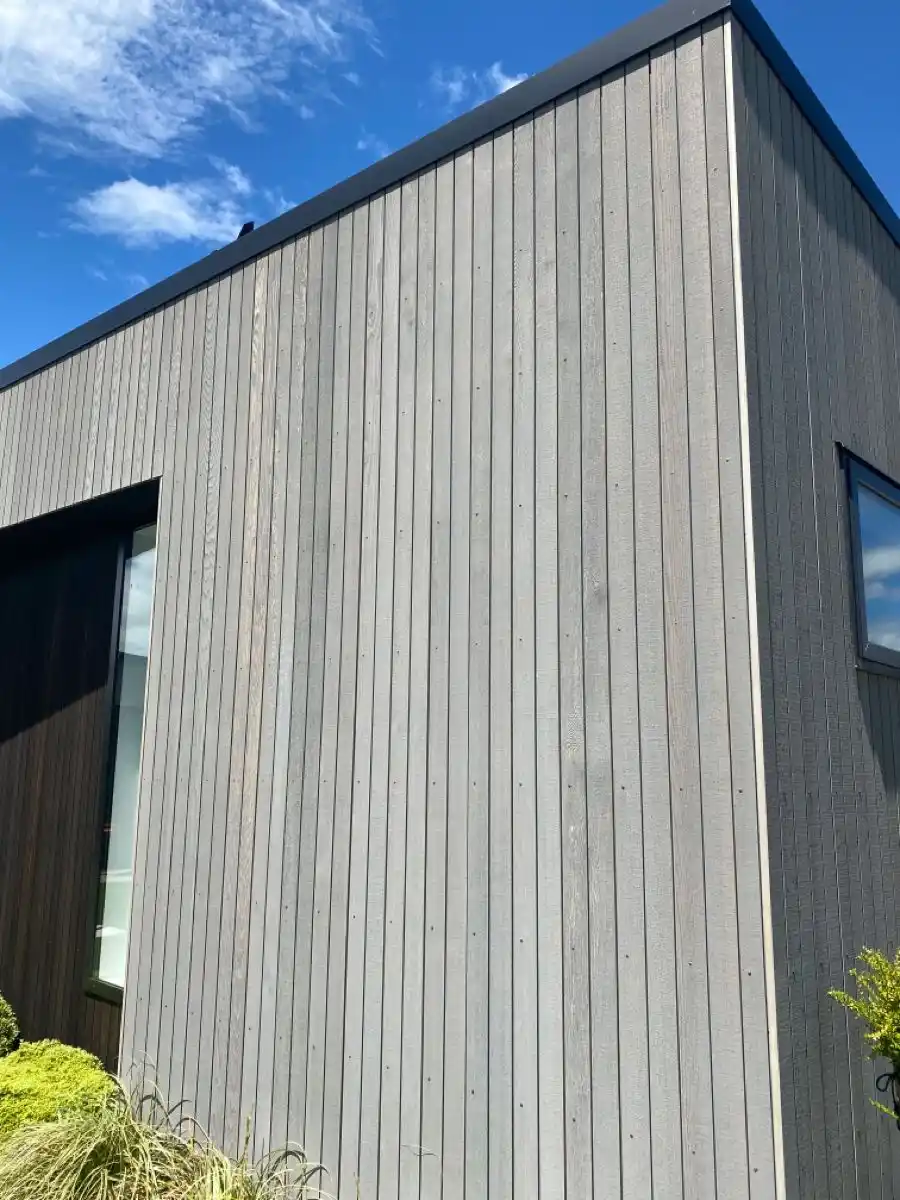
Naturally weathered charred timber on a UK garden room — over time the deep black surface gradually lightens to a rich dark charcoal grey. The cladding retains its structural integrity and continues to perform without any maintenance throughout this weathering process.
For UK projects specifying charred timber cladding, the terminology is less important than the specification decisions. Here is what to focus on:
- Finish level — deep charred for maximum visual impact and zero maintenance; brushed and stained for a more refined surface and wider colour choice; charred and oiled for consistent colour retention
- Species — Siberian larch for deep charred and premium applications; Nordic spruce for brushed and stained finishes and where cost is a priority
- Profile — rainscreen batten for open joint vertical installation; shadow gap for contemporary horizontal; feather edge for traditional horizontal; board-on-board for maximum shadow depth
- Installation — always as a ventilated rainscreen system with minimum 25mm cavity, breather membrane, and A4 stainless steel fixings. Handle with gloves during installation — deep charred boards transfer carbon residue. See our rainscreen cladding guide and cladding fixings guide for full installation details
- Cost — deep charred larch costs approximately £90–£130 per m² for materials. For a full cost breakdown see our timber cladding cost guide
- NBS specification — reference as "charred timber cladding — Shou Sugi Ban inspired technique — [species] — [finish] — [profile and size]." Both yakisugi and Shou Sugi Ban are acceptable in specification text
Don't get distracted by the terminology debate. Whether you call it yakisugi or Shou Sugi Ban, you are specifying the same charred timber technique. The decisions that actually matter are species, finish level, and profile. For most UK residential and garden room projects — deep charred Siberian larch in a rainscreen or shadow gap profile is the strongest all-round specification: maximum visual impact, zero maintenance, 25–40 year service life, and available from UK stock. Contact our team to discuss your specific project.
What is the difference between yakisugi and Shou Sugi Ban?
Yakisugi and Shou Sugi Ban refer to the same Japanese technique of charring timber for preservation and aesthetics. Yakisugi is the correct Japanese term. Shou Sugi Ban is a Westernised phonetic romanisation that became widely used in design media. Both terms describe the same charring process — burning timber until a protective carbonised layer forms. In the UK both terms are used interchangeably.
Is yakisugi the same as Shou Sugi Ban?
Yes — yakisugi and Shou Sugi Ban describe the same charred timber technique. Yakisugi is the original Japanese term. Shou Sugi Ban is a Westernised version that became widely used in design media outside Japan. In practice UK suppliers and architects use both terms interchangeably.
What does yakisugi mean?
Yakisugi is a Japanese compound word: yaki (焼き) means burned, and sugi (杉) means Japanese cedar. So yakisugi literally means burned cedar — describing the ancient technique of charring sugi cedar boards with fire to create a protective carbonised surface layer.
Can you get yakisugi cladding in the UK?
Yes — charred timber cladding inspired by the yakisugi technique is widely available in the UK, produced using Siberian larch and Nordic spruce rather than traditional Japanese sugi cedar. UK-produced charred cladding achieves the same visual and performance characteristics at lower cost and shorter lead times than imported authentic sugi cedar.
What timber is used for yakisugi in the UK?
In the UK, charred cladding inspired by yakisugi is produced using Siberian larch and Nordic spruce. Siberian larch is preferred for deep charred applications — its dense grain produces the most pronounced alligator-skin texture. Nordic spruce suits brushed and stained finishes and is the most affordable option. Both are available from UK stock with nationwide delivery.
Charred Timber Cladding UK — Yakisugi Inspired, From Stock
We supply charred timber cladding in Siberian larch and Nordic spruce — deep charred, brushed and stained, and charred and oiled finishes. FSC and PEFC certified. UK stock with nationwide delivery in 7–21 days. Contact our team with your project details for a precise quote.