
- Durability: Class 3 — moderately durable. No preservative treatment required. Oil every 3–5 years to maintain colour.
- Cost: £45–£65 per m² materials — comparable to Siberian larch, more affordable than ThermoWood.
- Appearance: Warm reddish-brown with bold, pronounced grain. One of the most visually distinctive UK cladding species.
- Weathering: Weathers to silver-grey without oiling. Oiling every 3–5 years maintains the warm tone.
- Best for: Contemporary residential extensions, garden rooms, and architect-specified projects where strong grain character is the design intent.
- Profiles available: Rainscreen (27x68mm) and tongue and groove V-joint (20x140mm) from UK stock.
Douglas Fir cladding occupies a distinctive position in the UK market — less widely specified than Siberian larch, less maintenance-free than ThermoWood, but offering something neither can quite match: a warm reddish-brown tone with a bold, pronounced grain that becomes the defining feature of any exterior it covers. When an architect or self-builder specifies Douglas Fir, they are choosing it for its character as much as its performance. This buyers guide covers everything you need to know — durability, profiles, costs, weathering, treatment, and how it compares to the alternatives — so you can decide whether Douglas Fir is the right choice for your project.
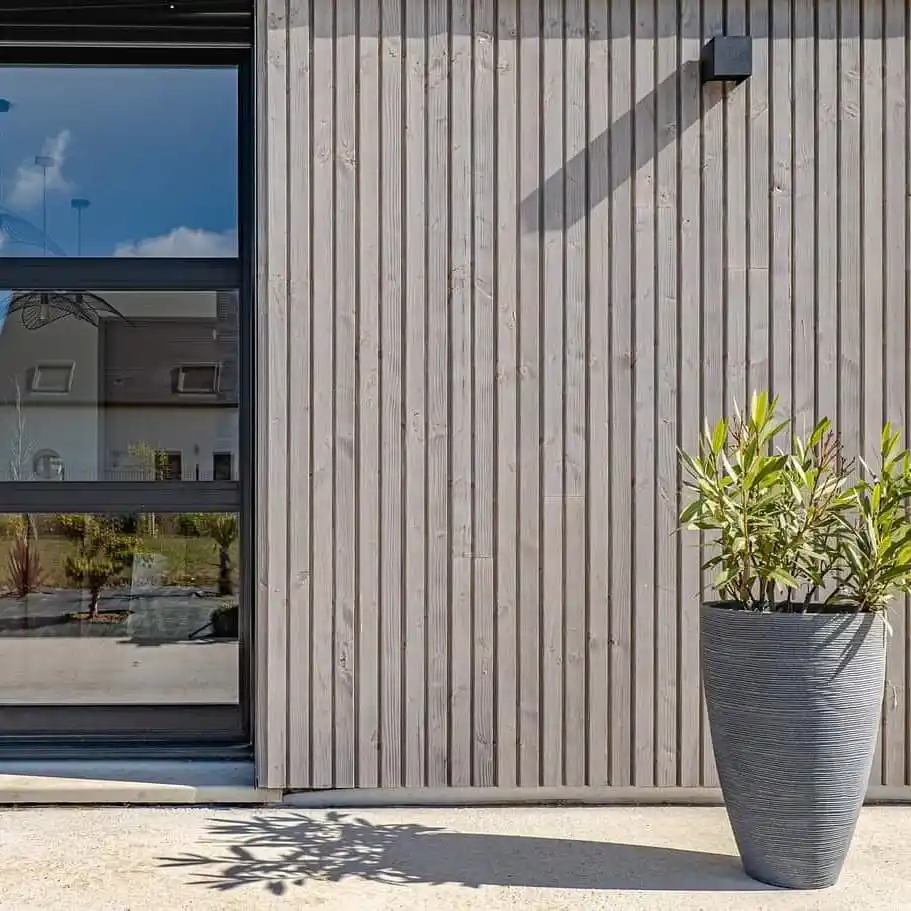
Douglas Fir cladding pre-weathered to silver-grey — left untreated, Douglas Fir develops a natural silver patina over 12–18 months. The greying is uniform and attractive but permanent without sanding back. Oiling before installation and every 3–5 years maintains the warm reddish-brown tone.
What Is Douglas Fir Cladding?
Douglas Fir (Pseudotsuga menziesii) is a large softwood species native to the Pacific Northwest of North America — British Columbia, Washington, and Oregon — where it is one of the most commercially important timber species in the world. Despite being called a fir, it is not a true fir — it belongs to its own genus, Pseudotsuga, and has distinct characteristics that set it apart from both true firs and pine. It is widely grown in managed plantations and is available as FSC and PEFC certified timber.
For exterior cladding, Douglas Fir's key qualities are its natural durability (Class 3 under BS EN 350), its bold grain character, its warm reddish-brown colour, and its good dimensional stability relative to other softwoods. Its resin content — higher than larch but lower than pine — provides some natural protection against surface moisture penetration and contributes to its moderate natural durability without any chemical treatment.
In the UK, Douglas Fir cladding is specified most often by architects on residential extensions and contemporary new builds where a bold, warm timber exterior is the design intent. It is available in our Douglas Fir cladding range in rainscreen and tongue and groove V-joint profiles from UK stock. For a full cost breakdown see our timber cladding cost per m² guide. For installation guidance see our timber cladding installation guide and our cladding fixings guide.
Douglas Fir Cladding Profiles Available in the UK
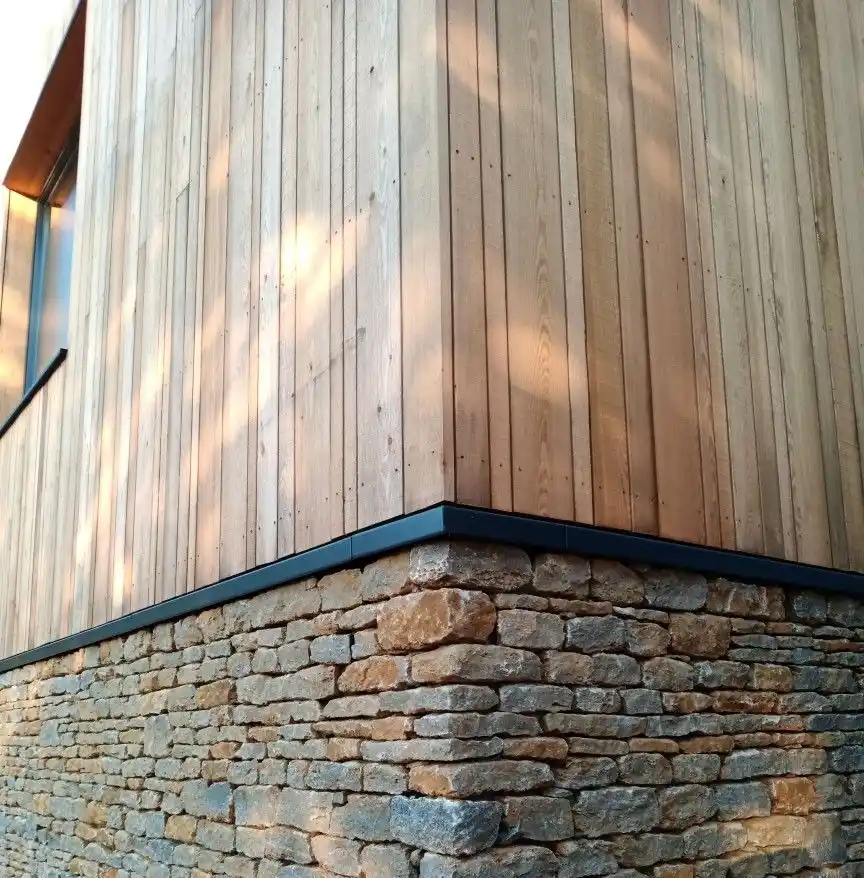
Douglas Fir sawn finish — the bold, pronounced grain and warm reddish-brown colour of Douglas Fir are most visible in the sawn finish. The prominent grain pattern gives Douglas Fir a character that is distinctly different from the smoother, more uniform appearance of ThermoWood or the tighter grain of Siberian larch.
| Profile | Dimensions | Cost per m² | Best for |
|---|---|---|---|
| Rainscreen | 27x68mm | £48–£65 | Contemporary facades, open joint system, maximum ventilation |
| Tongue & Groove V-joint | 20x140mm | £45–£62 | Horizontal or vertical installation, traditional profile, wide board |
Douglas Fir's profile availability in the UK is more limited than Siberian larch or ThermoWood — the two profiles above represent the most widely specified options and what we hold from UK stock. If your project requires a specific profile not listed above, contact our team to discuss availability and lead times. For the broadest profile range in naturally durable timber, Siberian larch offers shadow gap, double shadow gap, feather edge, shiplap, loglap, and rainscreen from UK stock.
How Douglas Fir Weathers — What to Expect
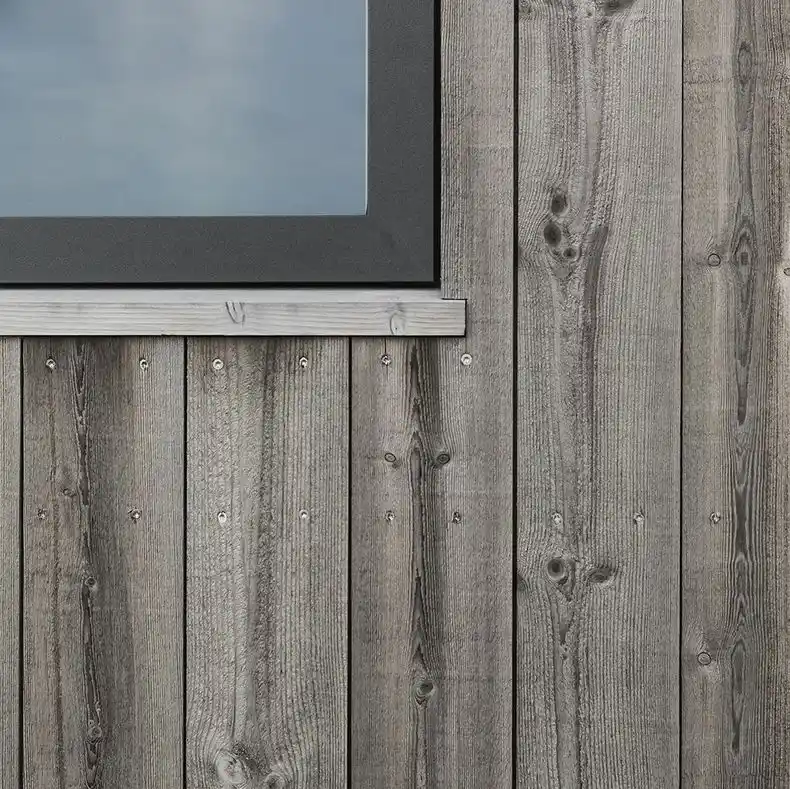
Douglas Fir fully weathered to silver-grey — the weathering process on Douglas Fir is gradual and attractive. The transition from warm reddish-brown through golden-honey to silver-grey takes approximately 18–24 months in UK exterior conditions. Once fully grey, the colour is stable and requires no maintenance.
Douglas Fir's weathering behaviour is one of its most discussed characteristics — and one of the most misunderstood. Like all naturally durable hardwoods and modified softwoods, Douglas Fir will weather to silver-grey if left untreated. Unlike spruce or pine, this greying is not a sign of decay — it is a purely surface photochemical process driven by UV degradation of lignin. Beneath the grey surface layer, the timber remains sound and structurally intact.
The weathering timeline in UK exterior conditions is approximately as follows: months 1–6, gradual colour shift from reddish-brown toward gold; months 6–12, continuing shift toward silvery-tan; months 12–24, full silver-grey established. Once grey, the colour is stable and self-maintaining. Douglas Fir is more prone to surface checking (fine surface cracks following the grain) than larch during initial weathering — this is a cosmetic characteristic of the species and does not affect performance. It reduces once the initial moisture equilibration is complete.
Surface checking on Douglas Fir is more pronounced than on most other cladding species due to the pronounced grain and growth ring structure. To minimise checking: allow boards to acclimatise on site for 48–72 hours before installation; oil all faces before installation including the back face; maintain adequate ventilated cavity behind the boards; and avoid installing in direct strong sunlight in very hot conditions. Surface checking is not a defect — it is characteristic of the species.
Treatment — Does Douglas Fir Cladding Need Treating?
Douglas Fir cladding with oil treatment — a quality UV-stable wood oil applied before installation and every 3–5 years maintains the warm reddish-brown colour and reduces surface checking. The oiled finish is richer and deeper than the uncoated surface, and significantly different in appearance from the silver-grey of untreated weathered Douglas Fir.
Douglas Fir is Durability Class 3 — moderately durable — and does not require preservative treatment to perform in above-ground exterior use in the UK. This means no chemical treatment is necessary for the timber to last its expected service life of 20–30 years. However, treatment with a quality wood oil is strongly recommended for colour retention and surface protection.
Without oiling, Douglas Fir will grey over 12–24 months. If grey is the intended final colour — many architects specifically choose this — then no treatment is required after installation. If the warm reddish-brown tone is the intent, the maintenance obligation is real: oil before installation, oil again after 12 months, then every 3–5 years depending on exposure. Use a UV-stable penetrating wood oil such as Koopmans Houtolie or similar — not a film-forming paint or varnish, which will eventually peel and look far worse than untreated timber.
| Treatment approach | Frequency | Result |
|---|---|---|
| No treatment | None | Weathers to attractive silver-grey — no maintenance ever required |
| UV-stable penetrating oil | Before install + every 3–5 yrs | Maintains warm reddish-brown — low maintenance |
| Opaque colour stain | Every 3–5 yrs | Full colour control — hides grain character |
| Preservative treatment | Not required | Unnecessary — Class 3 species performs without it |
Douglas Fir vs Siberian Larch vs ThermoWood
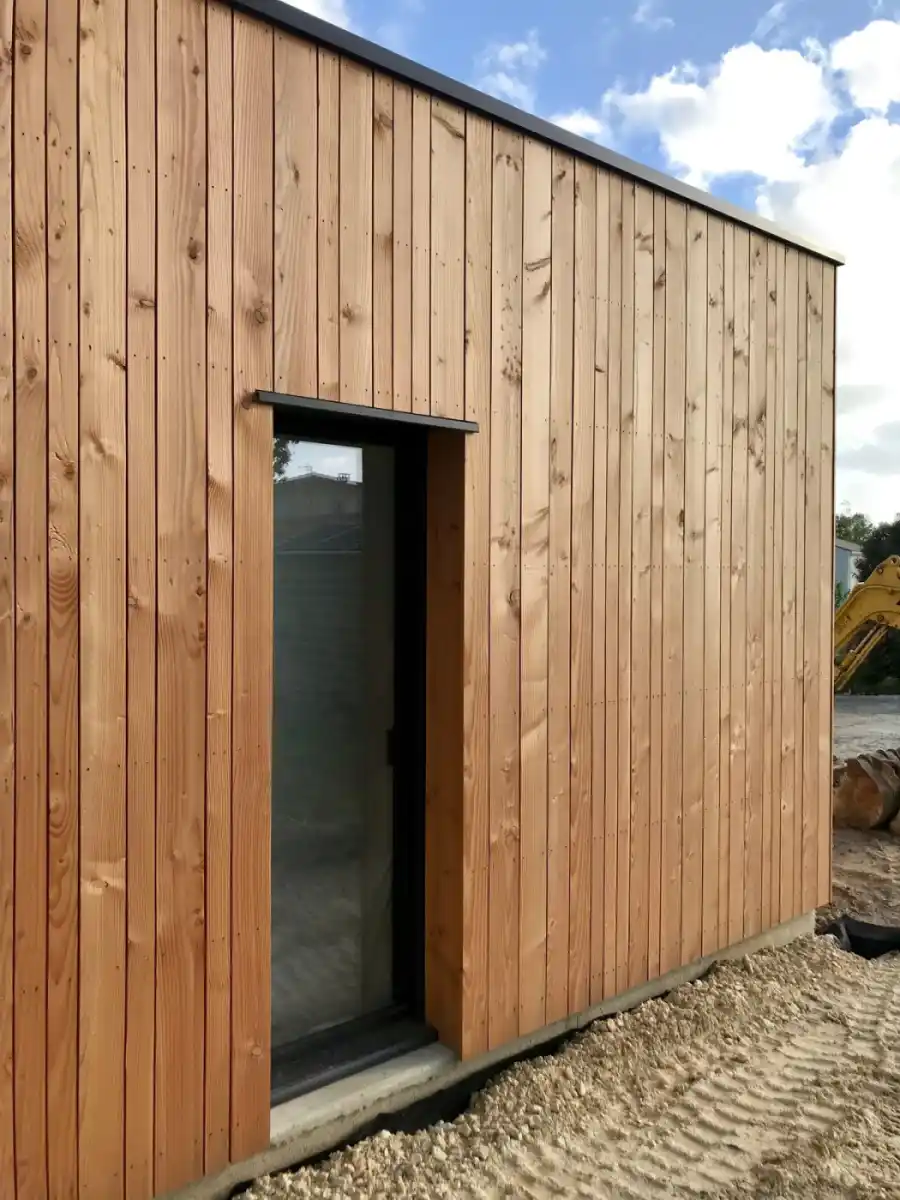
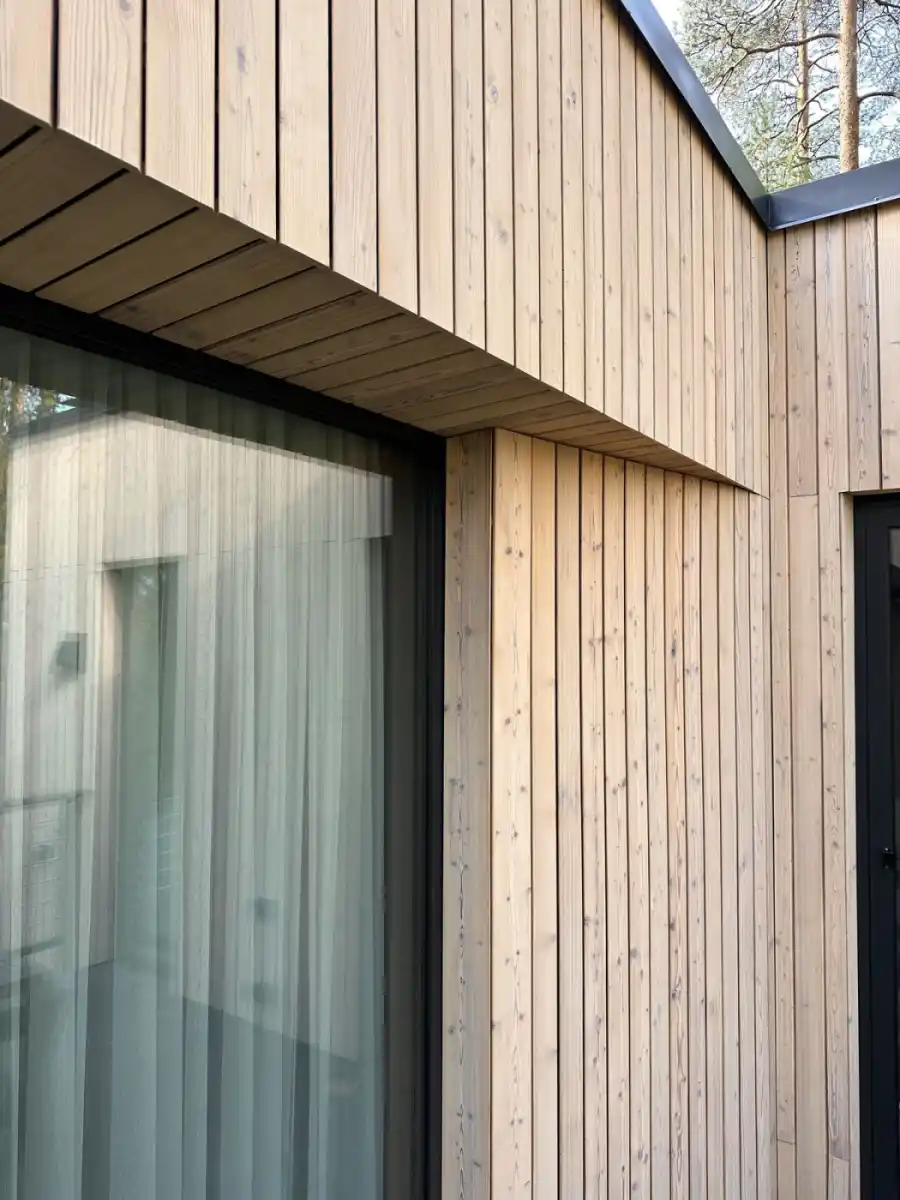
Douglas Fir installed vertically — vertical installation emphasises the length of the boards and the bold vertical grain lines of the species. Douglas Fir's pronounced grain is particularly effective in vertical rainscreen installations where the shadow depth and grain texture create strong visual rhythm.
| Property | Douglas Fir | Siberian Larch | ThermoWood |
|---|---|---|---|
| Durability class | Class 3 | Class 3 | Class 2 |
| Treatment required | None — oil optional | None — oil optional | None — ever |
| Service life | 20–30 yrs | 20–35 yrs | 25–40 yrs |
| Cost per m² | £45–£65 | £35–£70 | £55–£95 |
| Colour | Warm reddish-brown | Honey-gold | Rich dark brown |
| Grain character | Bold, pronounced — distinctive | Medium — consistent | Fine — uniform |
| Profiles available | Rainscreen, T&G | Full range | Full range |
| Dimensional stability | Good | Good | Excellent |
| Best for | Bold grain aesthetic | Broadest specification | Zero maintenance |
Choose Douglas Fir if the bold grain character and warm reddish-brown colour are specifically what the project calls for — it is a distinctive species that no other UK cladding timber quite replicates. Choose Siberian larch if you need the broadest profile range in a naturally durable species. Choose ThermoWood if zero maintenance and maximum service life are the priority. For a full side-by-side see our Douglas Fir vs Larch comparison guide.
Douglas Fir Cladding Costs UK 2026
| Cost element | Cost | Notes |
|---|---|---|
| Cladding boards | £45–£65 per m² | Rainscreen or T&G V-joint from UK stock |
| Battens, membrane, fixings | £10–£15 per m² | A4 stainless fixings — essential for Douglas Fir's tannin content |
| Installation labour | £25–£45 per m² | London and SE 20–30% premium |
| Wood oil treatment | £3–£6 per m² per application | Every 3–5 years if maintaining colour |
| Fully installed — 40m² extension | £3,200–£5,000 | Materials only — add labour for installed cost |
| 30-yr whole-life cost per m² | £55–£95 | Boards + optional oiling — no preservative treatment |
Is Douglas Fir good for external cladding in the UK?
Yes — Douglas Fir is a good external cladding species for UK conditions when correctly specified. It is Durability Class 3 (moderately durable), performs well above ground without preservative treatment, and has a 20–30 year service life. Oiling every 3–5 years is recommended to maintain colour. Its warm reddish-brown tone and pronounced grain make it a popular choice for architect-specified residential projects.
How much does Douglas Fir cladding cost in the UK?
Douglas Fir cladding costs approximately £45–£65 per m² for materials. Add £10–£15 per m² for battens, membrane and fixings, and £25–£45 per m² for professional installation. This places it broadly comparable to Siberian larch and below ThermoWood on upfront cost.
Does Douglas Fir cladding need treating?
No preservative treatment is required — Douglas Fir is Durability Class 3 and performs in above-ground exterior use without chemical treatment. However, oiling every 3–5 years with a UV-stable penetrating wood oil is strongly recommended to maintain the warm reddish-brown colour and reduce surface checking. Without oiling, Douglas Fir weathers to silver-grey within 12–24 months.
How does Douglas Fir compare to Siberian larch for cladding?
Both are Durability Class 3 and require no preservative treatment. Douglas Fir has a warmer reddish-brown tone and bolder grain character. Larch has a broader profile range from UK stock. Both have comparable service lives of 20–35 years. Choice typically comes down to colour preference and profile requirements.
What profiles is Douglas Fir cladding available in?
Douglas Fir cladding is available in rainscreen (27x68mm) and tongue and groove V-joint (20x140mm) from our UK stock in 7–14 days. Contact us for other profiles — we can advise on availability and lead times. For the broadest profile range in naturally durable timber, Siberian larch is available in shadow gap, shiplap, feather edge, loglap, and rainscreen.
Douglas Fir Cladding — Rainscreen & T&G from UK Stock
We supply Douglas Fir cladding in rainscreen (27x68mm) and tongue and groove V-joint (20x140mm) from UK stock. FSC and PEFC certified. Nationwide delivery in 7–14 days. Contact our team for a precise quantity and price for your project.