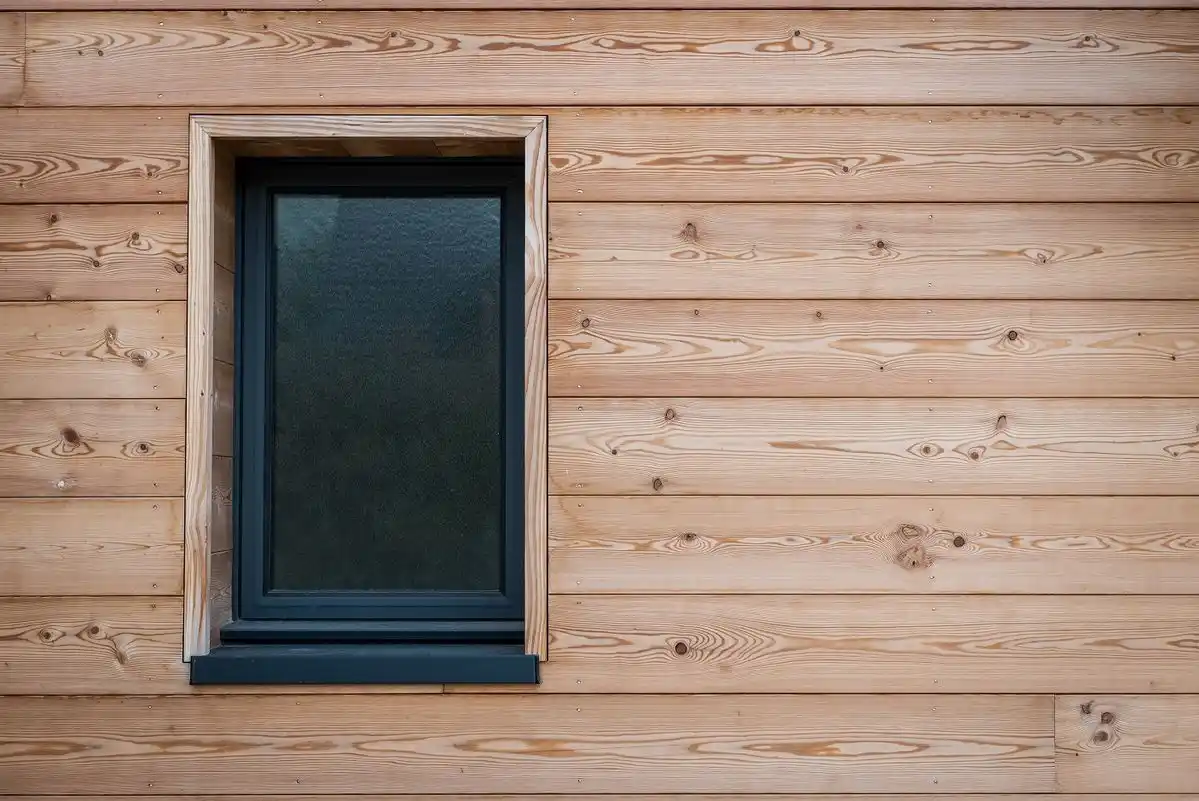
Siberian larch cladding weathering naturally — the even silver-grey patina is a popular low-maintenance finish choice for UK residential projects.
Fresh from the mill, both timbers are visually distinctive. Siberian larch has a warm honey to golden-brown colour with a straight, fine grain that takes oil finishes well. Western Red Cedar has a richer, deeper reddish-brown colour with a more pronounced grain and a subtle aromatic quality that is noticeable during installation.
When left unfinished, both species weather to a similar silver-grey patina over time — though the process happens slightly faster on Western Red Cedar due to its lower density and higher oil content. Western Red Cedar also has a tendency to show tannin bleed staining on lighter coloured surfaces below the boards in the early stages of weathering, which is worth considering in projects with light-coloured render or masonry beneath the cladding line.
For projects where maintaining the fresh timber colour is important, a UV-stable exterior oil or stain is recommended for both species, applied every 2–4 years depending on exposure. For more detail on finishing options, see our exterior wood paint and oil guide.
Performance in the UK Climate

Both Siberian larch and Western Red Cedar weather consistently in the UK climate — correct installation detailing determines long-term performance more than species choice.
The UK's wet, variable climate puts any exterior timber under sustained pressure. High annual rainfall, frequent wet-dry cycles, and seasonal UV exposure are the primary factors that drive deterioration on external facades. Both Siberian larch and Western Red Cedar handle these conditions well, but in different ways.
Siberian larch performs well due to its density and resin content. The dense grain structure resists moisture penetration, and the natural resins inhibit biological decay. It is less prone to surface checking (small surface cracks that appear as the timber dries) than lighter softwoods, and its hardness makes it more resistant to impact and abrasion on lower elevations.
Western Red Cedar performs well due to its natural oils. These oils actively inhibit fungal and insect attack, giving Cedar a natural decay resistance that is comparable to larch despite its lower density. Its lower dimensional movement in service means it is less prone to cupping and distortion on large facades — a genuine advantage on wide-board applications or where tight shadow gap joints need to stay consistent over time.
Key Point
Both timbers will perform well in the UK climate when correctly installed with a ventilated cavity, open base details, and appropriate head flashings. Detailing quality and exposure level have more impact on long-term performance than the species choice itself. A well-installed Cedar facade will outperform a poorly installed larch facade every time.
Available Profiles in the UK
Siberian larch has the broader profile range of the two species in the UK market. It is available in shadow gap, double shadow gap, tongue and groove, rainscreen, feather edge, shiplap, and log lap profiles — covering virtually every cladding application from contemporary residential to rural outbuildings. Our full Siberian larch range includes all major profiles from stock.
Western Red Cedar is most commonly available in shiplap, tongue and groove, and board-on-board profiles in the UK. The shadow gap and rainscreen profiles that are standard in larch are less commonly available in Cedar, which can limit design options on contemporary projects where a clean recessed joint is specified.
If your design requires a specific contemporary profile — particularly shadow gap or rainscreen — Siberian larch is the more practical choice simply due to availability. If your design suits shiplap or a traditional horizontal overlap, both species are equally accessible.
Which Should You Choose? A Project-by-Project Guide
Choose Siberian Larch if...
Best for these projects
- You want the best value naturally durable cladding in the UK
- Your design specifies shadow gap, double shadow gap, or rainscreen profiles
- The facade has exposed lower elevations subject to impact
- You need a wide range of sizes and profiles from stock
- Budget is a priority without compromising on durability
- You are supplying a commercial or architect-specified project
Choose Western Red Cedar if...
Best for these projects
- You are cladding a large facade where lightweight material reduces installation effort
- Thermal performance of the cladding layer is a specification consideration
- The design calls for a richer, more distinctive fresh timber colour
- You are using shiplap or board-on-board profiles
- The project is a garden building, sauna, or outbuilding
- You want very low dimensional movement on wide-board applications
Maintenance Requirements — What to Expect Long Term
Neither Siberian larch nor Western Red Cedar requires chemical preservative treatment — both are naturally durable enough for UK exterior use without it. The maintenance decision is primarily about appearance rather than performance.
For both species, the options are the same: leave untreated and allow the timber to weather to silver-grey, or apply a UV-stable oil or stain every 2–4 years to maintain the original colour. There is no functional reason to finish either species with a film-forming coating (paint or varnish) — these products trap moisture, accelerate deterioration, and require significantly more maintenance than an open oil finish.
The one maintenance difference worth noting is Western Red Cedar's tannin bleed behaviour in the early stages of weathering. If Cedar is installed above render, stonework, or other light-coloured surfaces, tannin run-off can cause dark staining during the first year or two. This is temporary and resolves as the tannins leach out, but it is worth flagging to clients or contractors on sensitive projects. Applying an initial coat of exterior oil before installation significantly reduces this tendency.
For a full maintenance schedule and product guide, see our timber cladding maintenance guide.
Cost Comparison — Siberian Larch vs Western Red Cedar per m²
| Species & Profile |
Siberian Larch |
Western Red Cedar |
| Shadow gap cladding |
£35–£55 per m² |
£55–£75 per m² |
| Double shadow gap cladding |
£45–£65 per m² |
£60–£80 per m² |
| Shiplap / tongue & groove |
£30–£50 per m² |
£50–£70 per m² |
| Fixings (per m²) |
£3–£8 per m² — A4 stainless steel screws recommended for both species |
These are indicative price ranges based on current UK market pricing. For a precise quote on your project, contact our team with your dimensions and profile requirements. For a full breakdown of cladding costs across all species, see our timber cladding cost guide.
Frequently Asked Questions
Is Siberian larch better than Western Red Cedar for exterior cladding?
For most UK exterior cladding projects, Siberian larch is the stronger choice. It is denser and harder than Western Red Cedar, offers comparable natural decay resistance, and is generally more widely available in the UK at a lower cost per m². Western Red Cedar has advantages in thermal insulation and is lighter to work with, making it a good choice for large facades or projects where weight is a consideration. Both are excellent cladding timbers — the right choice depends on your project priorities.
How long does Siberian larch cladding last compared to Western Red Cedar?
When correctly installed with a ventilated cavity and appropriate detailing, Siberian larch cladding typically achieves 20–35 years of service life in UK conditions. Western Red Cedar typically achieves 20–30 years. Both timbers benefit significantly from correct installation and periodic maintenance — the detailing quality and exposure level have more impact on lifespan than species choice alone.
Does Western Red Cedar cladding need treating in the UK?
Western Red Cedar does not require chemical preservative treatment — its natural oils provide inherent decay resistance. However, a UV-stable exterior oil or stain is recommended to maintain colour and extend the maintenance interval. Left untreated, Western Red Cedar weathers to a silver-grey patina similar to Siberian larch, though the weathering process is slightly faster due to its lower density.
Which is cheaper — Siberian larch or Western Red Cedar cladding?
Siberian larch is generally less expensive than Western Red Cedar in the UK market. Siberian larch cladding typically costs £35–£70 per m² depending on profile and grade, while Western Red Cedar typically costs £50–£90 per m². The price gap varies depending on market conditions and availability — Western Red Cedar is imported from North America and can be more susceptible to supply chain pricing fluctuations than Siberian larch.
Can I use Siberian larch and Western Red Cedar together on the same project?
Yes — mixing species on the same project is perfectly acceptable and can produce striking results. A common approach is using Siberian larch for the main facade cladding and Western Red Cedar for feature elements, soffits, or garden structures where its lighter weight and distinctive colour are an advantage. The two timbers weather at slightly different rates, so mixing them on the same elevation is generally not recommended unless a varied appearance is the design intent.
Siberian Larch Cladding — UK Stock, Nationwide Delivery
We supply FSC and PEFC certified Siberian larch cladding across the UK from stock, in all major profiles including shadow gap, double shadow gap, rainscreen, tongue and groove, and feather edge. Nationwide delivery in 7–14 days. Contact our team to discuss profiles, quantities, and specification requirements for your project.
TCS
Timber Cladding Specialists
Written by the Timber Cladding Specialists team — supplying architects, developers, and homeowners across the UK with FSC and PEFC certified timber cladding since 2015. We supply Siberian larch cladding in all major profiles from stock, with nationwide delivery. Based in March, Cambridgeshire.