

Key Takeaways
- Thermally modified timber cladding uses heat and steam — no chemicals — to permanently improve durability and dimensional stability.
- The process reduces moisture absorption by up to 50%, significantly cutting the risk of warping, twisting and surface distortion.
- ThermoWood achieves Durability Class 2 (BS EN 350), with a BRE-accredited service life of 30 years for external cladding.
- It is PEFC and FSC certified, making it one of the most environmentally responsible external cladding materials available in the UK.
- Available in a wide range of profiles including shadow gap, shiplap, rainscreen and tongue and groove for residential and commercial projects.
Thermally Modified Timber Cladding — Key Facts
| Process | Heat and steam treatment at 185–215°C — no chemicals used |
| Durability class | Class 2 (BS EN 350) — suitable for above-ground exterior use |
| Service life | 30 years BRE-accredited for external cladding applications |
| Moisture reduction | Up to 50% reduction in moisture absorption vs untreated softwood |
| Certification | FSC and PEFC certified — sustainably sourced Nordic pine and spruce |
| Colour | Warm honey-brown when new; weathers to silver-grey if left untreated |
| Fire treatment | Compatible — can achieve Euroclass B with approved treatment |
| Profiles available | Shadow gap, shiplap, rainscreen, tongue and groove, feather edge |

Thermally modified timber cladding has become one of the most widely specified external cladding materials in the UK over the past decade. Architects, developers and homeowners consistently turn to it for the same reason: it solves the two problems that have historically made timber cladding difficult to specify with confidence — moisture movement and long-term durability — without resorting to chemical preservatives.
This guide covers everything you need to know about thermally modified timber cladding in the UK: what the process involves, how it performs against alternatives, which profiles are available, and what to expect in terms of maintenance and service life.
What is thermally modified timber cladding?
Thermally modified timber is wood that has been heated to temperatures between 185°C and 215°C in a controlled kiln environment using steam, with no oxygen and no chemicals. This process permanently alters the cell structure of the timber, reducing its ability to absorb moisture, improving dimensional stability, and increasing resistance to biological decay. The result is a cladding material that behaves more consistently outdoors than untreated softwood — without the environmental concerns associated with chemical treatment.
How the thermal modification process works
The thermal modification process is straightforward in principle but highly controlled in practice. Timber — typically Nordic pine or spruce — is placed in a sealed kiln. The temperature is raised gradually using steam to prevent surface cracking, reaching the target modification temperature of 185–215°C. The timber is held at this temperature for a specific period depending on the classification required. During this phase, the hemicelluloses in the wood break down, permanently reducing the timber's hygroscopic properties.
After the modification phase, the timber is cooled slowly using water mist to bring the moisture content back to a stable 4–7%. The result is timber with a characteristic warm honey-brown colour, a faint caramelised aroma, and permanently improved performance characteristics.
Critically, the entire process uses only heat and steam. No preservatives, biocides or chemical treatments are applied at any stage, which is why thermally modified timber cladding is increasingly specified on projects where environmental credentials are part of the design brief. You can read more about our ThermoWood performance and lifespan guide for detailed technical data on how modification affects long-term behaviour.

Performance advantages over untreated softwood
The case for thermally modified timber cladding in the UK comes down to four measurable performance improvements over standard untreated softwood.
Dimensional stability
Standard softwoods like pine and spruce absorb and release moisture as conditions change, causing boards to swell, shrink, cup and twist over time. Thermal modification reduces moisture absorption by up to 50%. In practical terms, this means boards maintain their profile more consistently across seasons, reducing the risk of distortion in shadow gap profiles and tight-tolerance installations. For specifiers working with ThermoWood triple shadow gap cladding, this stability is particularly important — the clean shadow line that defines this profile's appearance depends on boards remaining flat over time.
Durability and decay resistance
Thermal modification removes the nutrients in wood that fungi and wood-destroying organisms feed on. This improves the timber's natural resistance to biological decay, achieving Durability Class 2 to BS EN 350 — the same classification as naturally durable species such as Western red cedar, without the sourcing constraints. For above-ground external cladding applications correctly installed in a ventilated rainscreen system, a 30-year service life is achievable and BRE-accredited.
Reduced maintenance requirements
Because the modification is a permanent change to the timber's structure rather than a surface treatment, it does not wear off or require periodic reapplication. Thermally modified timber cladding can be left to weather naturally to silver-grey, or treated with a UV-protective oil to maintain the original honey-brown colour. Either way, the maintenance interval is significantly longer than for untreated softwood, which typically requires treatment every 2–3 years to maintain performance. For a full breakdown of maintenance requirements by species, see our low maintenance timber cladding guide.
Environmental credentials
Thermally modified timber cladding carries FSC and PEFC certification, confirming that the source timber comes from sustainably managed forests. Because no chemicals are used in the modification process, the end-of-life disposal presents no environmental concerns — the timber can be composted or disposed of as untreated wood. For projects pursuing BREEAM or other sustainability assessments, thermally modified timber typically scores well as a responsibly sourced, low-embodied-carbon cladding material. Our sustainability page provides more detail on the environmental performance of the timber species we supply.
Thermally modified timber vs alternative cladding materials
| Material | Durability class | Maintenance | Chemical treatment | Sustainability |
|---|---|---|---|---|
| Thermally modified timber (ThermoWood) | Class 2 | Low — every 3–5 years if coated | None | FSC / PEFC certified |
| Untreated softwood (pine/spruce) | Class 4–5 | High — every 1–2 years | Preservative required | Varies by source |
| Siberian Larch | Class 3 | Low–moderate | None required | FSC certified options |
| Composite cladding | N/A | Very low | N/A | Recycled content varies |
| Charred timber (Shou Sugi Ban) | Class 2–3 | Low | None | FSC certified options |
For a detailed species-by-species comparison, our Douglas Fir vs Larch comparison guide and ThermoWood versus treated softwood article cover the key performance differences in depth.
Available profiles for UK projects
One of the practical advantages of thermally modified timber cladding is the range of profiles available from stock in the UK. Because the modification process is applied to standard-dimension boards before profiling, virtually any cladding profile can be produced in thermally modified form.
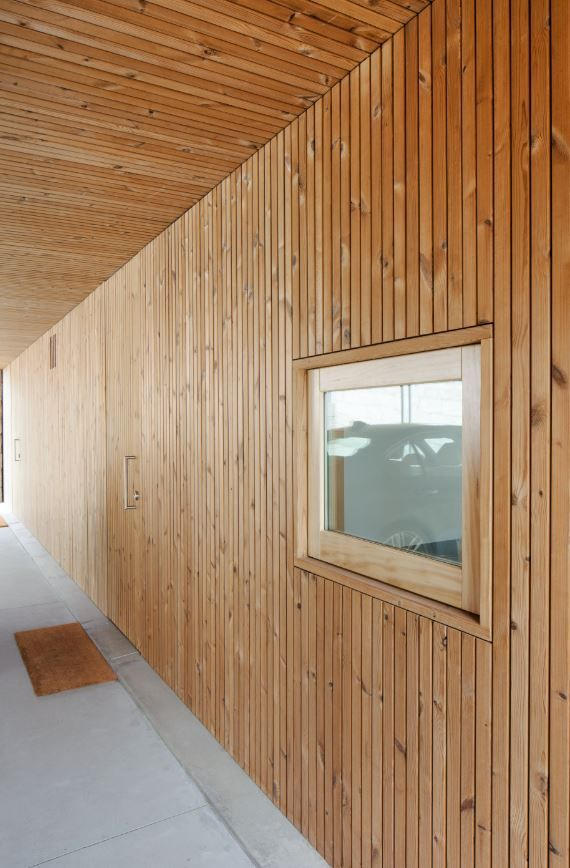
The most commonly specified ThermoWood cladding profiles for UK residential and commercial projects include shadow gap (single and double), triple shadow gap, shiplap, rainscreen battens, tongue and groove, and feather edge. Each profile has specific applications and detailing requirements — shadow gap profiles suit contemporary elevations where the expressed joint is part of the design intent, while shiplap and feather edge profiles are better suited to traditional or rural contexts.
For contemporary residential projects and architect-specified commercial facades, the ThermoWood triple shadow gap 32x140mm has become one of the most widely specified profiles, offering a strong horizontal rhythm and clean joint expression that suits modern timber facades. The double shadow gap 26x142mm is an alternative for projects where a shallower reveal is preferred.
Specifying thermally modified timber for UK building projects
When specifying thermally modified timber cladding for a UK project, there are several key decisions that affect both performance and appearance outcomes.
Species selection
The two primary species used for thermally modified timber cladding in the UK are Nordic pine (Pinus sylvestris) and Nordic spruce (Picea abies). Pine is the more commonly specified choice for exterior cladding, offering a tight, consistent grain that machines precisely for shadow gap profiles. Spruce is sometimes used for wider-format boards or interior applications. Both achieve the same durability classification following thermal modification.
Fire performance
Standard thermally modified timber cladding does not have enhanced fire resistance — thermal modification does not significantly improve reaction-to-fire performance. However, thermally modified timber is compatible with fire retardant treatment and can achieve Euroclass B classification when treated with an approved fire retardant system. This makes it suitable for projects where the UK building regulations require improved fire classification, including residential buildings over 11 metres and many commercial applications. Our fire retardant treatment service covers the treatment options available for ThermoWood and other species.
Fixings and installation
Because thermal modification increases the brittleness of timber compared to untreated wood, pre-drilling is recommended when using face fixings to prevent splitting. Stainless steel fixings should always be used with thermally modified timber — galvanised fixings are not suitable. For hidden fixing systems, the TIGA facade system is compatible with ThermoWood rainscreen profiles and provides a clean face-free finish. All installation should be carried out as part of a ventilated rainscreen system with a minimum 25mm drained and ventilated cavity behind the cladding. For full installation guidance see our timber cladding installation guide.
Surface treatment options
Thermally modified timber can be supplied untreated or with factory-applied coatings. Left untreated, boards weather gradually from honey-brown to silver-grey — a natural, even patina that many architects and homeowners find attractive. If the original colour is to be maintained, a UV-protective oil such as Remmers or Koopmans should be applied before installation and refreshed every 3–5 years depending on exposure. Factory-applied coatings offer the most consistent finish and reduce on-site application time. Our factory coating service covers available colour options and coating systems.
Frequently asked questions
Is thermally modified timber cladding better than untreated softwood?
For external cladding applications in the UK, yes. Thermally modified timber significantly outperforms untreated softwood in dimensional stability, durability and maintenance requirements. Standard softwoods are typically Durability Class 4–5 and require preservative treatment and regular maintenance to perform outdoors. Thermally modified timber achieves Durability Class 2 without any chemical treatment, with a BRE-accredited 30-year service life when correctly installed.
How long does thermally modified timber cladding last?
When correctly installed as part of a ventilated rainscreen system with appropriate fixings, ground clearance and detailing, thermally modified timber cladding can achieve a 30-year service life. This is BRE-accredited for Lunawood ThermoWood and other products from International ThermoWood Association members. Actual service life depends on exposure conditions, detailing quality and maintenance approach.
Does thermally modified timber need treating before installation?
Not necessarily. Thermally modified timber can be installed untreated and left to weather naturally to silver-grey. If you want to maintain the original honey-brown colour, a UV-protective oil should be applied before installation. No preservative treatment is required — the modification process itself provides the decay resistance.
Can thermally modified timber cladding meet UK fire regulations?
Standard thermally modified timber does not have enhanced fire resistance, but it is compatible with fire retardant treatment that can achieve Euroclass B classification. This meets the requirements of Approved Document B for many residential and commercial applications. Always confirm the required classification with building control before specifying — fire performance depends on the complete wall build-up, not just the cladding material alone.
Where can I buy thermally modified timber cladding in the UK?
We supply a full range of ThermoWood cladding profiles from stock with nationwide delivery across the UK. Profiles are available in shadow gap, triple shadow gap, shiplap, rainscreen, tongue and groove and feather edge, in a range of board dimensions. Orders can be placed online or by contacting our team for a project-specific quote.
Browse Thermally Modified Timber Cladding
We stock a full range of ThermoWood profiles for immediate UK delivery — shadow gap, triple shadow gap, shiplap, rainscreen and more. Request a quote or order online today.
