
- ThermoWood wins on stability — moisture absorption reduced by up to 50%, significantly less seasonal movement than larch.
- Siberian larch wins on cost — typically £35–£70 per m² vs £55–£95 for ThermoWood.
- ThermoWood wins on maintenance — can be left completely untreated, oil every 4–6 years if preferred.
- Siberian larch wins on natural character — more pronounced grain, visible knots, rustic appeal suited to traditional projects.
- ThermoWood wins on service life — 30 years BRE-accredited vs 20–35 years for larch depending on exposure.
- Both weather to silver-grey when left untreated — the weathering process is similar, the consistency differs.
ThermoWood and Siberian larch are the two most commonly specified quality timber cladding materials for UK residential and commercial projects — and choosing between them is one of the most frequent questions we answer. Both are widely used, both produce attractive facades, and both are marketed as durable low-maintenance options. The real differences only become clear once you understand how each material behaves over time — and what that means for your specific project, budget, and maintenance expectations.
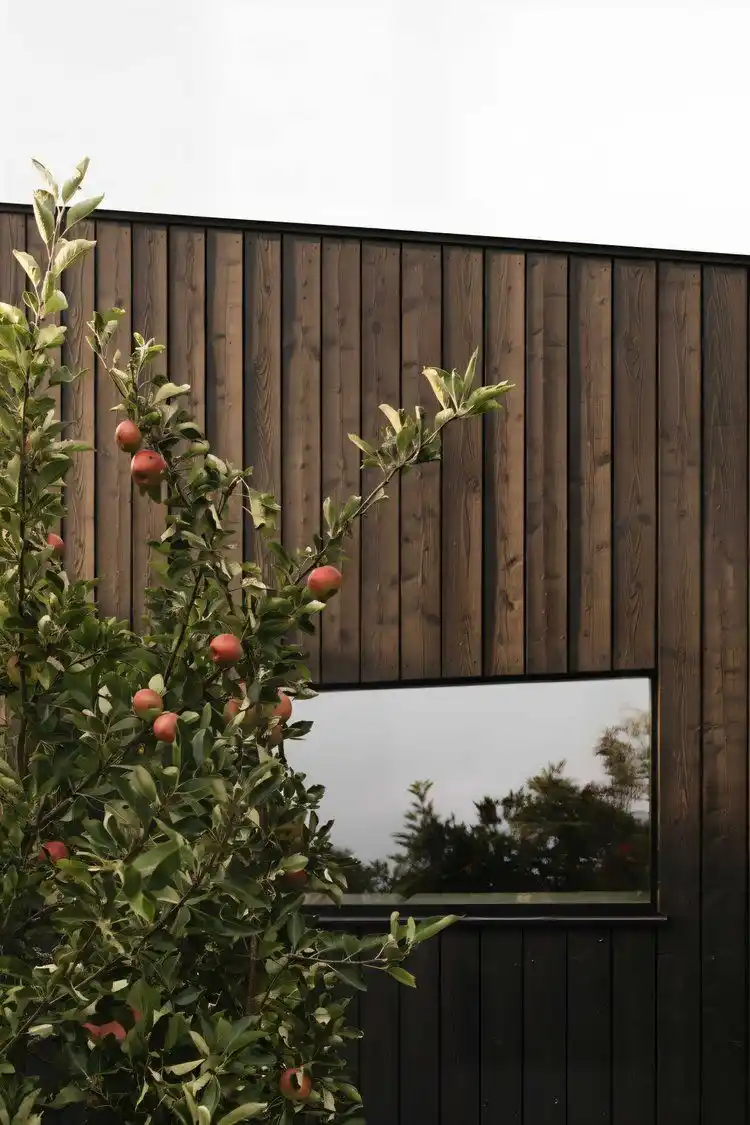
We supply both ThermoWood and Siberian larch cladding from UK stock and specify both regularly across residential, garden room, and commercial projects. This guide gives you the honest comparison — not a sales pitch for either material.
The Fundamental Difference — How Each Material Works
Understanding why ThermoWood and Siberian larch behave differently starts with understanding what makes each of them durable in the first place.
Siberian larch (Larix sibirica) is naturally durable due to its high resin content and dense grain structure, developed through slow growth in the extreme cold of Siberian forests. The tight annual growth rings give it a harder, denser structure than most European softwoods, and its natural resins provide inherent resistance to biological decay. It is classified as Durability Class 3 (BS EN 350) — moderately durable for above-ground exterior applications.
ThermoWood starts as a less durable softwood — typically Nordic pine or spruce — and is permanently improved through thermal modification at 185–215°C using steam. This breaks down the hemicellulose in the wood's cell walls, reducing moisture absorption by up to 50%, eliminating resins, and removing the organic compounds that biological organisms use as a food source. The result is timber classified as Durability Class 2 (BS EN 350) — more durable than untreated larch — with a BRE-accredited 30-year service life.
The key practical implication of this difference is moisture behaviour. Siberian larch, despite its natural durability, is still a responsive timber — it absorbs and releases moisture, expands and contracts seasonally, and continues to move throughout its service life. ThermoWood moves significantly less, because its reduced moisture absorption limits the wet-dry cycling that drives dimensional movement.
Siberian Larch Cladding — Strengths and Limitations

Fully weathered Siberian larch cladding — the natural silver-grey patina develops consistently over 12–24 months and is one of the most popular low-maintenance finishes for UK residential cladding.
Siberian larch is the most widely specified naturally durable cladding timber in the UK — and for good reason. Its combination of natural performance, accessible cost, and distinctive appearance makes it the right choice for a broad range of projects.
Where larch excels
- Cost — at £35–£70 per m², Siberian larch is significantly more affordable than ThermoWood upfront, making it accessible for larger projects and tighter budgets.
- Natural character — larch has a pronounced, varied grain with visible knots and natural colour variation that gives it a warmth and authenticity composite or modified materials cannot replicate.
- Weathering appeal — left untreated, Siberian larch weathers to an attractive silver-grey patina. Many architects and homeowners actively choose this natural weathered finish for its character and zero-maintenance appeal.
- Profile range — we stock Siberian larch in the widest range of profiles — shadow gap, double shadow gap, rainscreen, tongue and groove, shiplap, feather edge, and batten — giving maximum design flexibility.
- Established track record — larch has been used on UK buildings for decades with a well understood performance profile.
Where larch has limitations
- Seasonal movement — larch continues to expand and contract with moisture changes throughout its service life. On exposed or high-rainfall elevations this can lead to cupping, surface checking, and joint gaps opening over time.
- Uneven weathering — on buildings with mixed orientation, sheltered and exposed elevations can weather at different rates, creating colour inconsistency across the facade.
- Coating performance — when a coloured finish is applied, larch's movement can cause coatings to crack or fail locally, requiring more frequent re-coating than ThermoWood.
- Resin bleed — in high summer temperatures, natural resins can bleed from the surface — more of an aesthetic issue than a performance problem but worth noting on south-facing elevations.
ThermoWood Cladding — Strengths and Limitations

ThermoWood installed vertically on a contemporary UK facade — the consistent grain, resin-free surface, and dimensional stability make it one of the most specified timber cladding materials for modern UK architecture.
Where ThermoWood excels
- Dimensional stability — reduced moisture absorption means boards move far less seasonally. Joints stay tighter, shadow lines stay consistent, and coatings last significantly longer between applications.
- Lower maintenance — ThermoWood can be left completely untreated for its entire service life. If colour retention is wanted, oil every 4–6 years on exposed elevations — compared to every 2–4 years for larch.
- Consistent appearance — the finer, more uniform grain and resin-free surface of ThermoWood gives a cleaner, more controlled aesthetic that suits contemporary architecture where precision matters.
- Sauna suitability — ThermoWood is resin-free and dimensionally stable at high temperatures, making it the preferred choice for sauna interior walls and ceilings.
- BRE-accredited service life — 30 years independently verified by the Building Research Establishment — longer than the typical service life achieved by larch in high-exposure UK conditions.
Where ThermoWood has limitations
- Higher upfront cost — £55–£95 per m² vs £35–£70 for larch. On larger projects this is a significant budget consideration.
- More brittle — thermal modification makes ThermoWood slightly more brittle than untreated timber — pre-drilling is required within 50–75mm of board ends to prevent splitting.
- Less natural character — the more consistent grain and uniform appearance that suits contemporary architecture is less suited to traditional or rural projects where natural variation is wanted.
ThermoWood vs Siberian Larch — Full Comparison

Siberian larch cladding — the natural grain variation, visible knots, and depth of character are qualities that thermally modified timber cannot fully replicate, and that many architects and homeowners actively specify.
| Factor | ThermoWood | Siberian Larch |
|---|---|---|
| Durability class (BS EN 350) | Class 2 — Durable | Class 3 — Moderately durable |
| BRE service life | 30 years accredited | 20–35 years typical |
| Dimensional stability | Excellent — moisture absorption reduced 50% | Good — some seasonal movement |
| Material cost per m² | £55–£95 | £35–£70 — more affordable |
| Maintenance frequency | None required — oil every 4–6 years optional | Oil every 2–4 years recommended |
| Appearance | Consistent, fine grain — suits contemporary | Varied grain, knots — natural character |
| Weathering consistency | Very consistent silver-grey | Consistent — slight variation on mixed exposures |
| Resin bleed | ✓ Resin-free — no bleed | Minor resin bleed possible in high heat |
| Sauna suitability | ✓ Excellent — resin-free, stable at heat | Not recommended — resin content |
| Profile range | Wide — shadow gap, shiplap, T&G, rainscreen | Widest — all profiles available |
| Fire rating option | Euroclass B-s1,d0 available | Euroclass B-s1,d0 available |
| Certification | PEFC — sustainably sourced | FSC/PEFC — sustainably sourced |
Which Should You Choose?

Siberian larch board-on-board cladding — a contemporary installation that showcases the natural grain and character that makes larch the preferred choice for projects where material authenticity matters.
- Long-term consistency and low maintenance are the priority
- The project is contemporary architecture with clean, precise detailing
- The facade has mixed or high exposure — particularly coastal or high-rainfall
- A coloured finish is planned — ThermoWood holds coatings longer
- The building is a sauna, garden room, or structure in a damp position
- You want a BRE-accredited 30-year service life
- Budget allows the premium over larch
- Budget is a significant consideration
- Natural grain character and variation are wanted
- The project is traditional, rural, or where rustic character suits
- Natural weathering to silver-grey is the intended finish
- The widest possible profile range is needed
- Periodic maintenance every 2–4 years is acceptable
- The facade is sheltered or mixed-exposure rather than fully exposed
For most contemporary UK residential and garden room projects where low maintenance is the priority — ThermoWood is the stronger long-term specification. For projects where natural character, cost, and a wide profile range matter more than optimised stability — Siberian larch is an excellent choice that has proven itself on UK buildings for decades. Both are significantly better than untreated softwood in any exposure condition. The choice is rarely wrong — it is a question of which priorities your project has. For full profile and pricing details see our ThermoWood range and Siberian larch range.
Is ThermoWood better than Siberian larch for exterior cladding?
ThermoWood outperforms Siberian larch on dimensional stability, moisture resistance, and long-term consistency. Thermal modification reduces moisture absorption by up to 50%, meaning boards move less seasonally, joints stay tighter, and coatings last longer. Siberian larch outperforms ThermoWood on upfront cost and natural character — its pronounced grain and natural weathering suits traditional and rural projects where visible movement is accepted. For contemporary facades where consistent appearance and low maintenance are priorities, ThermoWood is the stronger specification.
How much more expensive is ThermoWood than Siberian larch?
ThermoWood cladding typically costs £55–£95 per m² compared to £35–£70 per m² for Siberian larch — a premium of approximately £20–£30 per m². On a typical 50m² house extension that represents an additional material cost of £1,000–£1,500. However ThermoWood's lower maintenance requirement over its service life means the whole-life cost difference is significantly smaller than the upfront premium suggests.
Does ThermoWood look the same as Siberian larch?
ThermoWood and Siberian larch look similar in profile and colour when freshly installed — both have a warm honey-brown tone and natural timber grain. Siberian larch has a more pronounced, varied grain with visible knots giving it a more rustic, characterful appearance. ThermoWood has a finer, more consistent grain and is resin-free, giving a cleaner, more uniform look that suits contemporary architecture. Both weather to silver-grey when left untreated.
Which requires less maintenance — ThermoWood or Siberian larch?
ThermoWood requires significantly less maintenance. ThermoWood can be left completely untreated to weather naturally, or oiled every 4–6 years to maintain its original colour. Siberian larch benefits from oiling every 2–4 years on exposed elevations to prevent uneven weathering and surface checking. Neither requires preservative treatment — both have sufficient durability for above-ground UK exterior applications.
Which lasts longer — ThermoWood or Siberian larch cladding?
ThermoWood carries a BRE-accredited 30-year service life for external cladding, classified as Durability Class 2 (BS EN 350). Siberian larch is classified as Durability Class 3 with a typical service life of 20–35 years depending on exposure and maintenance. In practice, correctly installed examples of both species regularly exceed these figures when installed with adequate ventilation, ground clearance, and stainless steel fixings.
ThermoWood and Siberian Larch Cladding — Both From UK Stock
We supply ThermoWood and Siberian larch cladding in a full range of profiles from UK stock — nationwide delivery in 7–14 days. FSC and PEFC certified. Not sure which is right for your project? Contact our team with your requirements and we will advise on the best specification.