- Preferred species: ThermoWood — Class 2 durability, zero maintenance, 25–40 years. Zero maintenance is the defining healthcare specification requirement.
- Alternative: Siberian larch — Class 3, no treatment required, 20–30 years. Widely specified where ThermoWood budget is not available.
- Fire performance: EuroClass B (B-s1,d0) factory FR treated — specified as standard on most NHS and private healthcare projects regardless of building height.
- BREEAM Healthcare: FSC/PEFC certified timber contributes to Mat 01 and Mat 03 credits. ThermoWood's 25–40 year service life contributes positively to Mat 01 LCA calculations.
- Live site: Healthcare construction is almost always on or adjacent to operational clinical sites — CDM compliance, access management, and infection control protocols are standard for TCS on healthcare projects.
- NBS clause: H92. We provide H92 specification text, species data sheets, and fire certification on request.
Timber cladding on UK healthcare buildings — hospitals, GP surgeries, community health centres, mental health facilities, and hospices — is specified to a more demanding standard than almost any other building type. The combination of fire performance requirements, zero-maintenance obligations, BREEAM Healthcare targets — see our schools guide for how similar requirements apply in education — biophilic design principles in mental health settings, and the practical challenges of construction on live clinical sites creates a specification environment where every material decision has consequences that extend well beyond the initial build cost. This guide covers the complete specification picture for timber cladding on UK healthcare buildings — what to specify, why, and what to expect from a specialist cladding subcontractor working in this sector.
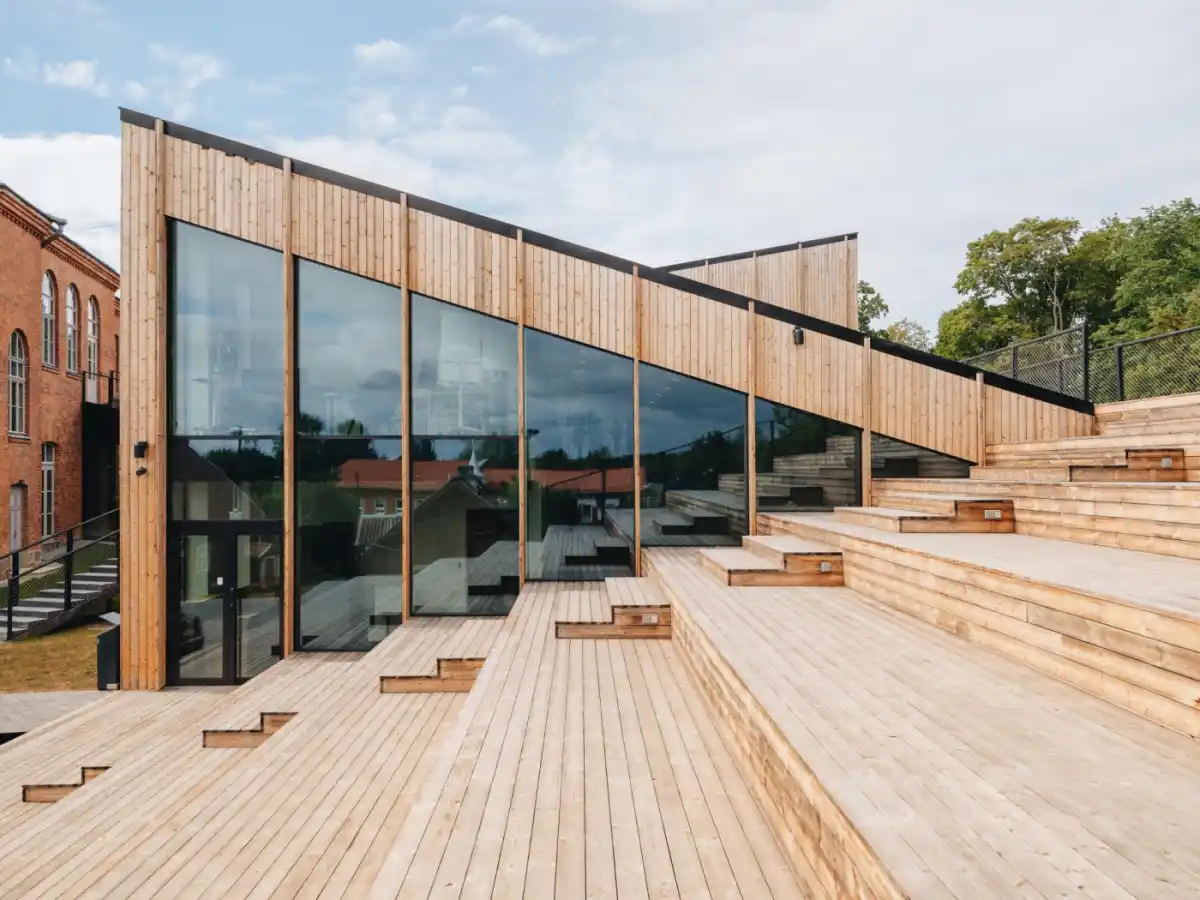
ThermoWood pine timber — Class 2 durability, zero maintenance, 25–40 year service life. The preferred specification for healthcare buildings where facade maintenance on an operational clinical site is operationally impractical. ThermoWood weathers to a consistent silver-grey without any treatment programme.
Why Timber Cladding Is Specified on Healthcare Buildings UK
Natural timber has a specific role in healthcare building design that goes beyond material performance — it is part of the evidence-based design approach that informs contemporary healthcare architecture in the UK. The drivers for timber cladding on healthcare buildings:
- Biophilic design: The evidence base for biophilic design in healthcare settings is substantial — natural materials, including timber facades visible from patient rooms and external spaces, have demonstrable positive effects on patient recovery times, stress levels, and staff wellbeing. On mental health facilities in particular, natural materials are a primary design brief requirement rather than an aesthetic preference
- Zero maintenance: On an operational clinical site, facade maintenance is not merely inconvenient — it is a genuine operational disruption that creates infection control risks, restricts access, and diverts estates management resource. ThermoWood's Class 2 durability with zero maintenance obligation removes this problem entirely for 25–40 years
- BREEAM Healthcare credits: FSC and PEFC certified timber cladding contributes directly to BREEAM Healthcare Mat 01 and Mat 03 credits — relevant on virtually all NHS and private healthcare new build projects where BREEAM Excellent is typically the minimum target
- Whole-life cost: The whole-life cost of naturally durable timber cladding over 25–40 years compares favourably with most alternatives — see our ThermoWood cost guide and Siberian larch cost guide for budget context in the calculation — which they must be on any serious healthcare estate cost-benefit analysis
- Infection control compatibility: A correctly installed ventilated timber facade — boards over cavity over membrane — presents no infection control issues in clinical settings. The boards are not in contact with clinical areas and do not harbour pathogens in a way that is relevant to infection control policy
Key Specification Requirements — Healthcare Timber Cladding
ThermoWood Class 2 for zero maintenance. Siberian larch Class 3 minimum where ThermoWood budget is unavailable. No Class 4 softwood on healthcare facades — treatment obligation cannot be met on clinical sites.
The defining requirement. No preservative treatment, no staining, no painting programmes. Specify ThermoWood or Siberian larch and remove the maintenance obligation entirely for the building's service life.
Most NHS and private healthcare clients specify EuroClass B (B-s1,d0) on external cladding as a minimum regardless of building height. Full certification documentation provided.
FSC and PEFC chain of custody on all TCS timber. CoC number and species documentation provided with every order for BREEAM Healthcare assessor submission.
Project-specific RAMS before mobilisation. Live clinical site protocols — delivery management, infection control awareness, restricted working hours where required by the clinical team.
H92-format specification text for any TCS product available on request. Species data sheets, fire certification, and fixing schedules included in the technical submittal package.
Species for Healthcare Timber Cladding — ThermoWood vs Larch

Siberian larch vertical cladding on a hospital exterior — natural timber is increasingly specified on UK healthcare buildings for its biophilic qualities, zero maintenance credentials, and BREEAM Healthcare credits. Vertical boarding with horizontal batten support produces a distinctive contemporary facade character well suited to clinical environments.
| Species | Durability | Service life | Maintenance | Dimensional stability | EuroClass B | Healthcare suitability |
|---|---|---|---|---|---|---|
| ThermoWood | Class 2 | 25–40 yrs | Zero | Excellent | Yes | Preferred — zero maintenance, maximum service life, consistent weathering |
| Siberian Larch | Class 3 | 20–30 yrs | None required | Good | Yes | Suitable — no treatment required, widely specified on healthcare new build |
| Nordic Spruce | Class 4 | 15–20 yrs | Every 2–4 yrs | Moderate | Yes | Not appropriate for healthcare facades — treatment obligation cannot be met on clinical sites |
Siberian larch is Class 3 durable and requires no treatment — so why prefer ThermoWood on healthcare projects? Three reasons: (1) ThermoWood is Class 2, not Class 3 — a full durability class advantage that translates directly to a 5–10 year additional service life; (2) ThermoWood weathering is more consistent than larch on large elevations — it produces an even, predictable silver-grey rather than the patchy initial weathering pattern that larch can show on exposed south-facing elevations; (3) ThermoWood's lower equilibrium moisture content (4–6% vs 12–15% for larch) produces better dimensional stability — less board movement, more consistent joint widths across the life of the facade. On a building where facade access is operationally difficult, the premium for ThermoWood is well justified. See our full ThermoWood vs larch comparison for the complete picture.
Timber Cladding on Mental Health Facilities — The Biophilic Case
Mental health facility design in the UK has undergone significant development since the publication of the King's Fund's Enhancing the Healing Environment programme and the subsequent development of evidence-based design guidance for mental health settings. Natural materials — including external timber cladding visible from patient rooms, therapy spaces, and external gardens — are now a standard component of therapeutic environment design specifications on new mental health facilities.
The specific evidence for natural materials in mental health settings:
- Stress reduction: Exposure to natural materials and natural views is associated with measurable reductions in cortisol levels and self-reported stress in clinical settings — relevant to both patients and clinical staff
- Wayfinding and orientation: Natural materials help patients distinguish between different parts of a facility more easily than undifferentiated clinical finishes — timber cladding on specific wings or zones can contribute to a legible, less institutionalised environment
- Sensory grounding: Natural textures and colours — including the shadow and warmth of timber cladding — provide a grounding sensory environment that contrasts positively with the clinical character of interior spaces
- Dark finishes: On mental health facilities where a calm, contained exterior aesthetic is part of the brief, dark-stained or charred timber cladding is increasingly specified — producing a facade that reads as quiet and grounded rather than institutional. Dark stained larch and charred Nordic spruce are both compatible with this specification direction
Dark and Charred Timber Finishes on Healthcare Buildings
Siberian larch vertical cladding on a healthcare building — natural timber facades on hospitals and clinical facilities combine biophilic design benefits with zero maintenance credentials. Vertical boarding on a concealed fix system produces a clean, contemporary facade appropriate to both NHS and private healthcare settings.
Dark-finished timber cladding on healthcare buildings — particularly mental health facilities, hospices, and community health centres — is one of the fastest-growing specification directions in the UK healthcare construction market. Options and their characteristics:
- Factory-applied dark stain (Delta Hydrolasur or equivalent): Consistent finish applied in factory conditions before delivery — eliminates site application variation across large elevations. Available on Siberian larch and Nordic spruce in a full range of dark grey and near-black tones. Requires re-treatment on a 5–7 year cycle — less suitable for healthcare where maintenance is a concern
- Charred / Shou Sugi Ban inspired finish on Nordic spruce: The deep charring process carbonises the surface layer, creating a surface that is inherently resistant to moisture and UV — reducing the re-treatment obligation significantly compared to stained untreated spruce. The matt, near-black character is particularly appropriate for mental health facility exteriors. See our charred timber cladding guide
- Factory pre-greyed ThermoWood: ThermoWood naturally weathers to a consistent silver-grey — and factory-applied grey stain accelerates and standardises this weathering for clients who want a consistent grey appearance from day one rather than waiting for natural weathering. Zero maintenance on the underlying substrate regardless of stain application
Working on Live Healthcare Sites
Healthcare construction is almost always on or immediately adjacent to operational clinical sites — and the specific requirements this creates for a specialist cladding subcontractor are more demanding than any other live environment we work in. Our standard approach on healthcare sites:
- Infection control awareness: All TCS operatives receive site-specific infection control induction before starting work on healthcare sites. This covers hand hygiene, PPE requirements in clinical adjacency zones, waste management, and the escalation route for any potential infection control incident
- Delivery management: Healthcare sites have specific vehicle management requirements — restricted access routes, no deliveries during shift change periods, advance booking through the site logistics coordinator. We coordinate all deliveries through the main contractor's site logistics system rather than managing independently
- Noise and vibration: Clinical areas adjacent to construction have specific noise thresholds — we plan installation sequences to avoid high-noise activities during sensitive periods (patient rest periods, clinical procedures) in agreement with the main contractor and clinical management team
- Access control: Healthcare sites have strict access control. All TCS operatives are vetted, carry site-specific passes, and are familiar with the access control protocols of each site before starting work
- Programme flexibility: Clinical operational requirements can require programme changes at short notice — patient transfers, infection outbreaks, clinical emergencies. We build contingency into our programme assumptions on healthcare sites and respond flexibly to legitimate clinical operational requirements
What timber cladding is best for healthcare buildings UK?
ThermoWood — Class 2 durability, zero maintenance, 25–40 year service life, most dimensionally stable species. Zero maintenance is the defining healthcare specification requirement. Siberian larch is also appropriate at Class 3 with no treatment required. Nordic spruce is not appropriate for healthcare facades — the treatment obligation cannot be met on clinical sites.
Does timber cladding need to be fire rated on healthcare buildings?
Most NHS and private healthcare project specifications require EuroClass B (B-s1,d0) fire performance on external cladding regardless of building height — healthcare clients specify fire performance at a higher standard than the minimum required by Approved Document B. We supply factory FR treated timber cladding to EuroClass B on all species with full certification documentation. See our fire rated commercial cladding guide for the full compliance picture.
Does timber cladding on healthcare buildings qualify for BREEAM Healthcare credits?
Yes — FSC and PEFC certified timber cladding contributes to BREEAM Healthcare Mat 01 and Mat 03 credits. All TCS timber is FSC and PEFC chain of custody certified. We provide CoC certificate number and species documentation with every order for BREEAM assessor submission. ThermoWood's 25–40 year service life also contributes positively to Mat 01 life cycle assessment calculations.
Timber Cladding for Healthcare — Supply & Install Nationwide
We supply and install timber cladding on healthcare projects across the UK — ThermoWood and Siberian larch, EuroClass B fire rated where required, full documentation package including RAMS, FSC/PEFC certificates, fire certification, and H92 specification text. Live clinical site experience. Contact our commercial team for budget pricing, technical submittals, or tender returns — 24–48 hour response.