
- Best species: ThermoWood (zero maintenance, 30-yr life) or Siberian larch (naturally durable, 20–35 yrs, lower cost).
- Most popular profile: Shadow gap — contemporary, clean lines, strong shadow depth. Triple shadow gap for maximum architectural impact.
- Bold statement: Charred timber (Shou Sugi Ban technique) — deep black, zero maintenance, instantly distinctive.
- Orientation: Vertical cladding suits tall, narrow extensions; horizontal suits wide, low extensions. Both work on any species.
- Cost (40m² extension): £2,200–£3,200 materials in Siberian larch shadow gap; £2,800–£4,200 in ThermoWood.
- Planning: Timber cladding on extensions generally requires planning approval — confirm the approved external materials before ordering.
Timber cladding on a house extension is one of the most effective ways to create a contemporary addition that is clearly distinct from the original building — and one that ages well, performs reliably, and requires little ongoing attention. The right species and profile combination transforms an extension from a box-on-the-back into an architectural statement. This guide covers the species, profiles, orientations, and design approaches that work best for modern UK house extensions in 2026 — with real costs, planning guidance, and the honest trade-offs between the main options.
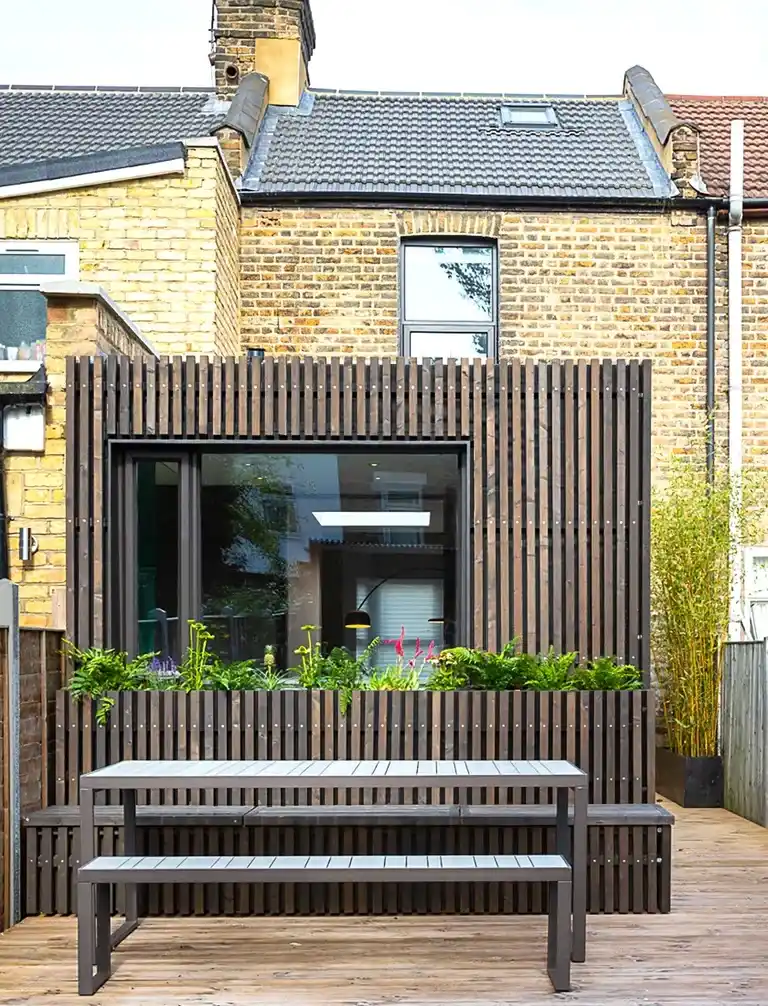
Contemporary timber cladding on a modern London house extension — the natural warmth of timber against existing brickwork is one of the most successful material contrasts in UK residential architecture. The extension reads as a considered contemporary addition rather than an attempt to mimic the original.
Choosing Your Species — The Most Important Decision

Siberian larch cladding on a UK house extension — the warm honey-gold tone of fresh larch against existing materials creates a striking contemporary contrast. Over 2–5 years the larch weathers to an attractive silver-grey without any treatment or maintenance obligation.
- Zero maintenance — no treatment ever
- 30-year BRE endorsed service life
- Rich honey-brown, weathers to silver-grey
- Exceptional dimensional stability
- Shadow gap, triple shadow gap, shiplap, rainscreen
- Naturally durable — no preservative needed
- 20–35 year service life
- Warm honey-gold, weathers to silver-grey
- Broadest profile range from UK stock
- 20–40% cheaper than ThermoWood
- Deep black — zero maintenance
- 25–40 year service life
- Most distinctive finish available
- Increasingly specified on contemporary extensions
- Works powerfully against brick and render
ThermoWood on Extensions — The Zero-Maintenance Specification
ThermoWood weathered to silver-grey on a UK house — the zero-maintenance characteristic of ThermoWood makes it particularly compelling for house extensions where ongoing treatment access may be difficult. Once installed, it requires nothing — no oiling, no preservative, no painting — for the full 30-year service life.
ThermoWood is the most specified premium cladding on architect-designed UK house extensions for a straightforward reason — it is genuinely zero maintenance. The thermal modification process reduces equilibrium moisture content from approximately 12% to 4–6%, improving dimensional stability by 60% and upgrading biological durability to Class 2. This means no preservative treatment, no colour maintenance, no repainting — for 30 years. On an extension where scaffolding access for future maintenance would be disruptive or expensive, this is a significant practical advantage.
The most popular ThermoWood profiles for extensions are shadow gap 19x140mm and triple shadow gap 32x140mm — both producing a clean, contemporary facade with strong shadow lines that suit the scale and proportion of most UK house extensions. For the complete ThermoWood profile range see our ThermoWood cladding range.
Vertical vs Horizontal — Which Orientation Works Best?

Siberian larch installed vertically — vertical cladding emphasises height and creates strong upward visual movement. For extensions that are taller than they are wide — rear extensions with a full-height glazed section, for example — vertical installation is often the stronger design choice.
Both vertical and horizontal installation work well on modern extensions — the choice should be driven by the proportion and character of the building, not convention. As a general principle: vertical cladding suits tall, narrow extensions and emphasises upward movement; horizontal cladding suits wide, low extensions and draws the eye along the building. Both orientations are available in all profiles and species.
One practical consideration: horizontal cladding is slightly more vulnerable to water sitting on the top edge of each board, particularly in the shadow groove of shadow gap profiles. In very high-exposure locations, vertical installation is marginally better at shedding water. In standard UK residential settings, both orientations perform identically well over the service life when correctly installed with adequate cavity ventilation. See our vertical vs horizontal cladding guide for full detail.
Charred Timber on Extensions — The Bold Alternative

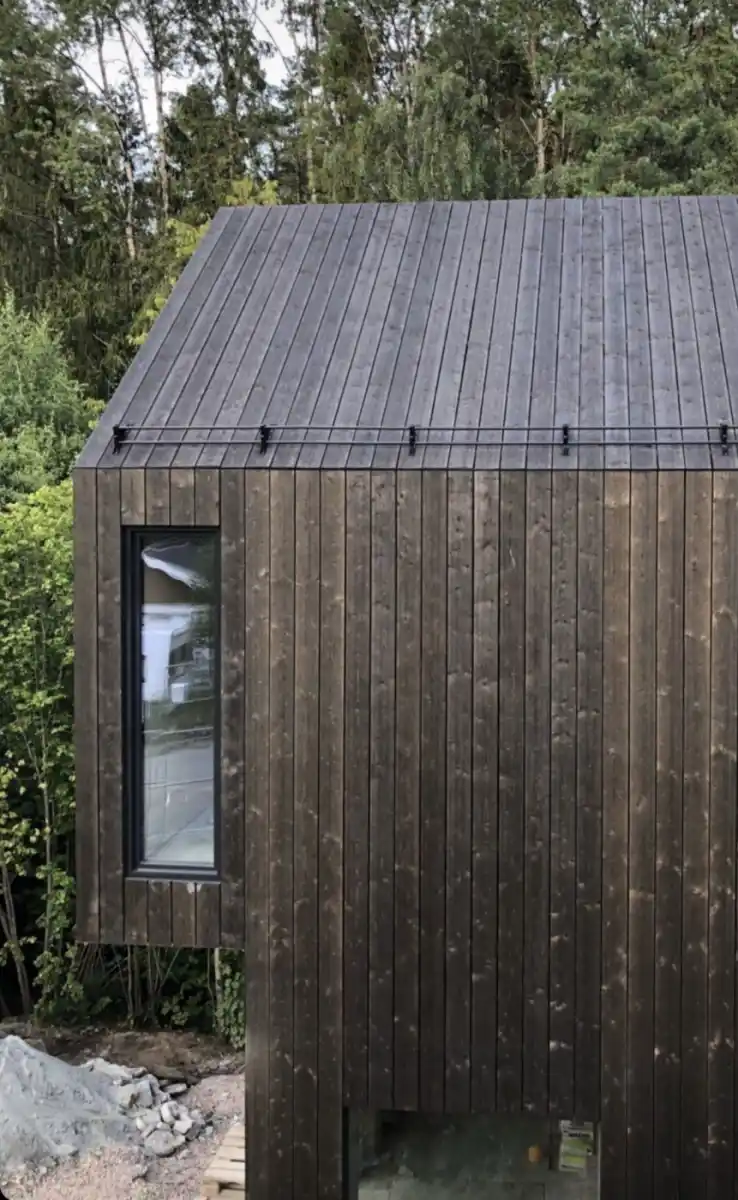
Charred timber cladding on a UK house extension — the deep black finish creates a bold architectural statement that reads powerfully against existing brick or render. The contrast between old and new is at its most dramatic with charred timber, making it a strong choice for extensions designed to be unambiguously contemporary.
Charred timber cladding — produced using the Shou Sugi Ban technique — is the fastest-growing cladding specification on contemporary UK house extensions. Its appeal is straightforward: a deep black finish that is completely self-maintaining, ages beautifully to dark charcoal grey over time, and creates an architectural contrast with existing brick or render that no other material quite replicates. It costs more upfront than larch or ThermoWood but its zero-maintenance characteristic means the whole-life cost gap is smaller than the upfront price difference suggests.
For extensions on traditional brick-built UK houses, charred timber creates the clearest possible visual distinction between old and new — which is often exactly the design intent. The extension does not try to replicate the existing building; it announces itself as a considered contemporary addition. Browse our full charred timber range for available species, profiles, and finishes.
Black Stained Cladding — The Accessible Alternative

Black opaque stained timber cladding on a UK extension — a more affordable route to a dark timber facade than charred timber. Siberian larch or ThermoWood with a factory-applied or site-applied opaque black stain produces a consistent, clean finish. Re-coating every 4–6 years is required to maintain the colour on stained cladding.
For projects where the deep black aesthetic is wanted but the budget does not stretch to charred timber, opaque black stain on Siberian larch or ThermoWood is a well-proven alternative. A quality microporous opaque stain such as Koopmans Cover Line applied to larch or ThermoWood boards produces a consistent, flat black finish that suits contemporary extension design. We also offer a factory coatings service — boards arrive pre-coated in your specified colour, eliminating site application and providing a more even finish than site-applied treatment.
Cost Guide — Timber Cladding on a House Extension UK 2026
| Species / profile | Materials — 40m² | Installed — 40m² | 30-yr maintenance |
|---|---|---|---|
| Siberian larch shadow gap | £2,200–£3,200 | £3,200–£5,000 | £0–£600 |
| ThermoWood shadow gap | £2,800–£4,000 | £3,800–£5,800 | £0 |
| ThermoWood triple shadow gap | £3,400–£4,400 | £4,400–£6,400 | £0 |
| Charred larch | £3,400–£4,600 | £4,400–£6,600 | £0 |
| Nordic spruce shiplap | £1,100–£1,800 | £2,100–£3,600 | £600–£1,200 (treatment) |
All figures are for 40m² of cladding area — a typical single-storey rear extension. Materials include cladding boards, battens, breather membrane, and A4 stainless fixings. Installed cost adds professional installation labour but excludes scaffolding. For a full breakdown see our timber cladding cost per m² guide.
For most UK house extensions — Siberian larch shadow gap installed vertically is the strongest all-round specification. Naturally durable, no maintenance, contemporary profile, warm honey-gold colour aging to silver-grey, and 20–35 year service life at 20–40% less than ThermoWood. For a truly zero-maintenance specification — ThermoWood shadow gap or triple shadow gap. For maximum visual impact — charred timber. All three are available from UK stock with 7–14 day delivery. Contact our team with your drawings for a precise quantity and quote.
What is the best timber cladding for a house extension in the UK?
ThermoWood and Siberian larch are the two strongest specifications for modern UK house extensions. ThermoWood offers zero maintenance and a 30-year BRE endorsed service life. Siberian larch is naturally durable, costs 20–40% less, and ages attractively to silver-grey. For a bold black statement, charred timber is increasingly specified on contemporary extensions.
Do I need planning permission to clad a house extension in timber?
The extension itself usually requires planning permission, and the approved materials will be specified. If timber cladding is in the approved drawings, it can be used. To change an approved material to timber after planning is granted, submit a non-material amendment first. In conservation areas all external material changes require permission. See our planning permission guide for full detail.
How much does timber cladding cost for a house extension?
For a typical 40m² extension: Siberian larch shadow gap costs approximately £2,200–£3,200 in materials and £3,200–£5,000 fully installed. ThermoWood shadow gap costs £2,800–£4,000 in materials and £3,800–£5,800 fully installed. All prices exclude scaffolding.
Should timber cladding on an extension match the existing house?
Not necessarily — many of the most successful contemporary UK extensions use timber cladding as a deliberate contrast to the existing building material. A brick house with a timber-clad extension reads as a considered contemporary addition. Attempting to match brick with a brick-coloured stain rarely looks convincing.
What profile works best for a modern extension?
Shadow gap is the most specified profile for modern UK house extensions — clean horizontal or vertical lines with strong shadow depth. Triple shadow gap produces even more architectural impact. Rainscreen open-joint cladding is the most dramatic. Shiplap is the simpler, cleaner alternative. Profile choice should follow the architect's design intent.
Timber Cladding for House Extensions — Specification Support & UK Supply
We supply ThermoWood, Siberian larch, charred timber, and Nordic spruce for UK house extensions from UK stock. We can calculate precise material quantities from your architect's drawings, provide NBS product data for planning submission, and supply sample boards for approval. Nationwide delivery in 7–14 days.