
- ThermoWood and Siberian larch are the strongest all-round timber cladding choices for UK garden rooms — durable, low maintenance, and available in profiles that suit both contemporary and traditional builds.
- Charred timber (Shou Sugi Ban inspired) is the most popular choice for black garden rooms and garden offices — virtually zero maintenance and a bold visual result that is trending fast in 2026.
- Material costs range from £500–£3,500 to clad a typical garden room, depending on species and size.
- Shadow gap, shiplap, and vertical board-on-board are the most popular profiles for garden room cladding in the UK.
- Most garden rooms do not require planning permission for cladding — but conservation areas and listed buildings are exceptions.
Garden rooms and garden offices have become one of the fastest growing sectors in UK home improvement — and cladding is one of the most important decisions in the build. The right cladding makes your garden room look considered and permanent rather than temporary and cheap. It protects the structure from the UK's wet climate for decades rather than years. And it determines how much time and money you will spend on maintenance over the life of the building.

This guide covers every timber cladding option for UK garden rooms in 2026 — from the best species and profiles to real cost figures and the design ideas that are trending right now. Whether you are building a simple garden office or a fully specified garden studio, this guide will help you choose the right cladding for your project and budget.
Why the Cladding Choice Matters More Than Most People Realise
A garden room sits in an exposed position — often in the middle of a garden with no shelter from adjacent buildings. It faces rain, UV, frost, and wind on all four elevations simultaneously. Unlike a house wall where the structure behind the cladding provides substantial thermal mass and protection, a garden room frame is typically timber stud — meaning the cladding is doing almost all the work of weatherproofing the building.
Choose the wrong cladding and you will be repainting, re-oiling, or replacing boards within 5–8 years. Choose correctly and your garden room exterior will be performing well in 25 years with minimal intervention. The cost difference between a budget softwood and a quality ThermoWood or larch specification is typically £600–£1,500 on an average garden room — a small premium against a decade of maintenance savings.
Garden rooms are typically smaller, more exposed structures than houses, with thinner frames and no adjacent buildings to provide shelter. They are often partially shaded by trees or fences — creating damp microclimates that accelerate biological growth on untreated or poorly maintained timber surfaces. Choosing a species with good natural decay resistance (larch, ThermoWood) or inherent surface protection (charred timber) is more important on a garden room than on a well-sheltered house wall.
Best Timber Species for Garden Room Cladding

Siberian larch cladding on a UK garden office — one of the most widely specified natural timber options for garden rooms, combining good durability with a distinctive grain character.
ThermoWood for Garden Rooms — Why It Works So Well

ThermoWood shadow gap cladding on a UK garden office — the clean profile and consistent tone make it one of the most widely specified choices for contemporary garden room builds.
ThermoWood is consistently the most specified timber for garden room exteriors among architects and specialist builders in the UK. The reason is straightforward — it combines the natural appearance of real timber with a level of stability and durability that untreated softwoods simply cannot match in the exposed conditions a garden room faces.
The thermal modification process permanently reduces ThermoWood's moisture absorption by 40–50% compared to untreated timber. For a garden room that may sit in a partially shaded, damp garden corner for 30 years, this matters enormously. It means the boards move less, the joints stay tighter, and the surface degrades more slowly than any untreated alternative at a comparable price point.
On a garden room exterior, ThermoWood triple shadow gap 26x92mm is the most widely used profile — it gives a clean, contemporary horizontal rhythm that suits the rectangular form of most garden rooms. It is available from stock and can be left to weather naturally or finished with a UV oil to maintain the original warm tone. For a full guide to ThermoWood performance see our ThermoWood cladding performance guide.
Charred Timber Garden Rooms — The Fastest Growing Trend

Charred timber on a UK garden room — the deep black finish requires virtually no maintenance and creates a bold architectural statement that suits the scale of a garden structure perfectly.
Charred timber cladding has seen a significant surge in popularity on UK garden rooms and garden offices over the past two years. The reasons are practical as much as aesthetic — the carbonised surface of a charred board requires virtually no ongoing maintenance, making it one of the most genuinely low-maintenance exterior finishes available for a garden structure.
The black finish also suits the scale of a garden room particularly well. A small structure in a garden can be overwhelmed by a busy natural grain — the deep, consistent black of a charred or charred-and-stained board gives the building a stronger, more considered visual identity. It sits well against planting, contrasts effectively with pale render or brick on adjacent house walls, and photographs exceptionally well — important for anyone planning to use their garden office as a background for video calls or social media.
Our deep charred larch is the most popular charred finish for garden rooms — the Siberian larch base timber provides excellent natural durability beneath the char layer, and the deep alligator-skin texture creates the most dramatic visual result. For a more controlled, uniform black finish, our charred brushed and stained range in black gives a consistent colour with visible grain texture. For more on charred timber options see our Yakisugi vs Shou Sugi Ban guide.
Best Cladding Profiles for Garden Rooms
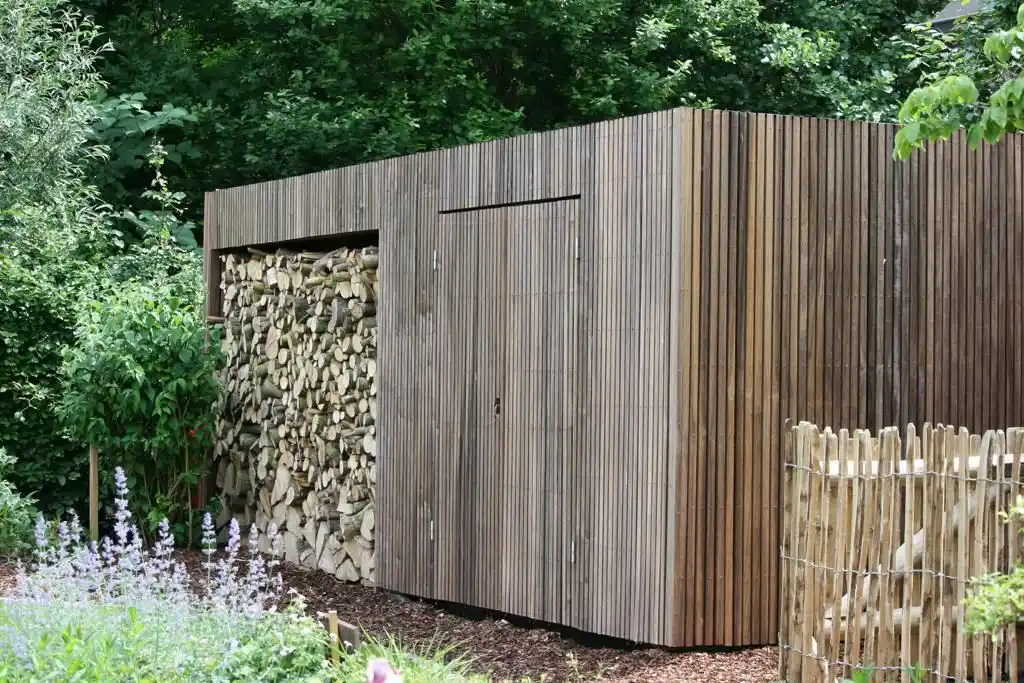
Timber cladding weathering naturally on a garden room — ThermoWood and larch both develop a consistent silver-grey patina without any treatment needed.
The profile you choose affects both the appearance of the garden room and how well it handles the UK climate. Here are the profiles that work best on garden room builds:
Black Garden Room Design — What's Trending in 2026

Black cladding on a UK garden office — one of the most searched finishes for garden rooms in 2026, combining bold visual impact with very low ongoing maintenance.
Black garden rooms have dominated UK garden design trends for the past several years and remain the most searched finish category going into 2026. The combination of dark timber against green planting creates one of the most visually effective garden room aesthetics — and the low maintenance requirement of charred or factory-stained black boards makes it a genuinely practical choice as well as a design one.
The most popular approach on contemporary UK garden offices is a vertical board-on-board or shadow gap profile in charred timber or factory black-stained larch, combined with dark aluminium or steel window and door frames, a flat or mono-pitch roof, and simple planting at the base. This combination creates a coherent, architectural result that looks considered and permanent rather than added on.
For a full guide to black cladding options, profiles, and costs see our black timber cladding UK guide. For maintenance guidance on charred and stained black finishes, see our timber cladding maintenance guide.
Cost to Clad a Garden Room — 2026 Figures
A typical UK garden room has between 15–30m² of external wall area to clad, depending on size. Here is what the material cost looks like across the main species choices:
| Species / Finish | Cost per m² | 15m² garden room | 25m² garden room | Maintenance |
|---|---|---|---|---|
| Nordic spruce | £20–£40 | £300–£600 | £500–£1,000 | High — treat every 2–3 years |
| Siberian larch | £35–£70 | £525–£1,050 | £875–£1,750 | Low — oil every 3–5 years or leave |
| ThermoWood | £55–£95 | £825–£1,425 | £1,375–£2,375 | Very low — oil optional, leave to grey |
| Charred timber | £75–£130 | £1,125–£1,950 | £1,875–£3,250 | Minimal — clean only, no treatment |
Add £10–£15 per m² for battens, fixings, and breather membrane. Labour to install garden room cladding typically costs £25–£45 per m², or £375–£1,125 for a typical 15–25m² garden room. For a full cost breakdown see our guide to how much it costs to clad a building in the UK.
For most UK garden rooms, ThermoWood or Siberian larch in a shadow gap or shiplap profile is the right specification — it will outlast the structure and require minimal maintenance over its lifetime. If you want a black finish, charred timber is the best long-term choice — the maintenance saving over 20 years compared to repeatedly re-staining a black-painted softwood more than justifies the higher initial cost. Use A4 stainless steel fixings on all species — standard steel will rust and stain even quality timber boards.
What is the best cladding for a garden room in the UK?
For most UK garden rooms, ThermoWood and Siberian larch are the strongest timber cladding choices. ThermoWood offers the best combination of low maintenance, dimensional stability, and long lifespan — it does not require preservative treatment and weathers naturally to a consistent silver-grey. Siberian larch is a strong mid-range option with excellent natural durability and a distinctive grain. Charred timber is the most popular choice for contemporary black garden rooms — it requires virtually no maintenance and has a bold visual impact that suits modern garden office designs.
How much does it cost to clad a garden room?
The material cost to clad a typical UK garden room ranges from £500–£1,000 for Nordic spruce, £875–£1,750 for Siberian larch, £1,375–£2,375 for ThermoWood, and £1,875–£3,250 for charred timber — based on 25m² of cladding area including 15% wastage. Labour typically costs £25–£45 per m² on top of materials. Most garden rooms can be clad in 1–2 days by an experienced carpenter.
Does a garden room need planning permission for cladding?
In most cases, cladding a garden room does not require planning permission — garden rooms are typically built under permitted development rights. However, if you live in a conservation area, national park, or Area of Outstanding Natural Beauty, permitted development rights may be restricted. If your garden room is listed or within the curtilage of a listed building, you will need listed building consent. Always check with your local planning authority if you are unsure.
What is the most low-maintenance cladding for a garden room?
Charred timber is the most low-maintenance timber cladding option for a garden room — the carbonised surface requires no ongoing treatment, just an occasional clean. ThermoWood is the second lowest maintenance option — it can be left to weather naturally to silver-grey with no treatment, or maintained with a UV oil every 3–5 years. Both significantly outperform untreated softwood, which requires re-treatment every 1–3 years.
What cladding profiles work best on a garden room?
Shadow gap, shiplap, and board-on-board vertical profiles are the most popular for UK garden rooms. Shadow gap gives a contemporary, architectural finish and works well with ThermoWood or larch. Shiplap suits traditional, cabin-style garden rooms and is one of the easiest profiles to install. Board-on-board vertical cladding creates a bold, modern statement and is increasingly popular on garden offices. Feather edge boards are the budget option and suit outbuildings and sheds where cost is the priority.
Garden Room Cladding — All Species, All Profiles, UK Stock
We supply timber cladding for garden rooms, garden offices, and outbuildings across the UK — ThermoWood, Siberian larch, charred timber, and more. FSC and PEFC certified. All profiles in stock for delivery in 7–14 days. Send us your dimensions and we will calculate the exact quantity and cost for your project.