A correctly specified timber facade works as a rainscreen — it sheds most water at the board surface, and manages any water that gets behind the boards through a ventilated cavity and breather membrane. Timber cladding does not need to be waterproof to perform reliably for 25–40 years on UK buildings. The system manages water. The timber does not repel it.
Is timber cladding waterproof? It is one of the most searched questions about timber cladding in the UK — and the answer surprises most people. No, timber cladding is not waterproof. But this does not mean it lets water into your building, or that it is unsuitable for the UK's wet climate. Quite the opposite. A correctly specified timber cladding system manages rainwater more effectively than most people expect — and has been doing so on UK buildings for centuries. This complete guide explains exactly how timber cladding handles water, why waterproofness is the wrong thing to measure, which species are most moisture resistant, and what the correct specification looks like.
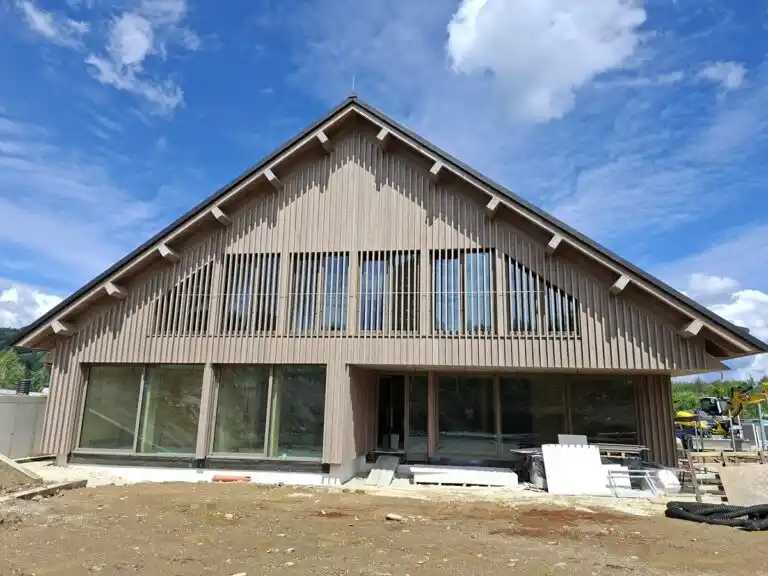
ThermoWood cladding fully weathered to silver-grey on a UK house — performing in the UK's wet climate without any waterproof coating, any treatment, or any maintenance. The rainscreen system behind the boards manages moisture; the Class 2 durable timber resists biological decay. Zero maintenance required over a 25–40 year service life.
Why Timber Cladding Is Not Waterproof — and Why That Is Fine
The question "is timber cladding waterproof?" comes from a reasonable assumption — that the outer skin of a building must stop water. With masonry, render, or composite cladding, this is largely true: the material itself is the barrier. Timber cladding works differently, and understanding how it works is the key to understanding why waterproofness is simply not the right measure.
Timber is a hygroscopic material — it absorbs and releases moisture as atmospheric conditions change. No timber species and no surface treatment makes timber permanently waterproof in the way that a sheet of glass or metal is waterproof. What varies between species is how much moisture timber absorbs, how quickly, and how much its structure degrades as a result. This is what durability class measures — not waterproofness, but resistance to biological decay in the presence of moisture.
A timber cladding system is designed around this reality. It is a rainscreen — a system that:
- Sheds the vast majority of wind-driven rain at the board surface
- Allows any water that penetrates joints or laps to drain downward and out at the base
- Uses a ventilated cavity to dry out any moisture that enters
- Protects the wall structure behind with a breather membrane
- Uses naturally durable or thermally modified timber that resists decay even when wet
The system works because water is managed, not excluded. This is not a compromise — it is an engineering principle that has been refined over hundreds of years of timber building in northern European climates far wetter than most of the UK.
How a Timber Rainscreen System Manages Water

Vertical batten spacing on a UK timber cladding rainscreen system — the battens create the ventilated cavity between the cladding boards and the breather membrane. Correct batten spacing, cavity depth (minimum 25mm), and open base detail are the three elements that allow water to drain and moisture to evaporate. See our full timber cladding rainscreen UK guide: rainscreen cladding explained.
Sheds the majority of direct rain. Profile choice — shadow gap, feather edge, shiplap — affects how efficiently water runs off the face.
Minimum 25mm air gap behind the boards. Water drains downward by gravity. Air circulation dries residual moisture. The most critical element.
Vapour-permeable membrane on the wall face. Stops liquid water reaching the wall structure while allowing moisture vapour to escape outward.
Creates the cavity and provides the fixing for the boards. Depth determines cavity size. Treated battens throughout.
Open base with insect mesh — ventilation in at the bottom, out at the eaves. Ground clearance minimum 150mm. Critical for drainage and airflow.
Naturally durable or thermally modified species resists decay even when wet. The final layer of protection — the timber itself.
Timber cladding fails not when water touches it — but when water cannot leave. A blocked cavity, missing ground clearance, omitted membrane, or sealed base detail traps moisture against the timber and the wall structure. That is when rot and structural damage occur. The system must drain and dry. When it does, timber cladding performs without issue in any UK location.
Which Timber Cladding Is Most Water Resistant UK?
Naturally weathered timber cladding boards — the silver-grey patina that develops on naturally durable species like larch and ThermoWood after exposure to UK weather. The colour change is purely aesthetic — the structural integrity and moisture resistance of the timber are unaffected. This is what correctly specified timber cladding looks like after years of UK rain, wind, and UV.
While no timber cladding is waterproof, the species choice dramatically affects how the timber responds to moisture — how much it absorbs, how quickly it dries, and how long it resists biological decay in wet conditions:
| Species | Durability class | Moisture absorption | Treatment needed | Service life |
|---|---|---|---|---|
| ThermoWood | Class 2 | Up to 50% less than untreated softwood | Zero — none ever | 25–40 years |
| Siberian Larch | Class 3 | Low — natural resins limit uptake | None above ground | 20–30 years |
| Charred SSB Larch | Enhanced Class 3 | Very low — char layer limits uptake | Zero — none ever | 25–40 years |
| Douglas Fir | Class 3 | Low-moderate | Optional oil | 20–30 years |
| Nordic Spruce (untreated) | Class 4–5 | High — no natural resin protection | Every 2–3 years | 10–20 years |
The durability class rating (BS EN 350) is the definitive measure of how well a timber species resists biological decay in the presence of moisture — which is far more useful than any measure of waterproofness. Class 2 (Durable) means the timber resists decay even in prolonged wet contact. Class 4–5 means it will decay without treatment. This is the specification decision that determines how timber cladding performs in UK weather over 20–40 years.
Does ThermoWood Cladding Repel Water Better?
ThermoWood cladding weathered to silver-grey — the thermal modification process permanently reduces moisture absorption by up to 50% compared to untreated softwood. This means boards move less as conditions change, the timber is less hospitable to the fungi responsible for decay, and the cladding performs more consistently across UK seasonal wet-dry cycles. See our full ThermoWood performance guide.
ThermoWood is the most moisture-resistant standard timber cladding available in the UK. The thermal modification process (185–215°C in a controlled low-oxygen environment) permanently alters the timber's cellular structure, breaking down the hemicellulose that is responsible for moisture absorption. The result:
- Up to 50% less moisture absorption than untreated softwood — boards move less, stay flatter, and work fixings less over seasonal wet-dry cycles
- Class 2 biological durability — the timber is inhospitable to the fungi responsible for decay even when wet
- Zero treatment required above ground throughout the 25–40 year service life — no waterproof coating needed, ever
- More consistent weathering — the reduced moisture cycling produces a more even silver-grey patina across all elevations than standard softwood
ThermoWood is not waterproof — but its dramatically reduced moisture absorption means it handles UK weather more effectively than any untreated softwood and most naturally durable species.
Does Timber Cladding Need a Waterproof Membrane?
Breather membrane and batten framework on a UK garden room before timber cladding boards are fixed — the membrane is installed over the wall structure, the battens are fixed through it creating the ventilated cavity, and the cladding boards fix to the battens. The membrane is not optional — it is the last line of protection for the wall structure from any water that penetrates the cladding layer.
Yes — a vapour-permeable breather membrane is required behind all timber cladding. It is important to understand what it does and what it does not do:
- What it does: Protects the wall structure (insulation, sheathing board, blockwork) from liquid water that penetrates the cladding layer. Allows moisture vapour from inside the building to escape outward, preventing interstitial condensation within the wall build-up
- What it is not: A substitute for the ventilated cavity. A breather membrane on its own — without a ventilated cavity — will not drain the water that gets behind the boards. Both are required
- What to specify: A vapour-permeable membrane with a minimum Sd value of 0.02m (highly vapour open) for most UK wall constructions. Standard underlay or vapour barrier is not appropriate — specify a proper breather membrane
When Does Timber Cladding Let Water Into the Building?
Timber cladding lets water into a building when the rainscreen system fails — not because the timber itself is permeable. The most common causes of failure are: no ventilated cavity (boards fixed directly to the wall with no air gap); blocked cavity (mortar droppings, insulation pushed into the cavity, sealed base detail); missing breather membrane; insufficient ground clearance (boards touching or close to ground level — wicking moisture upward); unsealed end grain (end grain absorbs water at ten times the rate of face grain — all cut ends must be sealed on installation); non-durable species without treatment (Nordic spruce without treatment will decay and fail structurally within 10–15 years on exposed elevations). Every one of these failures is a specification or installation error — not a failure of timber as a cladding material.
Timber Cladding in Heavy Rain and Exposed Locations UK
Naturally weathered timber cladding on a UK house — performing without treatment or waterproof coating in UK conditions. A correctly specified rainscreen system with naturally durable timber handles exposed UK locations including coastal and upland sites. The key variables are species choice, cavity depth, base detail, and end grain sealing — not whether the timber is waterproof.
The UK's wet climate is not a barrier to specifying timber cladding — provided the specification accounts for the exposure level. Key adjustments for highly exposed locations:
- Increase cavity depth: 38–50mm on exposed sites versus 25mm minimum on sheltered sites — deeper cavity improves drainage and ventilation
- Upgrade species: ThermoWood (Class 2) or Siberian larch (Class 3) on all exposed elevations. Nordic spruce is not appropriate for exposed coastal or upland sites without a committed treatment schedule
- Specify wider boards: Fewer joints mean fewer penetration points for wind-driven rain
- Detail reveals carefully: Window and door reveals are the most common points of water ingress — detail with appropriate flashings and seals
- Check BS 8104: The UK standard for assessing exposure to driving rain — determines whether the location is sheltered, moderate, severe, or very severe, and guides specification accordingly
For coastal and high-exposure sites see our coastal timber cladding guide for the full specification.
Can You Make Timber Cladding More Waterproof?
Nordic spruce cladding with factory-applied grey preservative stain — pre-treatment improves moisture resistance and extends service life on a species that has no natural durability. For naturally durable or thermally modified species, surface treatment is optional and aesthetic only — the timber's inherent moisture resistance is sufficient without any coating.
Surface treatments — oils, stains, paints, and water repellents — can reduce the rate at which timber absorbs surface moisture and improve the appearance of the cladding. What they cannot do:
- Make timber genuinely waterproof — all surface coatings allow some moisture vapour transmission
- Substitute for natural or modified durability — a Class 4 species with a water repellent coating is not equivalent to a Class 2 species without one
- Last indefinitely — all surface treatments on exterior timber require reapplication every 2–5 years depending on exposure
For naturally durable species (larch, ThermoWood, Douglas fir), surface treatment is optional and aesthetic only — to maintain the fresh colour longer, or to achieve a specific tone. The timber's inherent moisture resistance is sufficient without any coating above ground. For non-durable species (spruce, standard pine), treatment is essential for structural protection and must be reapplied every 2–3 years. See our timber cladding oiling guide and our exterior wood paint guide for the full treatment options.
Waterproof Timber Cladding Specification — Complete Checklist
Timber cladding alongside metal on a contemporary UK house — the rainscreen principle applies to both materials. The timber panels shed direct rain, the ventilated cavity manages any penetrating water, and the breather membrane protects the wall structure. Mixed material facades are increasingly popular in the UK and perform well when both materials are correctly detailed at their junctions.
- Species: naturally durable (larch, ThermoWood, Douglas fir, charred SSB) — not untreated spruce on any permanent exterior
- Ventilated cavity: minimum 25mm clear air gap between board back and membrane — 38–50mm on exposed sites
- Breather membrane: vapour-permeable, correctly lapped (bottom sheet first, laps shed water downward)
- Batten framework: treated C16/C24 softwood, vertical battens for horizontal cladding, counter-battens where needed
- Open base detail: 150mm minimum ground clearance, insect mesh at base to allow ventilation while excluding pests
- Open eaves: ventilation out at top of cavity — without this, warm moist air is trapped and cannot escape
- End grain sealing: all cut ends sealed immediately after cutting — end grain absorbs moisture at 10x the rate of face grain
- A4 stainless fixings: galvanised fixings corrode in UK conditions — A4 stainless throughout
- Window and door reveals: correctly detailed with flashings — the most common point of water ingress
- Board gaps: 3–5mm minimum between boards — allows thermal and moisture movement, aids drainage
Is timber cladding waterproof UK?
No — timber cladding is not waterproof, and it is not designed to be. It works as a rainscreen — shedding most rain at the board surface and managing any water that gets behind through a ventilated cavity and breather membrane. Timber does not need to be waterproof to perform reliably for 25–40 years on UK buildings.
Does timber cladding let water in?
Some water will always get behind timber cladding boards through joints and laps — this is normal and expected. The ventilated cavity drains and evaporates this water. The breather membrane protects the wall structure. The system fails not when water gets in but when water cannot get out — blocked cavity, missing ground clearance, sealed base detail.
What is the most water resistant timber cladding UK?
ThermoWood absorbs up to 50% less moisture than untreated softwood and is Class 2 durable — the most water resistant standard cladding timber available in the UK. Siberian larch is the best naturally durable option (Class 3, no treatment needed). Charred SSB larch has the lowest moisture absorption of any timber cladding — the char layer significantly limits water uptake.
Does timber cladding need a waterproof membrane UK?
Yes — a vapour-permeable breather membrane is required behind all timber cladding in the UK. It protects the wall structure from any water that penetrates the cladding and allows moisture vapour from inside the building to escape. It is not optional. A breather membrane alone is not sufficient — a ventilated cavity is also required.
Can timber cladding be used in heavy rain UK?
Yes — timber cladding performs well in heavy rain when correctly specified. The UK's wet climate is not a barrier. The key requirements are a naturally durable or thermally modified species, correctly detailed ventilated rainscreen cavity, breather membrane, A4 stainless fixings, 150mm minimum ground clearance, and sealed end grain. Thousands of UK buildings — including coastal and upland sites — are clad in timber and perform without issue.
Is wood cladding waterproof UK — does timber cladding rot UK?
Wood cladding is not waterproof — but correctly specified durable timber does not rot in normal UK conditions. Rot occurs when moisture content in the timber exceeds 20% for a sustained period — which happens when water is trapped and cannot dry out. A correctly detailed rainscreen system prevents this. Naturally durable species (larch, ThermoWood) resist decay even in wet conditions. Non-durable species (spruce) require preservative treatment every 2–3 years to prevent rot.
ThermoWood & Siberian Larch — Zero Maintenance, 25–40 Year Service Life
The most water-resistant timber cladding specifications available in the UK — from UK stock, FSC and PEFC certified, 7–14 day delivery. Free samples posted within 1–2 days. Contact us with your project details for a precise quote.