Timber cladding samples are the single most important step between choosing a species on screen and placing a confident order — because timber looks different in person. The colour, grain character, profile depth, and texture of Siberian larch, ThermoWood, Nordic spruce, charred SSB, and Douglas fir cannot be accurately judged from a photograph. A sample held against your brickwork, render, or window frames in natural daylight tells you immediately whether it is right for your project. This guide covers which samples to order, what to look for when they arrive, how the different species compare side by side, and how to go from sample to order with confidence.
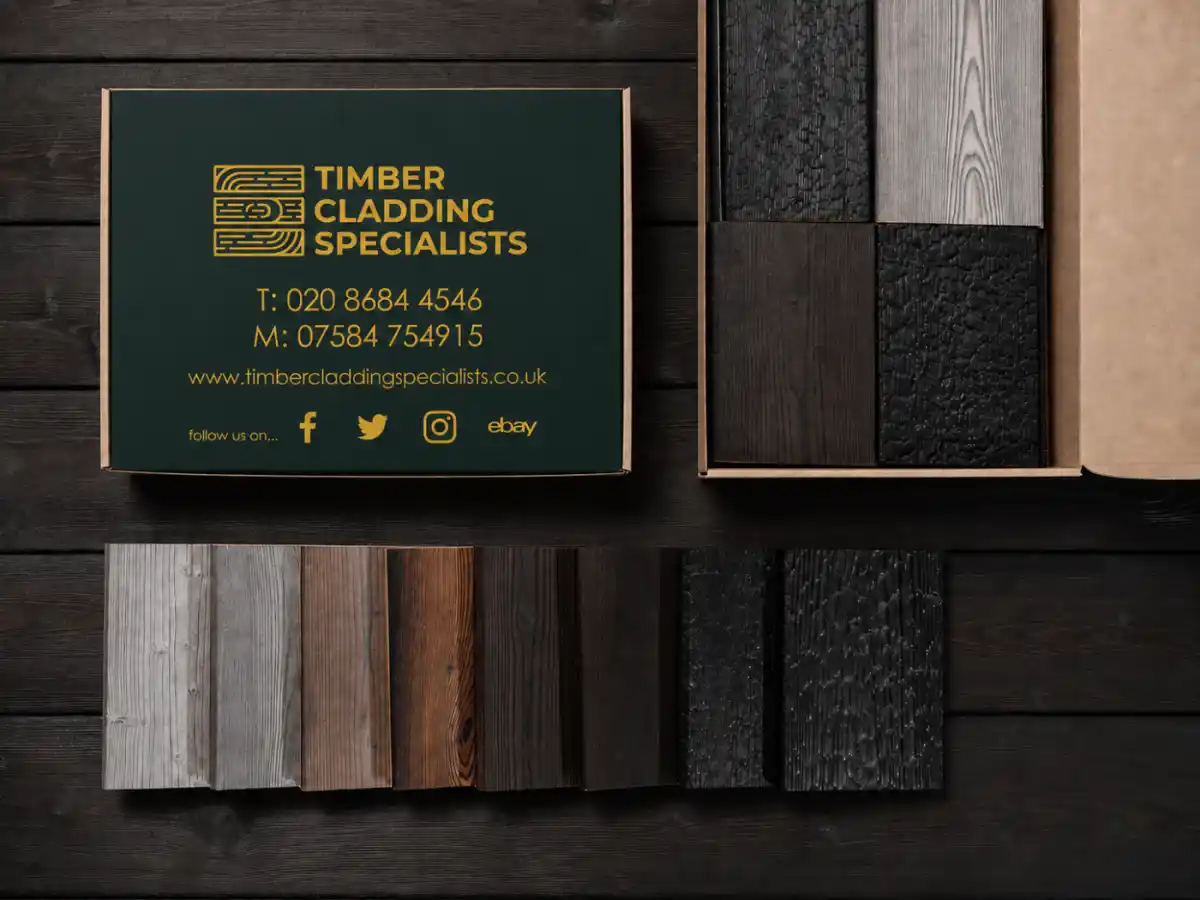
Timber Cladding Specialists sample box — free timber cladding samples posted across the UK within 1–2 working days. Every species we stock is available as a sample: Siberian larch, ThermoWood, Nordic spruce, charred SSB, and Douglas fir. Request yours today — no obligation, no cost.

Charred timber cladding samples — our Shou Sugi Ban range in different finishes and char depths. Charred cladding is one of the most difficult materials to judge from a screen — the depth of char, texture of the brushed surface, and warmth of the underlying grain all need to be seen and touched in person. Samples are free, posted within 1–2 days.
Why Timber Cladding Samples Matter — What You Cannot See on Screen
Every timber cladding buyer who has ordered without samples and then been surprised by the delivered boards will tell you the same thing: screens lie. The reasons are straightforward and apply to every species:
- Colour is never accurate on screen: Monitor brightness, colour temperature, and photography lighting all distort timber colour. Siberian larch's honey-gold looks orange on some screens and yellow on others. ThermoWood's honey-brown looks almost identical to larch on some displays. Charred SSB's deep black can look flat on screen but has extraordinary texture and depth in person. The only accurate colour reference is a physical sample held in daylight
- Grain character cannot be judged from photos: The tight, resinous grain of Siberian larch, the clean uniform grain of ThermoWood, and the coarser character of Nordic spruce all feel and look completely different at arm's length. Knot frequency, size, and character — which define so much of a cladding's visual personality — are invisible in scaled-down photography
- Profile depth only makes sense in person: A shadow gap looks like a line in a photo. In person, the shadow cast by the recessed rebate changes completely with the angle of the sun — morning, evening, overcast, direct sun all produce different depths of shadow. The profile depth of a triple shadow gap vs a single shadow gap is genuinely surprising to most buyers seeing it for the first time in person
- Charred texture must be felt: The brushed, textured surface of Shou Sugi Ban charred cladding — the char depth, the visible wood grain beneath, the warmth of the dark surface — is one of the most tactile building materials available. It cannot be conveyed in any photograph. Every buyer who has ordered charred cladding having only seen photographs reports the same thing: it is better in person
- Weathered vs fresh colour is a critical decision: Larch will silver-grey over 3–5 years. ThermoWood will silver-grey over 2–4 years. Whether you oil to maintain the fresh colour or let it weather is a whole-project decision. A weathered sample alongside a fresh sample makes this choice concrete and visual rather than abstract
Timber Cladding Samples — All Species Available UK
Treated and natural timber cladding samples — seeing the different species and finishes side by side makes the species selection decision straightforward. The colour, grain character, and surface finish of larch, ThermoWood, spruce, and charred boards are all immediately distinct when held together in natural daylight.
We supply free samples of every species and profile we stock. Here is what is available and what each sample will show you:
What to Check When Your Samples Arrive
Shadow gap cladding boards — the depth and precision of the machined rebate is one of the things that must be seen and felt in person. The shadow line the rebate casts changes significantly with the angle of light — morning sun, evening sun, and overcast conditions all produce different shadow depths. A sample tells you how bold or subtle the profile will read on your elevation.
Getting the most from your samples means checking the right things. Here is what to assess when they arrive:
Take the sample outside in natural daylight — not under artificial lighting. Hold it against the material it will sit next to on your building: brick, render, window frames, roof. Colour perception changes completely between indoor and outdoor light.
If you want to see the weathered colour — what larch or ThermoWood looks like after 3–5 years — ask us to send a weathered sample alongside a fresh one. This is the most useful comparison for deciding whether to oil or leave to weather naturally.
Hold the sample board at different angles in sunlight. The shadow cast by a shadow gap, double shadow gap, or triple shadow gap profile is the most striking thing about these profiles in person — and it changes dramatically throughout the day.
Look at the knot frequency, size, and pattern across the board face. Larch knots are small and tight. ThermoWood is clean and even. Spruce knots are larger and more frequent. The grain character defines the visual personality of the finished elevation.
Run your hand across the board face. ThermoWood and larch are smooth with minimal open grain. Spruce is slightly coarser. Charred SSB is the most tactile — the brushed char surface has a depth and texture that is completely different from any other material.
If you are undecided between shadow gap and shiplap, or single and double shadow gap, request samples of both. The difference in profile depth and board width character is much clearer side by side than from separate photographs.
Siberian Larch vs ThermoWood — What the Sample Difference Tells You
Fully weathered Siberian larch cladding — ordering a weathered larch sample alongside a fresh one shows you the full colour journey your cladding will make over 3–5 years. The silver-grey weathered end-state is what most uncoated larch installations eventually settle into — seeing it in person alongside the fresh honey-gold makes the oiling decision easy.
The most common sample request we receive is larch and ThermoWood together — and the comparison is immediately informative. In person:
- Colour: Fresh larch is honey-gold with a warm, slightly orange undertone. Fresh ThermoWood is honey-brown — slightly darker, richer, more caramel. Side by side the difference is obvious; on screen it is easy to confuse them
- Grain: Larch has a more resinous, slightly more rustic grain with visible knots and occasional resin pockets. ThermoWood is cleaner and more uniform — the modification process stabilises the grain and produces a more consistent surface across all boards
- Weight: Larch is noticeably denser and heavier than ThermoWood. Both are lighter than hardwood but the difference in hand is noticeable and gives a tangible sense of the material density
- Weathered comparison: A weathered larch sample alongside a weathered ThermoWood sample shows the difference in grey tone — larch weathers to a warm silver-grey; ThermoWood weathers to a slightly cooler, more even grey. On a multi-elevation building this consistency difference matters
See our full ThermoWood vs Siberian larch comparison guide for the complete performance and cost analysis, and our ThermoWood cladding performance guide for the full technical specification.
Charred Cladding Samples UK — Standard vs Premium Finish
Charred SSB samples generate the most consistent response of any material we send — everyone who receives one says the same thing: it is far more impressive in person than in any photograph. The two samples worth requesting together:
- Standard finish (spruce-based) — £60.39/m²: Nordic spruce substrate with deep charring and wire-brushed finish. The char is bold, the texture is pronounced, the black is deep and consistent. This is the standard charred specification for residential projects, garden rooms, and extensions. In person the brushed surface texture — raised grain lines visible beneath the char — is what makes it so distinctive
- Premium finish (larch-based) — £86.99/m²: Siberian larch substrate with the same deep charring process. The larch base gives tighter, denser grain beneath the char — the board face is more refined, the texture more precise, the surface quality noticeably higher. Hold the two samples side by side and the quality difference between spruce-base and larch-base is immediately apparent
See our full charred timber cladding guide, our black timber cladding guide, and browse our full Shou Sugi Ban range.
We have never had a customer regret ordering samples before buying. We have had customers regret not ordering them. The cost of a return and reorder — in time, logistics, and potential project delay — always exceeds the cost of posting a handful of sample boards. Every order over £500 should start with samples. It is free, it takes 1–2 days, and it removes all material selection uncertainty before you commit. Request your samples here →
Can I order free timber cladding samples UK?
Yes — samples are free of charge. Contact us with the species and profiles you want to see and we will post them within 1–2 working days. Available for all species: Siberian larch, ThermoWood, Nordic spruce, charred SSB (standard and premium), and Douglas fir. All standard profiles available — shadow gap, double shadow gap, triple shadow gap, feather edge, shiplap, log lap, rainscreen, and T&G.
How long do timber cladding samples take to arrive UK?
Typically 1–3 working days from request to arrival. We dispatch samples within 1–2 working days of receiving your request. Contact us via the website contact form or phone with the species and profiles you want to see and we will arrange dispatch the same or next working day where possible.
Can I get a weathered cladding sample UK?
Yes — ask us for a weathered sample alongside a fresh one. Seeing the silver-grey weathered colour of Siberian larch or ThermoWood alongside the fresh honey-gold or honey-brown is the most useful comparison for deciding whether to oil your cladding or leave it to weather naturally. Contact us and request both fresh and weathered samples for any species.
Which cladding samples should I order UK?
Order samples of every species you are considering, plus any profiles you are undecided between. The most useful combinations: larch and ThermoWood together (the colour and grain difference is immediately clear in person); standard and premium charred SSB together (the quality difference between spruce-base and larch-base is obvious side by side); shadow gap and double shadow gap in the same species (profile depth comparison). There is no limit to how many samples you can request.
What is the difference between timber cladding species in person?
Siberian larch: honey-gold, tight resinous grain, small knots, slightly orange undertone. ThermoWood: honey-brown, clean uniform grain, resin-free, slightly darker than larch. Nordic spruce: pale cream-white, coarser grain, larger more frequent knots. Douglas fir: warm reddish-brown, fine straight grain, distinctive warm character. Charred SSB: deep black, brushed texture, visible grain beneath the char — completely unlike any other material.
Request Your Free Timber Cladding Samples — Posted Within 1–2 Days
All species and profiles available — Siberian larch, ThermoWood, Nordic spruce, charred SSB (standard and premium), and Douglas fir. Free of charge, no obligation. Tell us which species and profiles you want to compare and we will arrange dispatch the same or next working day.