
- What it is: Larix sibirica — naturally durable softwood from Siberia. The most popular premium timber cladding species in the UK residential market.
- Durability: Class 3 — Moderately Durable. No preservative treatment required above ground. Ever.
- Service life: 20–30 years. No treatment needed to achieve this. Oiling is optional and cosmetic only.
- Cost: £35–£75/m² boards depending on profile. Installed 20m² elevation approximately £1,260–£2,600.
- Profiles: Shadow gap, double shadow gap, tongue & groove, rainscreen, feather edge, shiplap, loglap, batten — the full range from UK stock.
- Colour: Warm honey-gold when fresh. Weathers to even silver-grey over 12–24 months if untreated. Both are deliberate, beautiful finishes.
- vs ThermoWood: Larch is slightly less durable (Class 3 vs Class 2) and slightly less expensive. ThermoWood has better dimensional stability. Both are excellent zero-maintenance specifications.
Siberian larch cladding is the most widely specified premium timber cladding in the UK residential market — and has been for a decade. It combines natural Durability Class 3 performance (no preservative treatment ever required), a warm honey-gold grain that architects and homeowners consistently choose over painted or rendered alternatives, and a 20–30 year service life that requires zero mandatory maintenance. This complete buyers guide covers everything: what Siberian larch is and why it performs the way it does, every available UK profile, accurate 2026 costs, the honest weathering and maintenance picture, and a detailed comparison against ThermoWood and Nordic spruce. Whether you are specifying for a house extension, garden room, or contemporary new build, this guide gives you everything you need.

Siberian larch cladding on a UK house extension — the warm honey-gold tone and tight natural grain make larch the most popular premium cladding species in the UK residential market. Naturally Durability Class 3 — no preservative treatment required throughout its 20–30 year service life.
What Is Siberian Larch Cladding and Why Is It Naturally Durable?
Siberian larch (Larix sibirica) grows across the vast boreal forests of Russia and Siberia — one of the most extreme climates on Earth, ranging from −50°C to +35°C with deep seasonal freeze-thaw cycles and minimal rainfall compared to the UK. This environment has driven the species to develop high natural resin content, dense heartwood, and extractives in the timber that provide biological resistance to decay fungi and wood-boring insects without any chemical modification.
Under BS EN 350, Siberian larch is classified as Durability Class 3 — Moderately Durable — for above-ground exterior use. This classification means no preservative treatment is required for external wall cladding throughout its natural 20–30 year service life. The durability is intrinsic to the species — it cannot be washed out, degraded, or removed. Every larch board from our UK stock carries this performance built in from the forest.
Compared to UK-grown larch (European larch, Larix decidua), Siberian larch has consistently tighter grain rings due to its slower growth in the colder climate — typically 3–6 rings per 10mm versus 6–12 for European larch. This tighter grain translates directly to more stable boards with less surface checking and more consistent appearance across a facade.
All Siberian larch we supply is FSC and PEFC certified from sustainably managed Russian forests — certification required on a growing proportion of UK residential and commercial specifications.
Siberian Larch Shadow Gap Cladding — The Most Popular UK Profile

Siberian larch shadow gap cladding — the rebated board face creates a recessed joint that reads as a strong horizontal shadow line across the facade. The most widely specified larch cladding profile for contemporary UK residential projects.
The shadow gap profile is the defining Siberian larch cladding specification for contemporary UK homes. The board face is rebated at the lower edge — when boards are fixed in sequence, the rebate creates a recessed horizontal joint that reads as a shadow line across the facade. The dark shadow in the joint amplifies the horizontal rhythm and creates a strongly architectural appearance that works equally well in natural honey-gold, oiled, stained, or fully weathered silver-grey finishes.
We stock shadow gap Siberian larch in three dimensions — 20x146mm shadow gap for the standard residential specification, and 24x146mm double shadow gap for a bolder, deeper joint on larger facades and commercial projects. The shadow gap profile is face-fixed with A4 stainless steel screws — one screw per board per batten, countersunk flush.
All Siberian Larch Cladding Profiles — UK Stock 2026
Standard shadow gap — horizontal rebated joint profile. The most specified larch cladding profile for contemporary UK residential projects. Works horizontally and vertically.
Deeper double rebate — more prominent shadow line on larger facades. Thicker 24mm board adds structural rigidity. Best for commercial projects and large residential elevations.
Interlocking tongue and groove with V-chamfer at each joint. Traditional profile suitable for exterior and interior lining. The most versatile larch profile — works on all building types.
Open-joint battens on a ventilated support system. Maximum shadow depth between boards. The most architectural larch profile for contemporary facades, commercial buildings, and high-specification residential projects.
Tapered overlapping board — the classic agricultural cladding profile. Authentic vernacular character for barn conversions, rural projects, and garden buildings. Particularly effective weathered silver-grey.
Planed all round batten for board-on-board and vertical batten cladding systems. Bold vertical rhythm — popular on barn conversions and contemporary extensions where a strong vertical line is the design intent.
Convex face that mimics log construction. Distinctive rounded texture — popular for cabin-style garden rooms, glamping structures, and rural buildings where a handcrafted character is the intent.
Traditional overlapping shiplap profile — the premium alternative to Nordic spruce shiplap for garden buildings and outbuildings where natural durability and lower maintenance matter more than board cost.
Siberian Larch Rainscreen Cladding — Open Joint Systems

Siberian larch rainscreen cladding — open-joint battens on a ventilated support system. The gaps between boards allow air movement behind the facade, keeping boards dry between rain events and producing deep shadow between each batten for a bold architectural effect.
Rainscreen cladding differs from all other larch profiles in one fundamental way: the boards are open-jointed, with visible gaps between each batten rather than a rebated or overlapping joint. This creates a dramatically different visual effect — deep shadow between narrow boards across the full facade — and provides superior ventilation behind the cladding than closed-joint systems.
The ventilation advantage of open-joint rainscreen is significant for larch durability. Boards that dry quickly between rain events spend less time above the 20% moisture content threshold where biological decay can establish. Well-detailed rainscreen larch on a correctly designed support system consistently performs at the top end of the 20–30 year service life range. We stock larch rainscreen in 20x68mm, 20x90mm, and 20x140mm widths. For secret fix rainscreen, the 25x95mm extra secret fixing profile uses the Tiga hidden fastener system for no visible fixings on the board face.
Siberian Larch Grain, Colour and Weathering — What to Expect
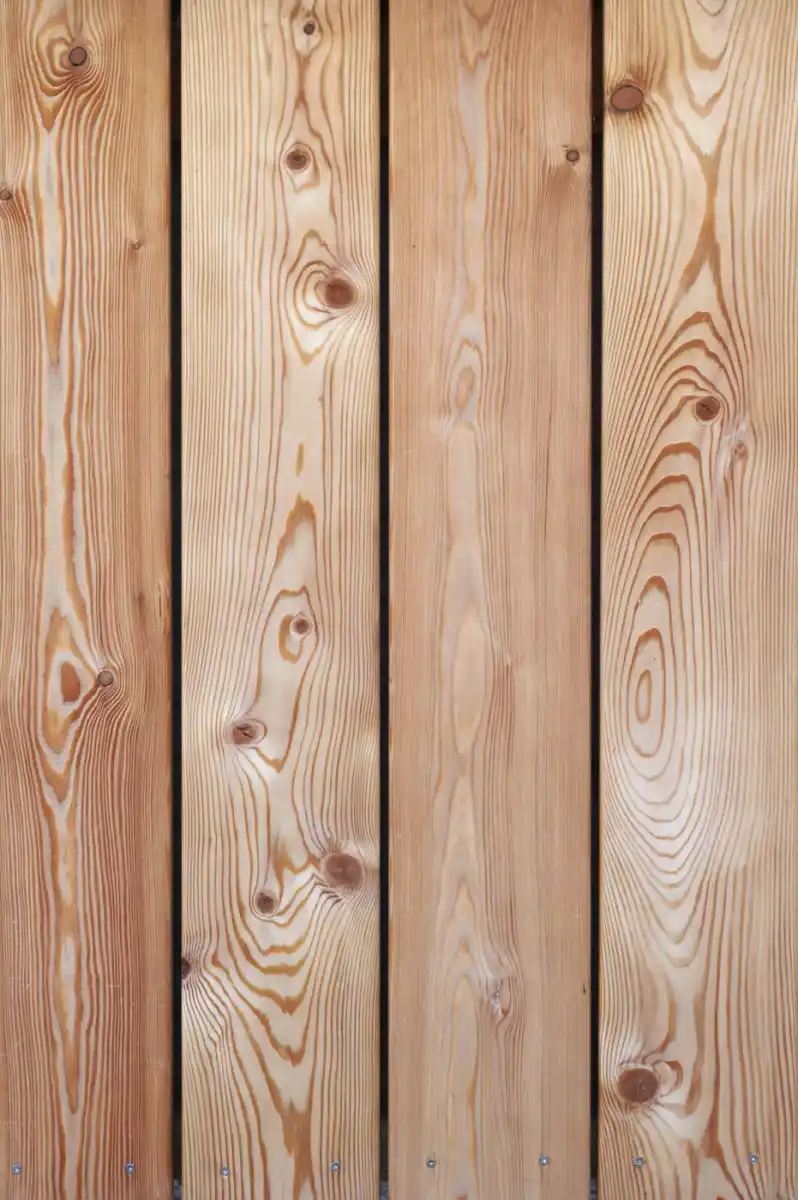
Siberian larch close-up — the tight, resinous grain and warm honey-gold colour that has made larch the dominant premium cladding choice in the UK residential market. The natural resin in the grain is visible as subtle darker streaking that adds character and variation across a completed facade.
Fresh larch — honey-gold tone
New Siberian larch boards have a warm honey-gold to light amber colour — richer and warmer than Nordic spruce (pale cream) but lighter and more golden than ThermoWood (warm honey-brown). The natural resin content gives the grain a slightly lustrous quality in direct light. There is moderate natural colour variation between boards — more than ThermoWood (which is very consistent) but less than many hardwood species. This variation reads as character rather than inconsistency across a completed facade and distinguishes natural larch immediately from factory-finished alternatives.
Weathered larch — silver-grey
UV radiation gradually degrades surface lignin, transitioning the colour from honey-gold to silver-grey over 12–24 months on a south-facing UK elevation. The process is entirely normal, cosmetic only, and does not indicate deterioration. The weathered silver-grey of mature larch is one of the most widely loved exterior timber finishes in UK architecture — even, attractive, and completely self-maintaining once established.
Oiling to maintain colour
To maintain the warm honey-gold colour, apply Koopmans Houtolie UV oil every 2–3 years. Clean the surface before oiling, apply along the grain with a brush, allow to penetrate. Two thin coats always outperform one thick coat. This is a purely cosmetic choice — the structural service life is identical whether larch is oiled or left to weather. See our Siberian larch cladding maintenance guide for the complete maintenance schedule.
Fully Weathered Siberian Larch — 5+ Years On

Fully weathered Siberian larch cladding — the stable silver-grey patina of aged larch is a deliberate design choice as much as a natural process. Once established, the colour is self-maintaining, requires no intervention, and the structural performance of the timber is completely unaffected.
A fully weathered Siberian larch facade that has been left untreated for 5 or more years has reached a stable equilibrium — the silver-grey colour is as consistent and even as it will ever be. The surface lignin has fully degraded and the colour change will not progress further. The structural Class 3 durability of the heartwood beneath the surface layer is completely unaffected by the surface colour change.
For architects and homeowners who specify larch with the weathered grey finish as the design intent — increasingly common on contemporary UK projects — the correct approach is to oil the facade once at installation (to even the initial colour across all boards) and then leave it entirely. Within 18–24 months the facade will have settled into a consistent silver-grey that requires no further intervention for the remaining 20+ years of the cladding's service life.
Siberian Larch Cladding Cost UK 2026 — All Profiles
| Profile | Dimensions | Boards/m² | + Battens & fixings | + Labour | Installed/m² |
|---|---|---|---|---|---|
| Shadow gap | 20×146mm | £48–£62 | £8–£15 | £20–£40 | £76–£117 |
| Double shadow gap | 24×146mm | £55–£72 | £8–£15 | £20–£40 | £83–£127 |
| T&G V-joint | 20×146mm | £38–£55 | £8–£15 | £20–£40 | £66–£110 |
| Rainscreen | 20×90mm | £35–£52 | £10–£18 | £22–£42 | £67–£112 |
| Feather edge | 26×146mm | £40–£55 | £8–£15 | £20–£40 | £68–£110 |
| Batten (board-on-board) | 20×90mm | £36–£48 | £8–£15 | £20–£40 | £64–£103 |
| Shiplap | 20×146mm | £38–£50 | £8–£15 | £20–£40 | £66–£105 |
All installed costs include treated softwood counter battens and horizontal battens, breather membrane, A4 stainless steel fixings, and professional installation. Excludes VAT (20% on residential labour), scaffolding, window reveals, and groundworks. London and South East add 25–35% to labour costs. For the full UK cladding cost comparison see our Siberian larch cladding cost guide.
Siberian Larch vs ThermoWood vs Nordic Spruce
| Siberian Larch | ThermoWood | Nordic Spruce | |
|---|---|---|---|
| Durability class | Class 3 — Mod. Durable | Class 2 — Durable | Class 4 — Sl. Durable |
| Service life | 20–30 years | 25–40 years | 15–25 years (maintained) |
| Treatment needed | None | None | Yes — every 2–4 yrs |
| Dimensional stability | Good | Excellent — lowest movement | Moderate |
| Colour | Warm honey-gold — rich natural character | Honey-brown — consistent tone | Pale cream — neutral |
| Charred base timber | Excellent | Not typically charred | Excellent |
| Board cost/m² | £35–£75 | £45–£90 | £18–£45 |
| Whole-life cost/m² | £35–£75 | £45–£90 | £70–£150 inc. maintenance |
| Best for | Natural grain character, residential, garden rooms | Maximum longevity, contemporary, zero maintenance | Budget projects, garden buildings, charred base |
Choose Siberian larch when the warm natural grain character of timber is important to the design intent, when charred or stained finishes are being considered, or when the slightly lower cost is a factor. Choose ThermoWood when maximum longevity (25–40 years), best dimensional stability, or the factory-consistent honey-brown tone are priorities. Both are zero-maintenance specifications that will outlast any softwood cladding alternative. For the full head-to-head see our ThermoWood vs Siberian larch cladding comparison.
Installing Siberian Larch Cladding — Key Requirements
- Ventilated batten system: All larch cladding must be installed on a counter batten and horizontal batten system providing minimum 25mm clear ventilated cavity behind boards. Never fix larch direct to masonry or sheathing — boards need air circulation on the hidden face to dry quickly after rain
- Breather membrane: Vapour-permeable breather membrane behind the batten system on all wall types — allows moisture vapour to escape while preventing wind-driven rain penetration at the wall construction level
- A4 stainless fixings only: A4 stainless steel screws throughout. Larch tannins corrode standard steel and galvanised fixings, causing rust staining on the honey-gold or silver-grey face. One screw per board per batten, countersunk flush
- End grain sealing: Apply exterior oil to all board ends before installation — end grain is the primary moisture entry point in any timber
- 150mm ground clearance minimum: Bottom of cladding boards at least 150mm above finished ground level to prevent ground-splash moisture accumulation
- Back prime where possible: Applying a coat of oil to the hidden board face before installation protects the surface that cannot be maintained after fixing. Particularly important on south and west-facing elevations
The Tiga facade hidden fixing system is compatible with our Siberian larch rainscreen 25x95mm extra secret fix profile — the only larch profile offering a completely clean face with no visible fixings. If hidden fixings are a design requirement for a larch project, this is the specification to use. Note: Tiga is a rainscreen system only — the shadow gap and T&G profiles are face-fixed.
What is Siberian larch cladding?
Larix sibirica — naturally Durability Class 3, no treatment required, 20–30 year service life. The most popular premium timber cladding in the UK. Available in shadow gap, double shadow gap, tongue and groove, rainscreen, feather edge, shiplap, loglap and batten profiles from UK stock.
Does Siberian larch cladding need treating?
No — naturally Durability Class 3, no preservative treatment ever required above ground. Oiling every 2–3 years is optional and purely for colour maintenance. Structural service life is identical whether oiled or left to weather naturally to silver-grey.
How long does Siberian larch cladding last in the UK?
20–30 years on a well-detailed ventilated facade. No treatment needed. Oiling maintains colour but does not extend service life. Correct installation — ventilated battens, A4 stainless fixings, 150mm ground clearance — is the primary factor determining where in the 20–30 year range performance falls.
How much does Siberian larch cladding cost in the UK?
£35–£75/m² boards in 2026 depending on profile. Rainscreen and batten at the lower end, double shadow gap at the higher end. Total installed 20m² elevation approximately £1,260–£2,600 including battens, fixings, membrane and professional installation.
Is Siberian larch better than ThermoWood for cladding?
Neither is universally better — both are excellent zero-maintenance specifications. ThermoWood is more durable (Class 2 vs Class 3), lasts longer (25–40 yrs vs 20–30 yrs), and has better dimensional stability. Siberian larch has richer natural grain character, is slightly less expensive, and is the better choice for charred or stained finishes. Both require no preservative treatment.
Why is my Siberian larch cladding going grey?
Normal UV photochemical weathering — entirely cosmetic, zero effect on durability or service life. Takes 12–24 months on a south-facing UK elevation. The silver-grey is stable and self-maintaining once established. To slow it: oil every 2–3 years. To embrace it: do nothing — structural performance is identical.
Siberian Larch Cladding — All Profiles from UK Stock
We supply Siberian larch cladding in shadow gap, double shadow gap, tongue and groove, rainscreen, feather edge, shiplap, loglap and batten profiles from UK stock. FSC and PEFC certified. Tell us your elevation dimensions for a precise board quantity and full material list. Nationwide delivery 7–14 days.