
- What it is: Pseudotsuga menziesii — a naturally durable North American softwood with a bold orange-red grain, harder and stronger than most softwood cladding species.
- Durability: Class 3 — Moderately Durable. No preservative treatment required above ground. Same classification as Siberian larch.
- Service life: 20–30 years. No treatment needed. Optional oiling every 2–3 years for colour.
- Colour: Warm orange-red when fresh. Weathers to distinctive driftwood grey-brown — warmer and more complex than larch silver-grey.
- Cost: £42–£70/m² boards depending on profile. Comparable to Siberian larch.
- Best for: Projects where the bold, distinctive orange-red grain and warm weathered driftwood tone are part of the design intent. Contemporary and rural projects alike.
- vs Siberian larch: Both Class 3, similar service life. Douglas fir is harder, bolder in colour, more distinctive in grain. Larch is more widely available in more profiles.
Douglas fir cladding is the less talked-about naturally durable softwood — overshadowed in the UK market by Siberian larch in terms of volume but frequently preferred by architects and specifiers who want a more distinctive, bolder grain character and a different weathering profile. Pseudotsuga menziesii grows in the forests of the Pacific Northwest of North America and British Columbia, producing some of the straightest, most structurally consistent softwood timber available. Its bold orange-red heartwood colour, pronounced grain pattern, and natural Durability Class 3 make it a compelling cladding choice for projects where the timber's own character is as important as its performance credentials.
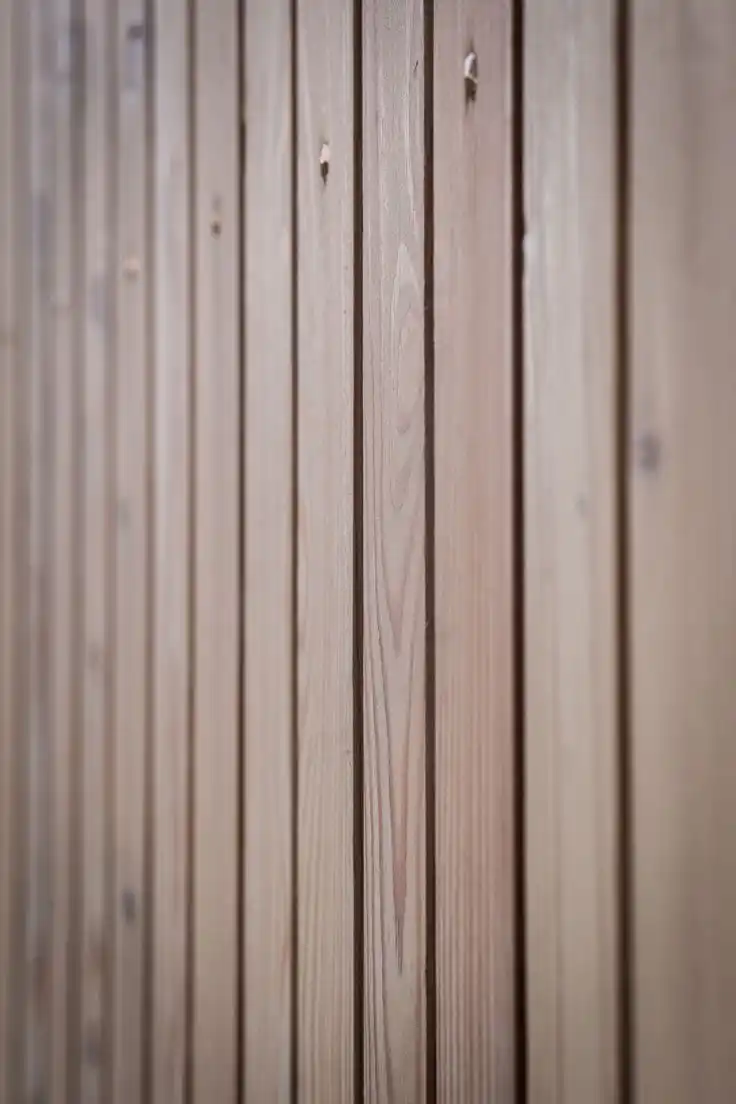
Douglas fir external cladding — the bold, warm orange-red grain of fresh Douglas fir is immediately distinctive against the paler honey tones of larch and the neutral cream of Nordic spruce. Naturally Durability Class 3 — no preservative treatment required throughout its 20–30 year service life.
What Makes Douglas Fir Cladding Different
Douglas fir stands apart from the other naturally durable cladding species in two specific ways — its hardness and its colour. Both are a direct result of the species' origin and growth conditions.
Douglas fir grown in the old-growth and managed forests of the Pacific Northwest produces timber with growth ring densities significantly higher than any European softwood cladding species. This density translates directly to hardness — Douglas fir is considerably harder than Siberian larch, which is itself harder than Nordic spruce. For exterior cladding this means better resistance to surface denting and wear, particularly important on ground-floor elevations and any cladding exposed to frequent physical contact.
The colour is equally distinctive. Fresh Douglas fir heartwood has a warm, saturated orange-red tone — deeper and more complex than larch's honey-gold, and completely different from the pale cream of Nordic spruce. This initial colour weathers over time to a warm driftwood grey-brown that retains more warmth and complexity than the cooler silver-grey of weathered larch or the neutral grey of ThermoWood. For architects who want a naturally occurring colour journey in the cladding rather than a fixed tone, Douglas fir's weathering profile is one of the most characterful available.
Douglas Fir Vertical Shadow Gap — The Most Specified UK Profile
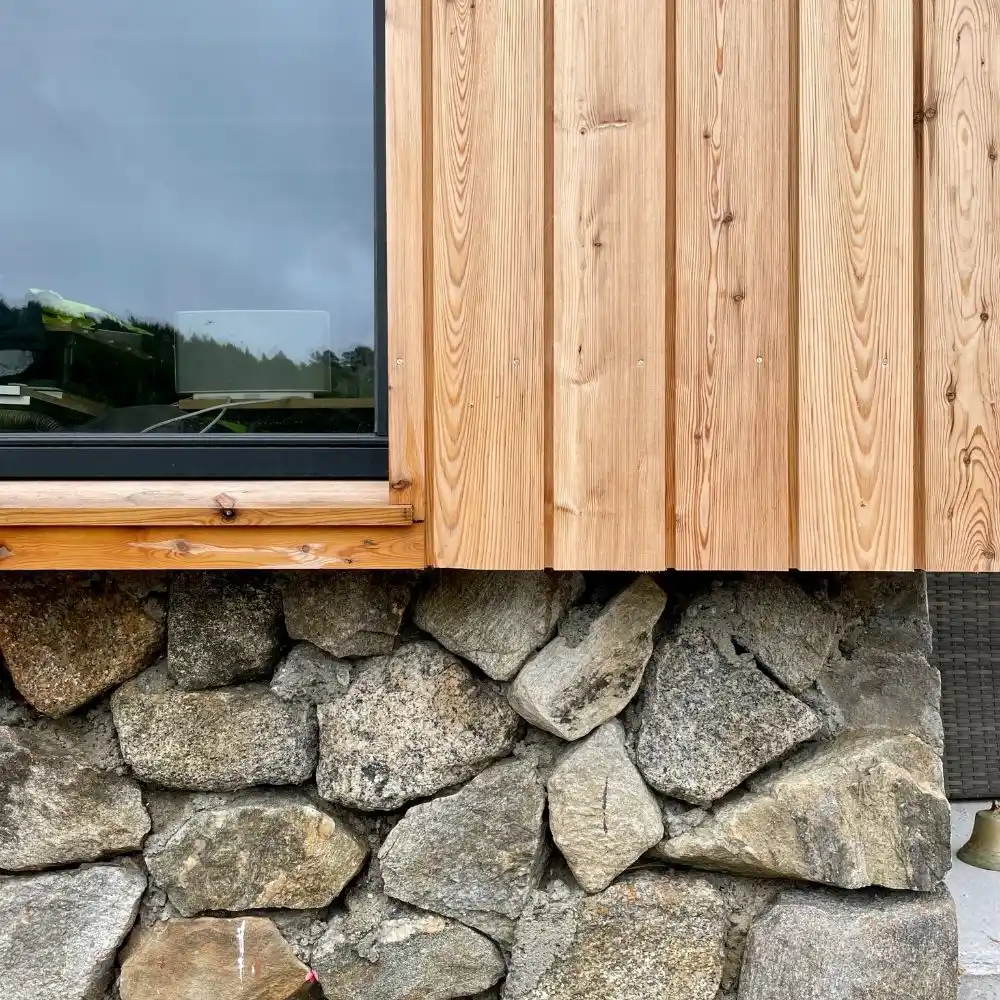
Douglas fir vertical shadow gap cladding — the bold grain of Douglas fir reads particularly strongly on vertical installations where the pronounced straight grain runs continuously from base to eave. The warm orange-red tone creates a dramatically different visual effect from larch or ThermoWood in the same profile.
Vertical shadow gap is the most widely specified Douglas fir cladding profile for contemporary UK residential architecture — the long straight grain of the species runs uninterrupted from base to eave in a vertical installation, making the pronounced grain pattern the most visible and impactful it can be. The shadow gap joint creates a clean recessed vertical line between each board, amplifying the height of the elevation and creating a strong upward visual rhythm.
Douglas fir's hardness and excellent dimensional stability make it particularly well suited to tall vertical board runs — less prone to bowing and twisting over time than softer softwood species in long vertical applications. The combination of clean vertical lines, bold grain, and natural durability makes vertical shadow gap Douglas fir one of the most distinctive cladding specifications available in the UK market. See our full vertical vs horizontal cladding guide for the full orientation comparison.
How Douglas Fir Weathers — The Driftwood Grey Journey
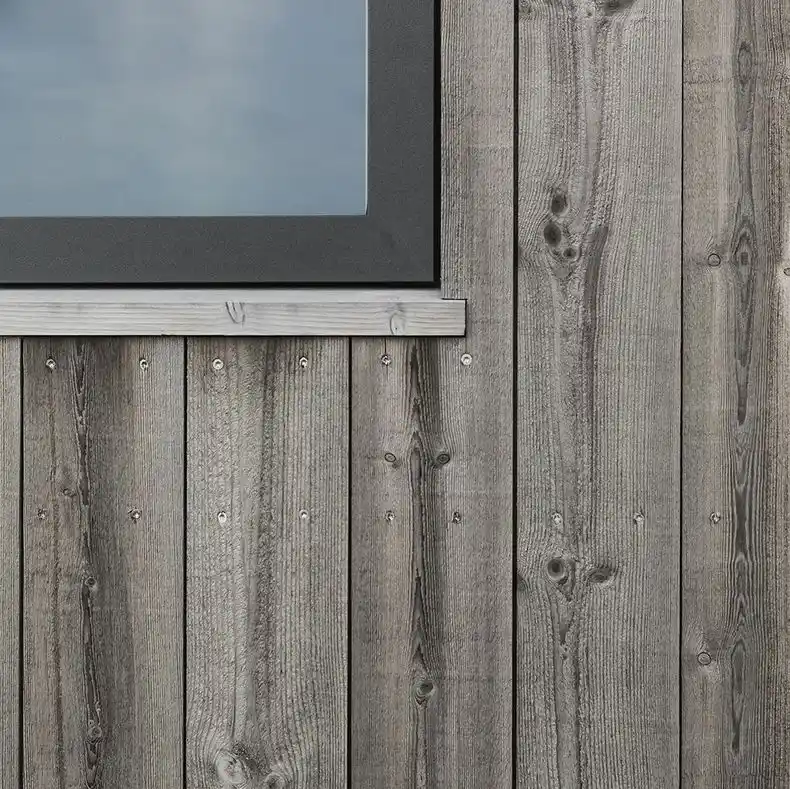
Weathered Douglas fir cladding — the warm driftwood grey-brown that Douglas fir develops over 24–36 months of untreated weathering. Unlike the cooler silver-grey of weathered larch, Douglas fir retains a warm, complex undertone in its weathered state that reads as rich and characterful rather than simply grey.
Douglas fir's weathering profile is one of the most distinctive of any UK cladding species. Left untreated, the initial orange-red transitions through a series of warm amber and honey tones before settling into a driftwood grey-brown over 24–36 months on a south-facing UK elevation. The weathered colour retains noticeably more warmth than the silver-grey of weathered Siberian larch — the result of the species' higher resin content, which continues to influence the surface colour even as the initial orange-red fades.
For architects and homeowners who specify Douglas fir with the weathered tone as the design intent, this warm grey-brown is genuinely different from any other commonly available cladding species — warmer than larch grey, richer than ThermoWood grey, and with a driftwood quality that references coastal and maritime timber in a way that reads naturally in rural, coastal, and contemporary contexts. See our grey timber cladding guide for the full weathering comparison across species.
Douglas Fir Cladding With Exterior Oil — Maintaining the Orange-Red
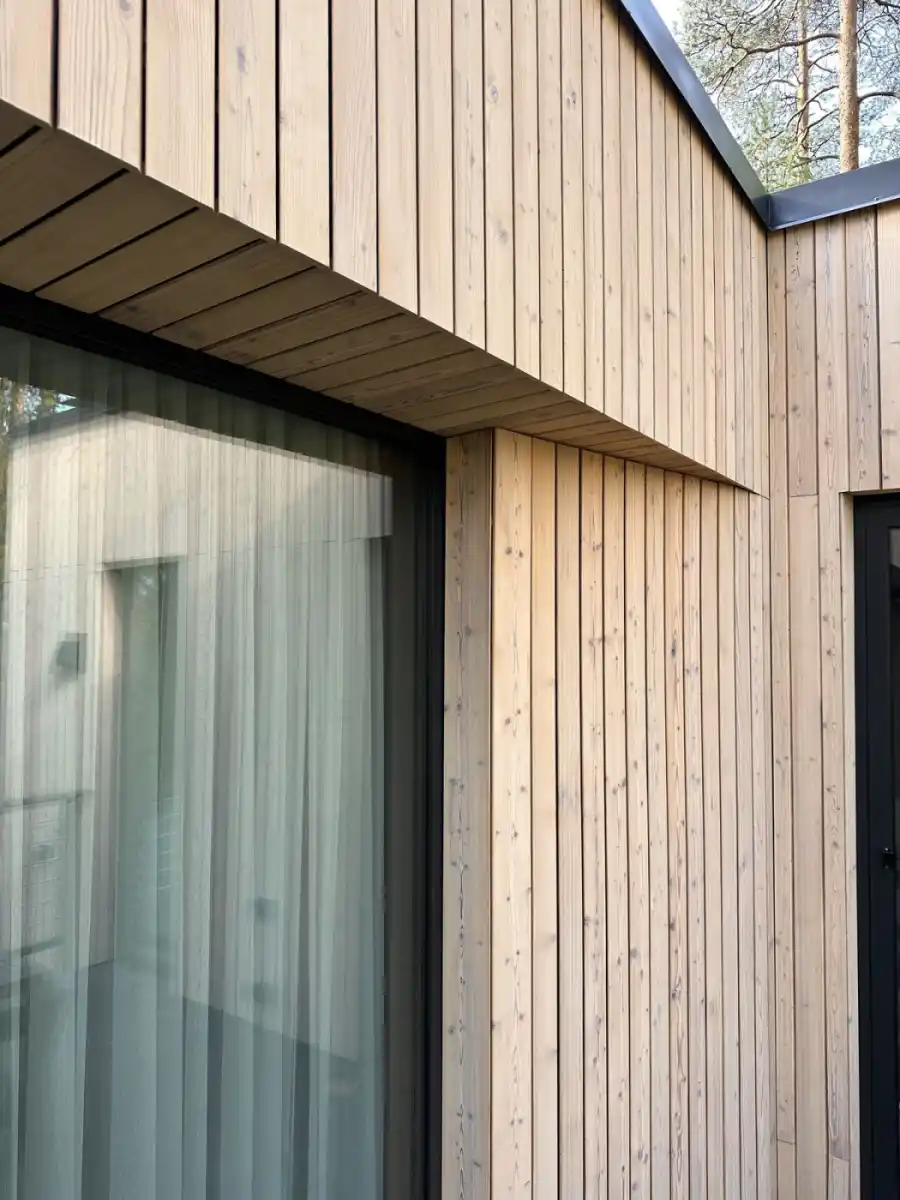
Douglas fir cladding with exterior oil applied — UV-stable penetrating oil maintains the warm orange-red tone and prevents the greying process, bringing out the full depth and complexity of the grain. On a well-detailed facade, two coats of exterior oil at installation then every 2–3 years maintains this appearance indefinitely.
To maintain the distinctive orange-red colour of Douglas fir, apply a UV-stable penetrating exterior oil every 2–3 years. Koopmans Houtolie in a clear or lightly pigmented natural tone works particularly well on Douglas fir — the oil penetrates the dense grain evenly and brings out the full depth and complexity of the orange-red heartwood pattern. The oil does not need to provide any structural protection — Douglas fir's Class 3 durability handles that without any surface treatment — it simply maintains the colour that would otherwise weather to grey-brown over time.
At installation: apply one coat to the hidden back face of all boards before fixing, and two coats to the visible face and edges after installation. Ongoing: clean the surface thoroughly before each re-application, and apply two thin coats for better penetration than one thick coat. For the full maintenance programme see our how to oil timber cladding guide.
Douglas Fir vs Siberian Larch vs ThermoWood — Which to Choose
| Douglas Fir | Siberian Larch | ThermoWood | |
|---|---|---|---|
| Durability class | Class 3 | Class 3 | Class 2 |
| Service life | 20–30 years | 20–30 years | 25–40 years |
| Treatment needed | None | None | None |
| Hardness | High — harder than larch | Moderate | Moderate |
| Initial colour | Bold orange-red — most distinctive | Warm honey-gold | Honey brown |
| Weathered colour | Warm driftwood grey-brown | Cool silver-grey | Neutral slate grey |
| Profile range | Good — shadow gap, rainscreen, T&G, feather edge | Wide — 8 profile types | Wide — 8 profile types |
| Board cost/m² | £42–£70 | £35–£75 | £45–£90 |
| Best for | Bold distinctive grain, warm weathering, vertical installations | Natural character, widest profile choice, most popular species | Maximum longevity, zero maintenance, contemporary |
Choose Douglas fir when the grain character and colour matter as much as the performance. The bold orange-red initial tone and warm driftwood weathering of Douglas fir are genuinely distinctive and not replicated by any other commonly available cladding species. If the brief calls for a timber facade that is immediately recognisable as something specific — not generically "natural timber" — Douglas fir delivers that character. For the full comparison see our Douglas fir vs larch cladding comparison.
Douglas Fir Cladding Profiles and Costs UK 2026
| Profile | Boards/m² | + Battens & fixings | + Labour | Installed/m² |
|---|---|---|---|---|
| Shadow gap / vertical shadow gap | £48–£65 | £8–£15 | £20–£40 | £76–£120 |
| Tongue & groove V-joint | £42–£58 | £8–£15 | £20–£40 | £70–£113 |
| Rainscreen / open joint | £45–£62 | £10–£18 | £22–£42 | £77–£122 |
| Feather edge | £42–£58 | £8–£15 | £20–£40 | £70–£113 |
All installed costs include treated softwood counter and support battens, breather membrane, A4 stainless fixings, and professional installation. Excludes VAT on labour, scaffolding, and groundworks. For a full species cost comparison see our Douglas fir cladding cost guide and UK timber cladding cost guide 2026.
Installing Douglas Fir Cladding — Key Requirements
- Ventilated batten system: Counter battens (25x38mm min) vertically, then horizontal support battens (25x50mm min) at 600mm centres maximum. Douglas fir's hardness and density mean it tolerates slightly wider batten spacing than softwood species without board deflection — but 600mm maximum remains the correct specification
- A4 stainless fixings only: A4 stainless steel screws throughout. Douglas fir's higher tannin content accelerates corrosion of standard steel or galvanised fixings even faster than larch — visible rust staining on orange-red timber is particularly conspicuous. Pre-drill all fixings to prevent the dense timber splitting under direct fixing
- Pre-drilling is important: Douglas fir is denser than most softwood cladding species — always pre-drill fixings to prevent splitting, not just at board ends but at every fixing point
- Back prime before installation: Apply one coat of exterior oil to the hidden back face and edges of every board before fixing. The visible face can be oiled after installation. This is essential for long-term board performance rather than optional
- 150mm ground clearance: Bottom of cladding at least 150mm above finished ground level — essential for all exterior cladding regardless of species durability
- No pre-treatment required: Do not apply preservative treatment before installation — Douglas fir's Class 3 durability is intrinsic and preservative treatment is not needed and not recommended for above-ground exterior use
Is Douglas fir good for exterior cladding UK?
Yes — naturally Durability Class 3, no treatment required, 20–30 year service life. Harder and more dimensionally stable than most softwood cladding species. Distinctive warm orange-red colour weathering to driftwood grey-brown. Particularly good for vertical installations and projects where bold grain character is part of the design intent.
Does Douglas fir cladding need treating?
No — naturally Durability Class 3, no preservative treatment required above ground throughout its 20–30 year service life. Oiling every 2–3 years is optional and purely for colour maintenance to slow the weathering from orange-red to driftwood grey-brown. Structural performance is identical whether oiled or left to weather.
How long does Douglas fir cladding last?
20–30 years on a well-detailed ventilated facade. No treatment needed. Oiling maintains colour but does not extend service life. Correct installation — ventilated battens, A4 stainless fixings, pre-drilled, 150mm ground clearance — determines where in the 20–30 year range performance falls.
How does Douglas fir cladding compare to Siberian larch?
Both Class 3, similar 20–30 year service life, no treatment required. Douglas fir is harder and has a more distinctive bold orange-red initial colour weathering to warm driftwood grey-brown. Larch has honey-gold initial colour weathering to silver-grey and a wider profile range. Choose Douglas fir for distinctive grain character and warm weathering; choose larch for wider profile availability and a more widely recognised natural timber look.
Douglas Fir Cladding — UK Stock, FSC Certified
We supply Douglas fir cladding in shadow gap, tongue and groove, rainscreen, and feather edge profiles from UK stock. FSC and PEFC certified. Tell us your elevation dimensions and preferred profile for a precise board quantity and material list. Nationwide delivery 7–14 days.