- What it is: Scots pine thermally modified at 185–215°C — transforms Class 4 pine into Durability Class 2 cladding requiring zero maintenance.
- Thermo-D vs Thermo-S: Always specify Thermo-D (215°C) for exterior cladding — Class 2, 25–40 years. Thermo-S (185°C) is Class 3 and better suited to interior/sheltered use.
- vs Siberian larch: ThermoWood pine is Class 2 vs larch Class 3 — longer service life, zero maintenance, more stable. Larch is naturally durable without modification and typically less expensive.
- Best profiles: Shadow gap, double shadow gap, shiplap, tongue and groove — all available in ThermoWood pine.
- Weathering: Weathers to an even, consistent silver-grey — more uniform than Siberian larch on large elevations.
- Cost: £40–60/m² supply only. Premium over larch but justified by longer service life and zero maintenance.
- Best for: Healthcare, social housing, schools, apartments — any project where zero maintenance over 25–40 years is a specification requirement.
ThermoWood pine cladding is the premium zero-maintenance timber cladding specification for UK buildings — a thermally modified Scots pine that has been permanently transformed from a Class 4 softwood requiring regular treatment into a Durability Class 2 exterior cladding material that performs reliably for 25–40 years with zero maintenance. This guide covers everything you need to know about ThermoWood pine cladding in the UK in 2026 — what it is, how it is made, the difference between Thermo-D and Thermo-S, which profiles are available, how it weathers, how it compares to Siberian larch, and what it costs.
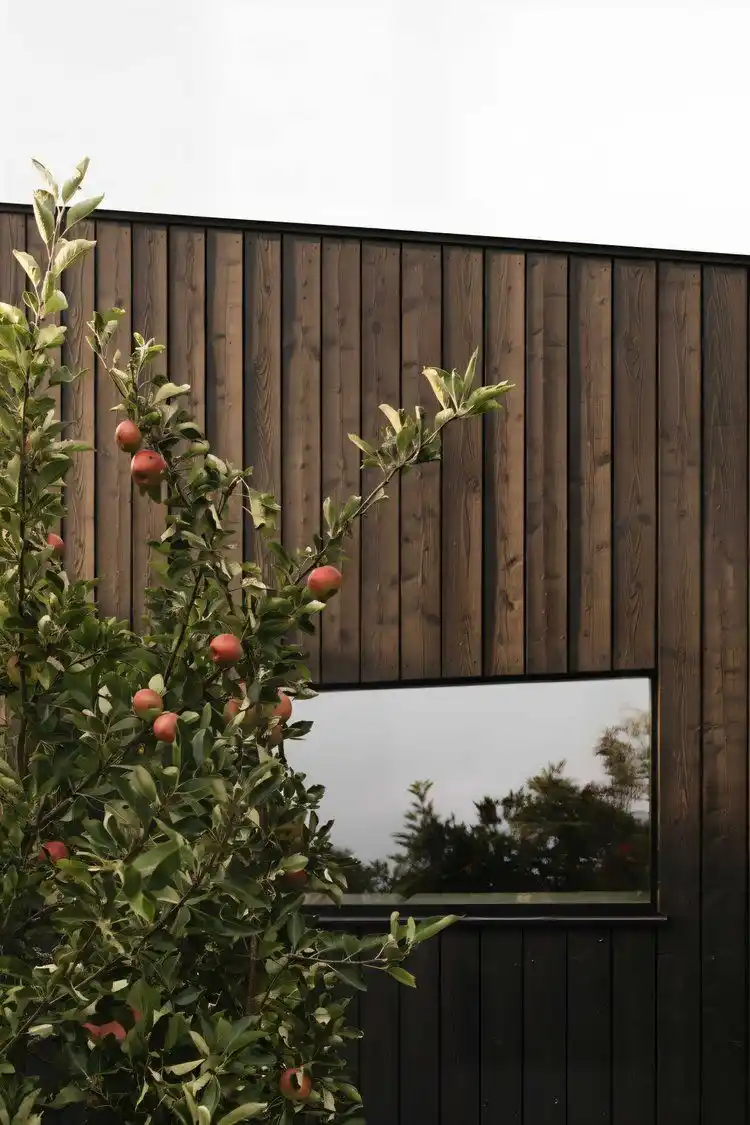
ThermoWood pine cladding on a contemporary house — thermally modified Scots pine provides Durability Class 2 performance with zero maintenance over a 25–40 year service life. The darker honey-brown colour of fresh ThermoWood pine weathers to a consistent silver-grey over time — more evenly than untreated Siberian larch on large multi-elevation facades.
What Is ThermoWood Pine Cladding?
ThermoWood pine cladding starts as Scots pine (Pinus sylvestris) — one of the most abundant softwood species in northern Europe, classified as Durability Class 4 (slightly durable) in its untreated state and requiring preservative treatment every 2–4 years for exterior use. Through the ThermoWood thermal modification process, this Class 4 softwood is permanently transformed into a Durability Class 2 cladding material — without any chemical preservatives, just heat and steam.
The modification process heats the pine to 185–215°C in a controlled steam atmosphere over several hours. This high-temperature treatment permanently changes the wood's cell structure — breaking down the hemicelluloses that bacteria and fungi feed on, reducing the wood's equilibrium moisture content from around 18% to 4–6%, and darkening the timber from its pale cream-yellow to a rich honey-brown. The result is a timber that is:
- Durability Class 2 — durable for above-ground exterior use without any preservative treatment
- Dimensionally stable — 4–6% equilibrium moisture content vs 12–18% for untreated pine, meaning significantly less shrinkage, swelling, and warping in response to moisture changes
- Zero maintenance — no preservative treatment, painting, or staining required throughout its service life
- FSC and PEFC certified — all TCS ThermoWood pine is chain of custody certified for planning and BREEAM compliance
- No chemical preservatives — the modification is purely thermal. ThermoWood pine contains no biocides or chemical additives
Thermo-D vs Thermo-S Pine — Which to Specify for Cladding UK
- Treatment temperature: 215°C
- Durability Class: 2 (Durable)
- Service life: 25–40 years above ground
- Maintenance: Zero
- Equilibrium MC: 4–5%
- Colour: Rich dark honey-brown
- Best for: All exterior cladding applications
- Specify this for UK exterior cladding
- Treatment temperature: 185°C
- Durability Class: 3 (Moderately Durable)
- Service life: 20–30 years
- Maintenance: None required (Class 3)
- Equilibrium MC: 5–6%
- Colour: Lighter honey-brown
- Best for: Interior, sheltered exterior, sauna
- Not the optimal exterior cladding spec
For exterior timber cladding in the UK, always specify Thermo-D — the higher treatment temperature achieves Durability Class 2, which is the correct specification for above-ground exterior use without maintenance. Thermo-S achieves Class 3 — the same class as Siberian larch — but at a higher cost than larch without the same durability advantage. The only reason to specify Thermo-S over Thermo-D is for interior applications (sauna linings, interior wall cladding) where the lower treatment temperature preserves slightly more of the wood's strength. See our full Thermo-D vs Thermo-S guide and our Siberian larch buyers guide for the full comparison.
ThermoWood Pine vs Siberian Larch — Which Is Better for UK Cladding?

ThermoWood pine shadow gap cladding on a contemporary building — the shadow gap profile is the most widely specified profile for ThermoWood pine on contemporary new builds, extensions, and commercial projects. The clean horizontal joint suits all building types from garden rooms to social housing new build.
| Property | ThermoWood Pine (Thermo-D) | Siberian Larch | Winner |
|---|---|---|---|
| Durability class | Class 2 — Durable | Class 3 — Moderately Durable | ThermoWood |
| Above-ground service life | 25–40 years | 20–30 years | ThermoWood |
| Maintenance required | Zero | None required | Equal |
| Dimensional stability | Excellent (MC 4–6%) | Good (MC 12–15%) | ThermoWood |
| Weathering consistency | Very consistent grey | Good — some variation | ThermoWood |
| Natural vs modified | Thermally modified | Naturally durable | Larch |
| Cost (supply only) | £40–60/m² | £25–40/m² | Larch |
| FSC/PEFC certified | Yes | Yes | Equal |
| EuroClass B available | Yes | Yes | Equal |
| Best application | Healthcare, social housing, schools, apartments | Most residential and commercial projects | — |
The summary: ThermoWood pine (Thermo-D) outperforms Siberian larch on durability class, service life, dimensional stability, and weathering consistency — but costs more and is a modified rather than naturally durable species. For projects where maximum service life and zero maintenance are absolute requirements — healthcare, social housing, apartments with management companies — ThermoWood pine is the correct specification. For most residential new builds, extensions, and garden rooms where budget is a consideration and natural unmodified timber is preferred, Siberian larch remains the standard recommendation. See our full ThermoWood vs larch comparison for the detailed analysis.
ThermoWood Pine Cladding Profiles UK
The dominant ThermoWood pine profile for contemporary buildings. Clean horizontal shadow line, suits all building types. Available in 20x146mm. Browse ThermoWood shadow gap.
Wider, deeper shadow line — more visual impact on large facades. Increasingly specified on social housing and commercial new build where a stronger horizontal rhythm is the design intent.
Overlapping boards with machined rebate. Suits rural and traditional building contexts. Available in ThermoWood pine for projects where the traditional shiplap profile is required with zero maintenance performance.
Interlocking flush boards — primarily used for interior wall cladding, sauna linings, and sheltered exterior applications. Available in ThermoWood pine in multiple widths. Browse ThermoWood range.
Open-joint concealed fix for high-specification commercial and residential projects. ThermoWood pine's dimensional stability makes it particularly suited to rainscreen — lower moisture movement means more consistent joint widths over time.
Rounded profile — characteristic log cabin appearance. Widely used on garden rooms, garden offices, and leisure buildings where the rounded profile adds character. See our loglap guide.
How ThermoWood Pine Cladding Weathers UK
ThermoWood pine cladding weathered to silver-grey on a residential building — one of the key advantages of ThermoWood over Siberian larch is the consistency of the weathered grey. On large elevations with multiple aspects, ThermoWood's lower moisture content means all elevations weather to a similar grey tone, avoiding the patchiness that can occur with larch during the 2–5 year weathering transition period.
ThermoWood pine weathers from its initial rich honey-brown to a consistent silver-grey over 2–5 years — and it does so more evenly than Siberian larch. The reason is ThermoWood's lower equilibrium moisture content (4–6% vs 12–15% for larch): because the boards take up and release less moisture in response to rain and humidity, the weathering process is driven more consistently by UV exposure than by the moisture cycling that produces patchy weathering on larch during the transition period.
On large facades with multiple elevations — particularly social housing blocks, apartment buildings, and commercial projects — this weathering consistency is a significant specification advantage. ThermoWood's grey is even and dignified across all elevations from year 3–4 onwards, while larch on a complex building can show significant colour variation between north and south-facing elevations for 5–8 years.
If consistent grey from day one is required, factory-applied grey stain is available on ThermoWood pine — applied in controlled conditions before delivery. See our ThermoWood cladding maintenance guide for the full weathering and treatment picture.
Where ThermoWood Pine Cladding Is Specified UK
ThermoWood pine (Thermo-D) is the preferred specification in any context where zero maintenance is a non-negotiable requirement:
- Social housing and affordable housing: Housing association landlords cannot commit to 2–4 year treatment programmes on large cladding elevations. ThermoWood pine removes the obligation entirely — see our social housing cladding guide and ThermoWood pine maintenance guide
- Healthcare buildings: Maintenance access on operational clinical sites is disruptive and expensive. ThermoWood's 25–40 year zero-maintenance specification is the correct choice for NHS and private healthcare new build. See our healthcare cladding guide
- Education buildings: School and university estates teams need facades that perform without a treatment programme. ThermoWood pine is increasingly specified on education new build. See our schools cladding guide
- Apartments and blocks: Where a management company is responsible for exterior maintenance, removing the treatment obligation saves costs and avoids the disputes that arise when maintenance programmes lapse
- Garden rooms and garden offices: For homeowners who want a premium garden room that requires no maintenance whatever — ThermoWood pine cladding in a garden room or garden office is the correct specification over Nordic spruce or even Siberian larch
- Holiday lets: Rural holiday let buildings need facades that look good year after year without owner intervention. ThermoWood pine's consistent weathering and zero maintenance make it ideal for holiday let properties
ThermoWood Pine Cladding Cost UK — 2026 Prices
ThermoWood pine — the distinctive rich honey-brown colour of thermally modified pine boards. The darker colour compared to untreated pine is a direct result of the thermal modification process — it is a permanent change to the wood's cell structure, not a surface treatment or stain.
| ThermoWood Pine Profile | Supply only (m²) | Supply & install (m²) | vs Siberian larch |
|---|---|---|---|
| Shadow Gap 20x145mm | £40–55/m² | £70–100/m² | +£10–15/m² vs larch |
| Double Shadow Gap | £42–58/m² | £72–105/m² | +£10–15/m² vs larch |
| Shiplap | £38–52/m² | £68–95/m² | +£10–15/m² vs larch |
| Rainscreen | £45–62/m² | £80–115/m² | +£10–15/m² vs larch |
The premium over Siberian larch (typically £10–15/m²) is justified over the building's lifetime by the 5–10 year additional service life and the complete elimination of any preservative treatment costs — which on a 100m² elevation requiring scaffolding access typically costs £500–1,500 per treatment visit every 4 years for treated softwood. See our full ThermoWood pine cladding cost UK guide and timber cladding cost per m² guide for detailed pricing and whole-life cost analysis.
What is ThermoWood pine cladding?
Scots pine thermally modified at 185–215°C in a steam process — permanently transforms Class 4 pine into Durability Class 2 (Thermo-D) cladding requiring zero maintenance over 25–40 years. No chemical preservatives — purely heat and steam modification. Available in shadow gap, shiplap, tongue and groove, rainscreen, and other profiles.
What is the difference between Thermo-D and Thermo-S pine?
Thermo-D (215°C) achieves Class 2 durability — the correct specification for exterior cladding. Thermo-S (185°C) achieves Class 3 — better suited to interior use or sheltered applications. Always specify Thermo-D for UK exterior cladding.
Is ThermoWood pine better than Siberian larch for cladding UK?
ThermoWood pine (Thermo-D) is Class 2 vs larch Class 3 — longer service life, more stable, more consistent weathering. Larch is naturally durable without modification and less expensive. For zero-maintenance critical projects (healthcare, social housing, apartments), ThermoWood is the better spec. For most residential projects where budget matters, larch is the standard recommendation.
How much does ThermoWood pine cladding cost UK?
£40–60/m² supply only for shadow gap or shiplap profiles. Supply and install £70–115/m² depending on profile and access. Typically £10–15/m² premium over Siberian larch — justified by the longer service life and elimination of any maintenance costs over the building's lifetime.
Does ThermoWood pine cladding need treating UK?
No — ThermoWood Thermo-D requires zero treatment throughout its 25–40 year service life. The thermal modification process permanently changes the wood's cell structure, eliminating the need for preservative treatment. It can be oiled or stained for aesthetic reasons (to maintain the fresh honey-brown colour or achieve a specific grey stain) but this is entirely optional and has no structural benefit.
ThermoWood Pine Cladding — Supply UK Wide, 7–14 Days
We supply ThermoWood Thermo-D pine cladding in shadow gap, double shadow gap, shiplap, rainscreen, and tongue and groove profiles across the UK. FSC and PEFC certified. EuroClass B fire treatment available. 7–14 day delivery. Contact us for a quote or free samples.