
- Both are premium modified timber products with zero maintenance requirements, excellent durability, and dimensional stability — the modification process is the key difference.
- ThermoWood: Thermal modification — heat and steam, no chemicals. Durability Class 2. BRE endorsed 30-year service life. £55–£95 per m². Available from UK stock in 7–14 days across full profile range.
- Accoya: Acetylation — chemical modification. Durability Class 1. 50-year above-ground warranty. £90–£160 per m². More limited UK profile availability and longer lead times.
- For most UK exterior cladding: ThermoWood is the stronger practical choice — comparable durability for above-ground use, significantly lower cost, and consistent UK stock availability.
- Accoya has a genuine advantage in ground-contact and high-moisture applications where its Class 1 durability matters — window joinery, ground-level applications, and in-ground use.
- We stock ThermoWood — not Accoya. This guide is written honestly from a position of knowing ThermoWood well.
ThermoWood and Accoya are the two most specified premium modified timber products for UK exterior cladding — and the two that architects most frequently compare when specifying a zero-maintenance natural timber exterior. Both outperform standard softwood and naturally durable hardwoods on durability and maintenance requirements. But they achieve this through very different modification processes, at different price points, with different availability profiles in the UK. This guide compares them honestly across every dimension that matters for UK cladding projects — so you can make the right choice for your project without supplier bias obscuring the facts.
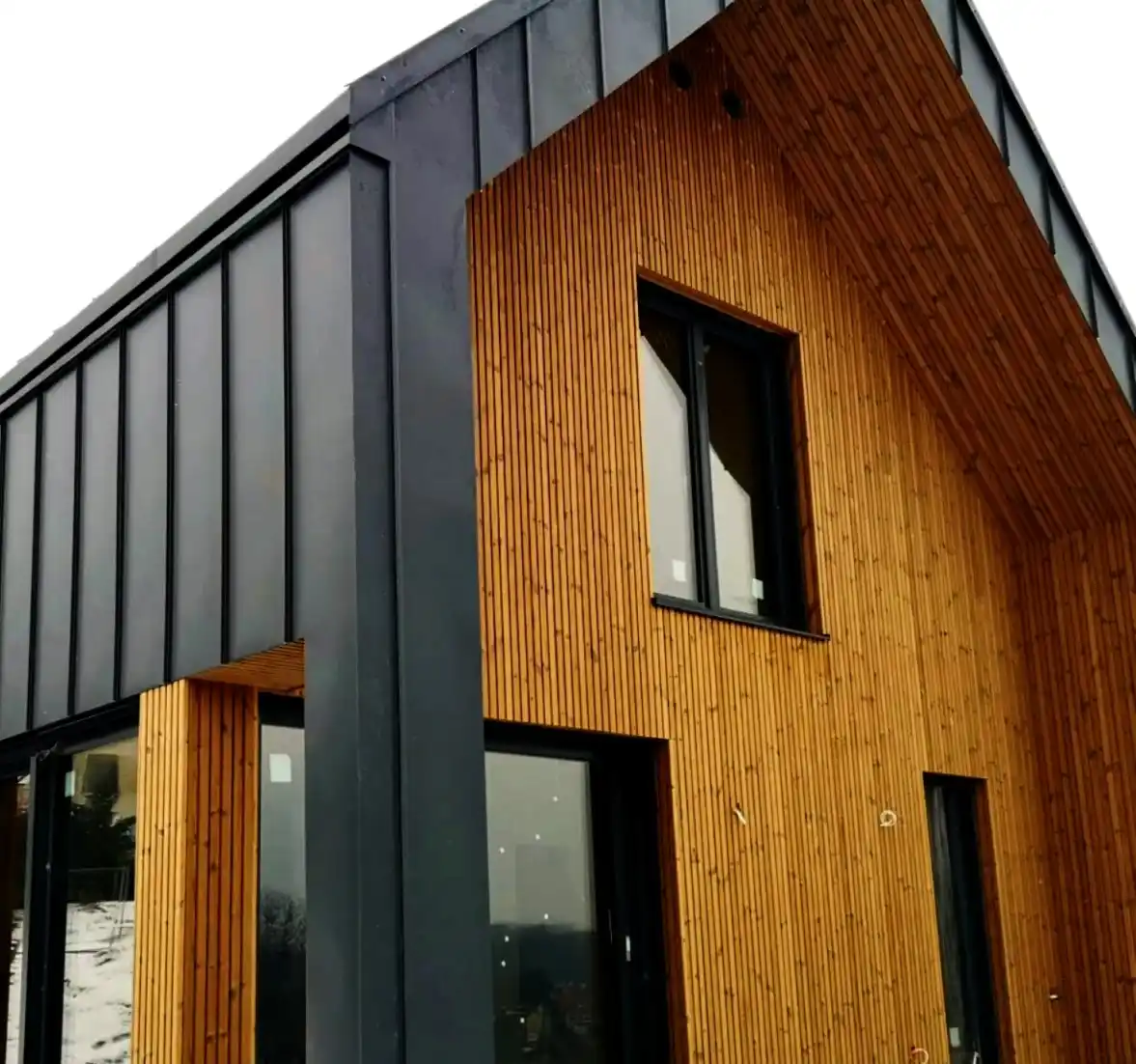
ThermoWood double shadow gap cladding — thermally modified pine achieving Durability Class 2 with zero maintenance requirement. Available from UK stock with 7–14 day delivery across the full profile range.
What Are ThermoWood and Accoya?
ThermoWood — Thermal Modification
ThermoWood is timber — typically Scots pine (Pinus sylvestris) or Norway spruce (Picea abies) — that has been heat-treated at 190–212°C in a controlled steam atmosphere, without any chemical additives. The high temperature permanently alters the cellular structure of the wood: breaking down hemicellulose (the primary food source for decay fungi), reducing equilibrium moisture content from approximately 12% to 4–6%, and improving dimensional stability by approximately 60% versus untreated softwood. The result is a Durability Class 2 timber with a BRE endorsed 30-year service life for above-ground exterior applications. ThermoWood is a registered trademark of the International ThermoWood Association (ITWA) — products produced outside this framework are thermally modified timber but cannot use the name.
We supply Lunawood ThermoWood — browse the full range including shadow gap, triple shadow gap, and rainscreen profiles — produced by Lunawood Oy, the world's largest thermally modified timber manufacturer, certified to the SFS 5765 ThermoWood standard. For full technical data see our ThermoWood technical guide and our ThermoWood performance and lifespan guide.
Accoya — Acetylation
Accoya is radiata pine (Pinus radiata) that has been acetylated — a chemical modification process in which acetic anhydride reacts with the hydroxyl groups in the wood's cell walls, replacing them with acetyl groups. This reaction is permanent and fundamentally alters the wood's relationship with moisture — acetylated wood no longer absorbs water in the same way as untreated timber. The result is Durability Class 1 (Very Durable), exceptional dimensional stability (claimed to be better than ThermoWood), and a 50-year above-ground service life warranty from Accsys Technologies. Accoya is produced exclusively by Accsys Technologies and their licensed manufacturers.
We supply ThermoWood — not Accoya. This comparison is written as honestly as we can manage given that bias, drawing on published technical data from both manufacturers. Where ThermoWood has a genuine advantage we say so. Where Accoya has a genuine advantage we say that too. We have no interest in recommending the wrong product to a customer who then has a bad project outcome.
Head-to-Head Comparison
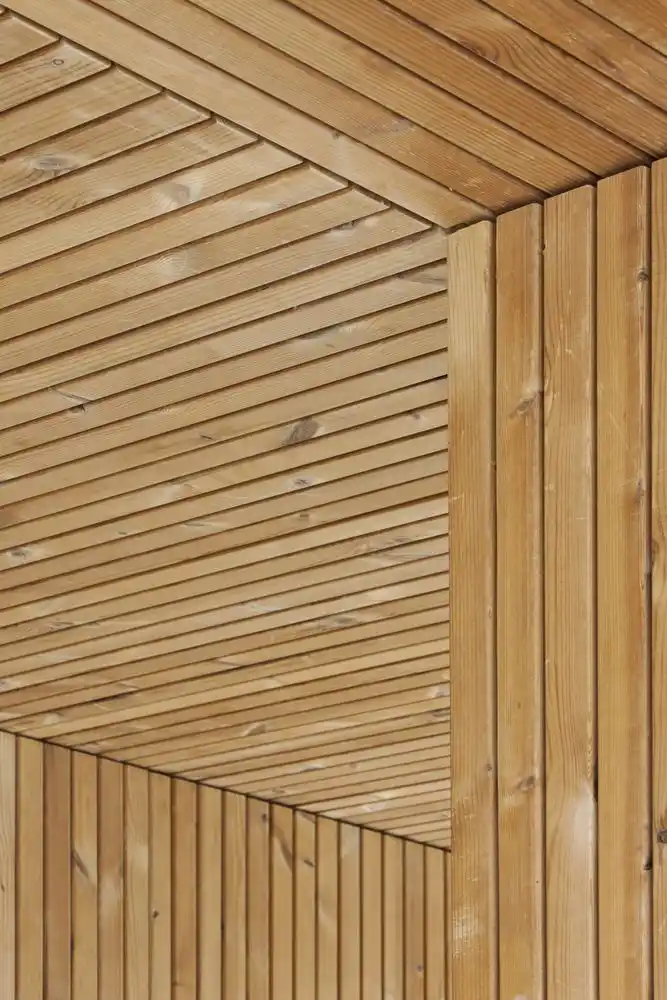
ThermoWood Pine close-up — the thermal modification process gives ThermoWood its characteristic rich honey-brown colour and fine, consistent surface texture. The colour is inherent to the modification process and is not a stain or coating.
| Property | ThermoWood (Thermo-D) | Accoya | Verdict |
|---|---|---|---|
| Modification process | Thermal — heat and steam, no chemicals | Chemical — acetylation with acetic anhydride | Different approaches |
| Durability class (BS EN 350) | Class 2 — Durable | Class 1 — Very Durable | Accoya |
| Service life — above ground | 30 yrs (BRE endorsed) | 50 yrs (Accsys warranty) | Accoya |
| Equilibrium moisture content | 4–6% | ~3–5% | Draw — both exceptional |
| Dimensional stability | Excellent — ~60% better than softwood | Exceptional — claimed superior to ThermoWood | Accoya (marginally) |
| Material cost per m² | £55–£95 | £90–£160 | ThermoWood |
| UK stock availability | Consistent — full profile range, 7–14 days | More limited — longer lead times | ThermoWood |
| Profile range (UK) | Full — shadow gap, shiplap, rainscreen, T&G, feather edge | More limited — primarily standard profiles | ThermoWood |
| Maintenance required | None — ever | None — ever | Draw |
| Chemical treatment | None — purely thermal process | Chemical modification (acetic anhydride) | ThermoWood (for chemical-free preference) |
| Colour | Rich honey-brown — weathers to silver-grey | Light straw-cream — weathers to silver-grey | Preference |
| FSC / PEFC certified | Yes — both | FSC available | ThermoWood |
Where Accoya Has the Genuine Advantage
This is an honest comparison — and Accoya does have genuine technical advantages in specific applications. Where it earns its premium:
- Ground-contact and high-moisture applications: Accoya's Class 1 durability makes it genuinely suitable for in-ground and ground-contact use — fence posts, door sill sections, garden features in wet soil. ThermoWood is rated for above-ground use only — its Class 2 durability is insufficient for in-ground applications
- Window and door joinery: Accoya's exceptional dimensional stability — claimed to be the most stable timber available — makes it the strongest specification for window frames and door frames where movement tolerance is extremely tight. ThermoWood is excellent but Accoya's edge in this application is real
- Very long planning horizons: If the building is genuinely intended to stand for 50+ years and the cladding is not expected to be replaced, Accoya's warranty is more appropriate than ThermoWood's 30-year BRE endorsement
- High-value projects where cost is secondary: On high-budget commercial or residential projects where the best possible performance is the brief regardless of cost, Accoya's technical superiority in durability class justifies the premium
Where ThermoWood Is the Stronger Choice
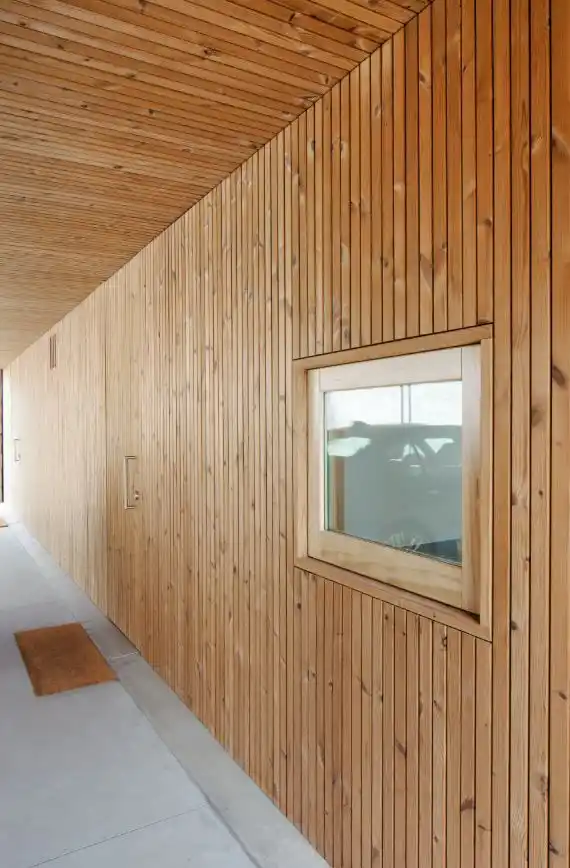
ThermoWood triple shadow gap — the most architectural profile in the range. Available from UK stock, this profile is difficult to source in Accoya at comparable lead times and price.
For the vast majority of UK exterior cladding applications — residential extensions, new builds, garden rooms, commercial facades — ThermoWood is the more practical and better-value choice:
- Cost: At £55–£95 per m² versus Accoya's £90–£160 per m², ThermoWood is 40–80% cheaper for equivalent profiles. See our ThermoWood cost guide for a full price breakdown by profile. On a 100m² commercial facade, that difference is approximately £3,500–£6,500 in materials alone
- 30-year service life is sufficient for most UK buildings: Most residential buildings undergo significant modification within 30–50 years. Accoya's 50-year warranty rarely translates into a meaningful practical advantage for typical UK extensions and houses
- Profile availability: ThermoWood is available from UK stock across the full range of contemporary profiles — shadow gap, triple shadow gap, shiplap, rainscreen. Accoya's UK profile range is more limited
- Chemical-free process: ThermoWood uses no chemicals — purely heat and steam. For clients who prefer a modification process that involves no chemical additives, ThermoWood is the correct specification
- UK stock and lead times: ThermoWood from Lunawood is available from UK stock with 7–14 day delivery. Programme certainty on UK construction projects is often more valuable than marginal performance differences between two excellent materials
Which Should You Choose?
- Above-ground exterior cladding is the application
- 30-year service life is sufficient
- Cost is a consideration
- UK stock availability matters to programme
- Contemporary profiles — shadow gap, rainscreen — are required
- Chemical-free modification process is preferred
- FSC/PEFC certification is required
- Sauna interior — ThermoWood is better suited
- Ground-contact or in-ground application
- Window or door joinery (maximum stability)
- 50-year service life warranty is specifically required
- Budget is secondary to absolute performance
- High-value commercial project, performance-driven brief
- Specification requires Class 1 durability specifically
For UK exterior wall cladding — the application this comparison is primarily about — ThermoWood is the better practical choice for most projects. It is significantly cheaper, consistently available from UK stock across the full profile range, carries a 30-year BRE endorsed service life that is more than adequate for typical UK building planning horizons, and requires zero maintenance — see our timber cladding lifespan guide for the full species comparison. Accoya is a genuinely superior product in specific applications — particularly ground-contact, window joinery, and very long service life requirements — but for standard above-ground exterior cladding, its 40–80% premium over ThermoWood is difficult to justify on performance grounds alone. Contact our team to discuss your specific project — we will give you the honest specification recommendation, not the one that maximises our margin.
Is ThermoWood better than Accoya for cladding?
For most UK above-ground exterior cladding, ThermoWood is the more practical choice — significantly cheaper, widely available from UK stock, and with a 30-year BRE endorsed service life that is adequate for most projects. Accoya has a technical edge on durability class and service life warranty, but at a 40–80% cost premium that is difficult to justify for standard cladding applications.
How much does Accoya cost compared to ThermoWood?
Accoya typically costs £90–£160 per m² for materials versus ThermoWood at £55–£95 per m² — a premium of approximately 40–80%. Both require zero maintenance, so the whole-life cost premium for Accoya is the same as the upfront premium.
What is the difference between ThermoWood and Accoya?
ThermoWood uses thermal modification — heat and steam, no chemicals — achieving Durability Class 2 and a 30-year BRE endorsed service life. Accoya uses acetylation — a chemical process — achieving Durability Class 1 and a 50-year above-ground warranty. Both require zero maintenance. ThermoWood is significantly cheaper and more widely available in the UK.
Is Accoya cladding available in the UK?
Accoya is available in the UK but with more limited stock and profile range than ThermoWood. Lead times for specific profiles can be longer. ThermoWood from Lunawood is available from UK stock with 7–14 day delivery across the full profile range — shadow gap, shiplap, rainscreen, triple shadow gap, feather edge, and tongue and groove.
How long does Accoya last compared to ThermoWood?
Accoya carries a 50-year above-ground service life warranty. ThermoWood carries a 30-year BRE endorsed expected service life. For most UK buildings with a 25–50 year planning horizon before modification or replacement, the extra longevity of Accoya rarely translates into a meaningful practical advantage for standard exterior wall cladding.
ThermoWood Cladding — UK Stock, Full Profile Range
We supply Lunawood ThermoWood Pine Thermo-D in shadow gap, triple shadow gap, shiplap, feather edge, rainscreen, and tongue and groove from UK stock. FSC and PEFC certified. Full technical data sheet and NBS product data available. Nationwide delivery in 7–14 days.