Rot requires two conditions: moisture content above 20% sustained over time, and a timber species without natural or modified resistance to biological decay. A correctly specified rainscreen system with a durable species eliminates both conditions. The cause of rot in timber cladding is almost always a specification or installation error — not an inherent failure of timber as a cladding material.
Does timber cladding rot? It is one of the most common concerns buyers have — and the answer is more nuanced than a simple yes or no. Yes, timber can rot. But correctly specified exterior timber cladding, using a naturally durable or thermally modified species installed in a correctly detailed rainscreen system, does not rot in UK conditions. This complete guide explains exactly what causes rot in timber cladding, which species are genuinely rot resistant, which are not, what the warning signs look like, and — most importantly — how to eliminate rot risk entirely through correct specification.
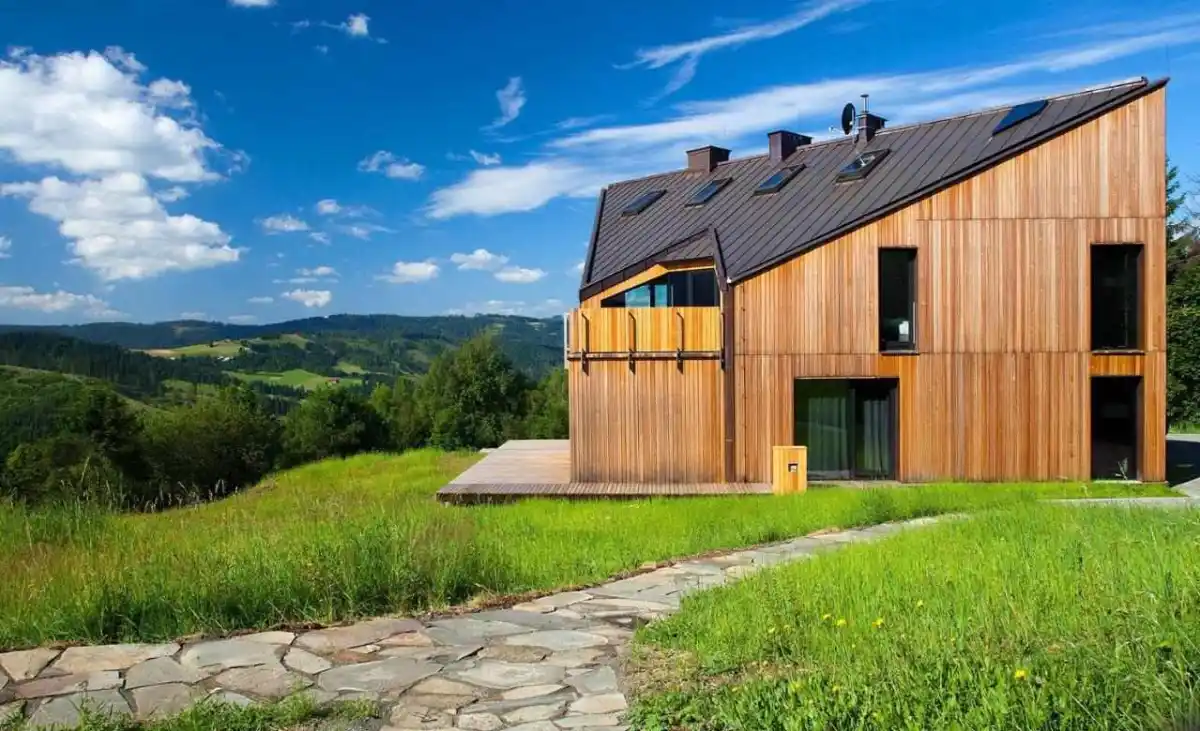
Siberian larch exterior cladding — Class 3 naturally durable, no preservative treatment needed above ground. Larch's natural resins and oils make it inhospitable to the fungi responsible for biological decay. Correctly installed with a ventilated rainscreen cavity and 150mm ground clearance, Siberian larch does not rot in UK conditions throughout its 20–30 year service life.
What Causes Timber Cladding to Rot UK?
Rot in timber is caused by fungi — specifically Basidiomycetes (brown rot and white rot) and Ascomycetes (soft rot). These fungi colonise timber when moisture content exceeds approximately 20% for a sustained period. Below 20% moisture content, the fungi cannot thrive and rot does not occur. This single fact is the foundation of every rot prevention strategy for exterior timber cladding.
In a correctly specified rainscreen system, timber boards get wet in rain and dry out between showers — their average moisture content stays well below 20%. Rot occurs when this cycle breaks down:
No ventilated cavity — boards fixed directly to the wall trap moisture between board and wall indefinitely. Missing or blocked base detail — water pools at the bottom of the cladding and wicks upward. Insufficient ground clearance — boards touching or near ground level absorb moisture continuously. Unsealed end grain — end grain absorbs moisture at ten times the rate of face grain and holds it. Non-durable species without treatment — spruce and standard pine decay within 5–10 years without consistent preservative treatment. Galvanised fixings corroding — rust bleeds into timber, creating entry points for moisture and biological decay.
Ventilated cavity (min 25mm) — water drains downward, air circulates and dries residual moisture. Open base detail with insect mesh — ventilation in, drainage out. 150mm minimum ground clearance — boards stay dry at the base. End grain sealed on installation — eliminates the primary moisture entry point. Naturally durable species (larch, ThermoWood) — resists decay even when wet. A4 stainless fixings — no corrosion, no entry points for moisture.
Timber does not rot because it gets wet. Timber rots because it cannot dry out. A correctly installed rainscreen system ensures that any moisture that enters the cladding system can always drain and evaporate. When that is true, even a moderately durable species will outlast its expected service life. When it is not true, even a highly durable species will eventually fail.
Does Larch Cladding Rot UK?

Naturally weathered cladding versus treated cladding side by side — the weathered boards have greyed naturally without any treatment while maintaining full structural integrity. The key distinction is between aesthetic change (greying — harmless) and structural degradation (rot — caused by trapped moisture, not by weathering). Greying is not rot. A grey board that is structurally sound is performing correctly.
Siberian larch does not rot above ground in UK conditions without preservative treatment. It is Class 3 naturally durable (BS EN 350) — its heartwood contains natural extractives and resins that are toxic to the fungi responsible for biological decay. Above ground, in a correctly installed rainscreen system, Siberian larch will last 20–30 years without any preservative treatment.
The important distinction with larch is heartwood versus sapwood. The natural durability is in the heartwood — the dense, resinous core of the tree. Sapwood (the pale outer ring) has no natural durability and will decay without treatment. A well-specified larch cladding board will be predominantly heartwood. Always confirm heartwood content with your supplier when specifying larch for demanding applications. See our Siberian larch buyers guide for the full specification.
Does ThermoWood Rot UK?
ThermoWood cladding weathered to silver-grey after years of UK weather — no rot, no treatment, no maintenance. The thermal modification process upgrades biological durability to Class 2 and reduces moisture absorption by up to 50%, making ThermoWood the most rot-resistant standard cladding timber available in the UK. See our full ThermoWood performance guide.
ThermoWood does not rot above ground in UK conditions. The thermal modification process (185–215°C) permanently alters the timber's cellular structure in two ways that eliminate rot risk:
- Breaks down hemicellulose: Hemicellulose is the primary food source for the fungi responsible for biological decay. When it is eliminated by thermal modification, the timber becomes inhospitable to these fungi — biological decay cannot progress even when the timber is wet
- Reduces moisture absorption by up to 50%: Less moisture uptake means the timber spends less time above the 20% moisture content threshold where rot fungi can thrive — even in the UK's wet climate
The result is Class 2 biological durability — the same classification as Western red cedar — with zero treatment required above ground throughout its 25–40 year service life. ThermoWood is the definitive rot-proof exterior cladding specification for UK buildings.
Does Spruce Cladding Rot UK?
Nordic spruce cladding weathered to grey — spruce is Class 4–5 (not durable) and requires preservative treatment every 2–3 years to resist biological decay in UK conditions. A well-maintained spruce cladding specification performs well and is the most affordable option — but the treatment schedule must be consistently maintained. Unmaintained spruce will begin to decay within 5–8 years on exposed elevations.
Nordic spruce will rot in UK exterior conditions without regular preservative treatment. Spruce is Class 4–5 (not durable to slightly durable) — it has no meaningful natural resistance to biological decay and will begin to deteriorate within 5–8 years on exposed south and west-facing elevations if left untreated.
This does not make spruce a bad cladding material — it makes it a maintenance-dependent cladding material. With a committed treatment programme (preservative stain or oil every 2–3 years), Nordic spruce performs well and is the most affordable exterior cladding option in the UK from £21/m². The problem arises when treatment lapses — and on most UK buildings, treatment eventually does lapse. The consequence is accelerating decay that is expensive to repair and impossible to fully reverse. For any building where future treatment access is difficult or uncertain, a naturally durable or thermally modified species is the correct specification. See our larch vs spruce cladding comparison for the full whole-life cost analysis.
Rot Resistant Timber Cladding UK — Species Comparison
| Species | Durability class | Rots without treatment? | Treatment needed | Service life UK |
|---|---|---|---|---|
| ThermoWood | Class 2 | No — modification prevents decay | Zero — never | 25–40 years |
| Charred SSB Larch | Enhanced Class 3 | No — char layer prevents decay | Zero — never | 25–40 years |
| Siberian Larch | Class 3 | No — naturally durable above ground | None above ground | 20–30 years |
| Douglas Fir | Class 3 | No — naturally durable above ground | Optional oil | 20–30 years |
| Nordic Spruce | Class 4–5 | Yes — within 5–15 years | Every 2–3 years | 15–25 years (maintained) |
Does Grey Timber Cladding Mean It Is Rotting?
Naturally weathered grey timber cladding on a UK house — the silver-grey patina is caused by UV degradation of the timber's surface lignin, not by biological rot. It is purely aesthetic. The boards are structurally sound and performing correctly. This is what timber cladding looks like when it is working exactly as it should — and many architects specify ThermoWood or larch specifically for this weathered grey appearance.
Grey timber cladding is not rotting. This is one of the most common misconceptions about exterior timber, and it causes homeowners to treat, paint, or replace boards that are performing perfectly well.
The greying of timber cladding is caused by UV photodegradation of surface lignin — the UV component of sunlight breaks down the lignin at the very surface of the board, producing the characteristic silver-grey colour. This is a surface-only process that does not affect the structural integrity of the timber at all. The boards are not decaying. The wood beneath the grey surface layer is unchanged.
How to tell the difference between normal greying and actual rot:
- Normal greying: Even silver-grey colour, board surface firm and hard to the touch, board profile intact, no soft spots, no crumbling, no discolouration concentrated at joints or end grain
- Biological rot: Soft, spongy, or crumbling areas when pressed with a finger or sharp instrument — particularly at joints, end grain, fixings, or the base of boards. Brown or black discolouration concentrated at specific points rather than even greying across the elevation. Structural deformation — boards warping, splitting, or losing profile
Rot always begins at the points where moisture enters and cannot exit. On a timber cladding installation, check these locations first: base of the cladding (lowest boards, where ground moisture wicks upward if clearance is insufficient); end grain at cut ends (particularly at horizontal board ends and at reveals); around fixings (particularly if galvanised rather than stainless — corroding fixings create moisture entry points); at window and door reveals (where flashing or sealant may have failed); and behind any blocked ventilation at the base or top of the cavity. These are the points to inspect annually on any timber cladding installation.
Rot and Fixings — The Galvanised vs Stainless Question
A4 stainless steel fixings in exterior timber cladding — stainless fixings are non-negotiable for any permanent timber cladding installation in the UK. Galvanised fixings corrode in contact with the tannins in naturally durable timbers (larch, ThermoWood) and in the wet UK climate, producing rust staining that bleeds into the timber and creates moisture entry points that accelerate biological decay around each fixing. See our PFS+ C2 A4 stainless fixings.
Fixing choice is more closely related to rot risk than most buyers appreciate. Galvanised or zinc-plated fixings corrode when in contact with the tannins naturally present in durable timber species (larch, ThermoWood, Douglas fir) and in the wet conditions of a UK exterior. The corrosion products:
- Create rust staining that bleeds outward through the timber surface — a visible indicator of corrosion that most homeowners mistake for staining
- Leave a corroded channel around the fixing shank that allows moisture direct access to the timber's interior — bypassing the surface grain entirely
- Reduce the fixing's structural holding power over time, allowing boards to move and gaps to open
A4 stainless steel fixings are non-negotiable for any permanent timber cladding installation in the UK. The cost difference versus galvanised is minimal — the consequence of specifying incorrectly is not.
How to Prevent Timber Cladding Rotting UK — Complete Checklist
A UK garden room with naturally weathered timber cladding — no rot, no treatment, no maintenance required. The uniform silver-grey patina is the result of UV weathering only — the boards are structurally sound. This is the result of correct species choice (larch or ThermoWood), correct installation detail (ventilated rainscreen cavity, open base, stainless fixings), and the 150mm ground clearance that keeps the lowest boards dry.
- Species: Specify Class 2–3 naturally durable or thermally modified timber — ThermoWood, Siberian larch, Douglas fir, or charred SSB. Not untreated spruce on any permanent exterior
- Ventilated cavity: Minimum 25mm clear air gap between board back and breather membrane — 38mm on exposed sites. Never fix boards directly to the wall
- Open base detail: Insect mesh at base — allows ventilation in, keeps insects out. Never seal the base
- Ground clearance: Minimum 150mm between lowest board and finished ground level — prevents moisture wicking from ground contact
- End grain sealing: Seal all cut ends immediately after cutting — end grain absorbs moisture at ten times the rate of face grain
- A4 stainless fixings: No galvanised or zinc-plated fixings on any species — corrosion creates moisture entry points
- Breather membrane: Vapour-permeable membrane correctly installed — bottom sheet first, laps shed water downward
- Open eaves: Ventilation out at the top of the cavity — prevents warm moist air from being trapped
- Reveal flashings: Correctly detailed at all window and door openings — the most common point of water ingress
- Annual inspection: Check base boards, end grain at reveals, and around fixings once a year — catch any issues before they become structural
What Happens if Timber Cladding Starts to Rot?
Nordic spruce cladding — a well-maintained spruce installation performs well at the lowest cladding cost from £21/m². The key is consistent preservative treatment every 2–3 years. When treatment lapses, biological decay begins at the most exposed points — base boards, end grain at reveals, and the south and west-facing elevations that receive the most driving rain and UV. Early detection and board replacement is far less costly than full reclad.
If rot is found in timber cladding boards, the response depends on the extent and cause:
- Localised rot in one or two boards: Individual boards can be removed and replaced without affecting the rest of the installation. This is one of the practical advantages of timber cladding over render or composite — it is repairable board by board. Fix the underlying cause (usually ground clearance, end grain, or a failed flashing) before replacing
- Rot spreading from a fixed point (base, reveal, fixing): Identify and fix the source of moisture ingress before any board replacement. Replacing boards without fixing the cause will result in the same failure recurring
- Widespread decay across an elevation: Full reclad may be required. Use the opportunity to upgrade to a naturally durable species and correctly detail the system — the same failure will not recur. See our reclad guide for the full process
- Structural decay behind the boards: If rot has penetrated behind the breather membrane to the wall structure, structural repair is needed before re-cladding. This is the most serious outcome and almost always the result of a missing or failed membrane combined with a non-durable species
Does timber cladding rot UK?
Timber cladding can rot — but only when moisture is trapped and cannot escape, and only with non-durable species without treatment. Correctly specified durable timber (larch, ThermoWood) in a ventilated rainscreen system with correct ground clearance and stainless fixings does not rot in UK conditions throughout its 20–40 year service life.
Does larch cladding rot UK?
No — Siberian larch does not rot above ground in UK conditions without preservative treatment. It is Class 3 naturally durable. Its natural oils and resins resist the fungi responsible for biological decay. Correctly installed with 150mm ground clearance and a ventilated cavity, Siberian larch lasts 20–30 years without any treatment.
Does ThermoWood rot UK?
No — ThermoWood does not rot above ground in UK conditions. The thermal modification process upgrades it to Class 2 durability by breaking down the hemicellulose that fungi feed on, and reduces moisture absorption by up to 50%. Zero treatment is required above ground throughout its 25–40 year service life.
Does spruce cladding rot UK?
Yes — Nordic spruce cladding will rot in UK conditions without preservative treatment every 2–3 years. It is Class 4–5 with no natural durability. Decay begins within 5–8 years on exposed elevations without treatment. Maintained spruce performs well and lasts 15–25 years — but the treatment schedule must be consistently kept.
How do I prevent timber cladding from rotting UK?
Specify a naturally durable or thermally modified species (larch, ThermoWood, charred SSB). Install in a ventilated rainscreen cavity (minimum 25mm). Use a vapour-permeable breather membrane. Maintain 150mm minimum ground clearance. Seal all end grain on installation. Use A4 stainless fixings. Ensure an open base detail. These measures eliminate the trapped moisture conditions that cause rot — making it virtually impossible in a correctly specified installation.
Is grey timber cladding rotting UK?
No — grey timber cladding is not rotting. The silver-grey colour is caused by UV photodegradation of surface lignin — a purely aesthetic, surface-only process that does not affect structural integrity. Rot is identified by soft, spongy areas when pressed at joints, end grain, or fixings — not by colour. Grey boards that are firm to the touch are performing correctly.
Rot-Resistant Timber Cladding — ThermoWood, Larch & Charred SSB
TCS supplies the UK's most rot-resistant timber cladding species — ThermoWood (Class 2, zero maintenance, 25–40 yr), Siberian larch (Class 3, zero treatment above ground), and charred SSB larch (zero maintenance ever). FSC and PEFC certified. Free samples posted within 1–2 days.