- Tapered board — thick to thin edge
- Horizontal installation only
- Overlapping boards — no interlocking joint
- Traditional horizontal profile
- Traditional, rustic, or rural aesthetic
- Slightly more visible movement between boards
- Best for: sheds, garden rooms, rural houses, tight budgets
- Rebated joint — boards interlock top and bottom
- Horizontal or vertical installation
- Defined shadow line between boards
- Slightly more expensive than feather edge
- Contemporary or traditional aesthetic
- Tighter joint — better water exclusion
- Best for: houses, extensions, contemporary projects
Feather edge vs shiplap — the most common profile comparison question in UK timber cladding. Both are horizontal cladding profiles, both are available in the same species, and both are significantly cheaper than shadow gap or rainscreen profiles. But they look different, install differently, perform differently in wet weather, and suit different building types. This complete 2026 guide covers every dimension of the feather edge vs shiplap decision so you can choose the right profile for your project.
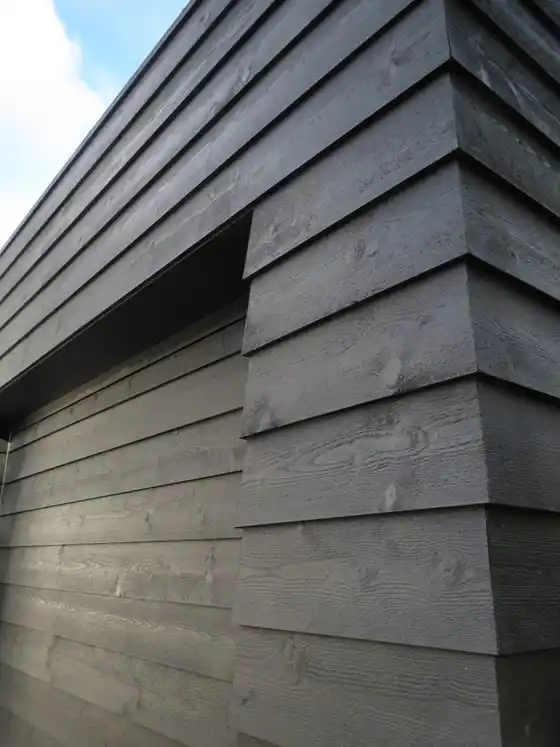
Black rebated feather edge cladding — the feather edge profile in a pre-treated black finish on a contemporary UK building. The tapered board and overlapping horizontal courses give the characteristic shadow-stepped appearance of feather edge cladding. Available in Nordic spruce from £32.88/m², Siberian larch from £50.39/m², and ThermoWood from £50.39/m².
What Is Feather Edge Cladding UK?

Nordic spruce feather edge cladding in pre-treated grey — the horizontal coursing and overlapping tapered boards give feather edge its distinctive shadow-stepped profile. Each board tapers from approximately 14–19mm at the thick edge to near-zero at the thin edge. The overlap between courses (minimum 25mm) sheds water by gravity. Available from £32.88/m² in Nordic spruce.
Feather edge cladding is a tapered board — machined so one long edge is thick (typically 14–26mm) and the opposite long edge tapers to near-zero. Boards are fixed horizontally with each board overlapping the one below, thick edge down, so the taper sheds water by gravity. The overlapping courses produce a distinctive stepped shadow profile across the elevation.
Key characteristics:
- Profile: Tapered — thick edge 14–26mm, thin edge near-zero. No machined joint — simple flat boards
- Installation: Horizontal only. The taper relies on gravity for water shedding — vertical installation is not appropriate
- Overlap: Minimum 25mm between courses — more on exposed sites. The overlap is the primary water exclusion mechanism
- Appearance: Strong horizontal shadow lines with visible overlap. Traditional, rural, and agricultural character
- Cost: Cheapest profile available in any species — minimal machining, minimal waste
What Is Shiplap Cladding UK?
Shiplap cladding close-up — the rebated joint visible at the top and bottom of each board. The rebate machined into each long edge allows boards to interlock — the bottom rebate of the upper board sits over the top rebate of the lower board, creating a defined shadow line and a mechanically interlocked joint. This is the key structural difference between shiplap and feather edge — the joint is machined, not simply overlapped.
Shiplap cladding has a rebated (stepped) joint machined into each long edge — the top and bottom of each board are stepped so they interlock with the boards above and below. This creates a defined, consistent shadow line between boards and a mechanically connected joint that excludes water more effectively than a simple overlap.
Key characteristics:
- Profile: Parallel-sided board with rebated joint at top and bottom. Consistent thickness throughout — typically 14–19mm
- Installation: Horizontal or vertical. The interlocking rebated joint works in both orientations — unlike feather edge which is horizontal only
- Joint: Mechanically interlocked rebate — more resistant to wind-driven rain than a simple overlap
- Appearance: Cleaner, more uniform horizontal or vertical lines with a defined, consistent shadow detail. Contemporary or traditional depending on species and orientation
- Cost: Slightly more expensive than feather edge — additional machining for the rebated joint
Feather Edge vs Shiplap — Head-to-Head
| Property | Feather Edge | Shiplap |
|---|---|---|
| Profile type | Tapered — thick to thin edge | Parallel with rebated joint |
| Joint type | Simple overlap — no machined joint | Interlocking rebate — mechanically connected |
| Installation direction | Horizontal only | Horizontal or vertical |
| Water exclusion | Good — overlap sheds by gravity | Better — interlocked joint resists wind-driven rain |
| Cost — spruce | from £32.88/m² | from £29.85/m² |
| Cost — larch | from £50.39/m² | from £53/m² |
| Aesthetic | Traditional, rural, agricultural | Contemporary or traditional — more versatile |
| Shadow line | Variable — depends on overlap depth | Defined and consistent — machined rebate |
| Board movement visibility | More visible — gap at thin edge can open | Less visible — rebate maintains consistent line |
| Installation difficulty | Simpler — overlap and fix | Slightly more care needed on rebate alignment |
| Species available | Spruce, larch, ThermoWood | Spruce, larch, ThermoWood, Douglas fir |
| Vertical fix | Not suitable | Yes — rebate works vertically |
Feather Edge Cladding — Appearance and Character
Nordic spruce feather edge cladding in black — the strong horizontal coursing and overlapping shadow of feather edge reads well in dark finishes on contemporary garden rooms and outbuildings. The stepped overlap profile creates bold, evenly-spaced horizontal shadow lines that work effectively on both rustic and contemporary structures. Pre-treated black from £25/m². See our Nordic spruce range.
The appearance of feather edge cladding is defined by its horizontal coursing — the overlapping tapered boards produce a series of stepped shadow lines across the elevation. The depth of these shadows varies with the amount of overlap and the time of day, giving feather edge a more dynamic, textured appearance than shadow gap or shiplap.
Feather edge looks most at home on:
- Rural and agricultural buildings: Barns, farm outbuildings, rural houses and cottages — feather edge is the historic cladding profile of agricultural England
- Garden rooms and sheds: The simplicity and low cost make feather edge the default profile for most garden buildings
- Traditional houses: Where the architecture is vernacular or period-influenced, feather edge sits more naturally than the cleaner lines of shiplap or shadow gap
- Contemporary projects with a dark finish: Black or dark grey pre-treated feather edge on a contemporary garden room or extension reads well — the bold horizontal lines suit modern minimalist architecture when the colour is right
Shiplap Cladding — Appearance and Character
Naturally weathered shiplap cladding in vertical orientation — the rebated joint maintains its clean, defined line as the timber weathers to silver-grey. Shiplap's versatility in both horizontal and vertical installation is one of its key advantages over feather edge. Vertical shiplap with a naturally durable species (larch or ThermoWood) is an increasingly popular choice on contemporary UK houses and extensions — zero maintenance, consistent shadow detail, 20–40 year service life.
Shiplap's defining visual characteristic is its consistent, machined shadow line — the rebated joint produces the same precise gap between boards regardless of installation variation. This consistency gives shiplap a cleaner, more resolved appearance than feather edge, and makes it more versatile across different architectural styles:
- Contemporary houses and extensions: Horizontal or vertical shiplap in larch or ThermoWood is one of the most widely specified exterior cladding profiles on contemporary UK residential architecture
- Garden rooms and offices: Shiplap gives a more polished result than feather edge on a garden room where the building is clearly visible from the house
- Traditional cottages: Horizontal shiplap in a painted or stained finish reads traditionally — the slightly cleaner lines versus feather edge suit period buildings where a formal horizontal coursing is appropriate
- Vertical cladding: Vertical shiplap is the go-to profile where a vertical board-and-shadow detail is wanted without the cost of shadow gap — the rebate creates enough shadow definition to read clearly on a facade
Feather Edge vs Shiplap — Which Species to Use
Siberian larch feather edge cladding — Class 3 naturally durable, no treatment needed above ground, 20–30 year service life. Larch feather edge at £50.39/m² is the cheapest naturally durable cladding in the UK — and despite the higher upfront cost versus Nordic spruce, the zero maintenance overhead makes it cheaper over 20+ years for most projects. See our cheapest timber cladding guide for the full whole-life cost analysis.
Both feather edge and shiplap are available in three main species — each with a different durability, maintenance requirement, and price point:
| Species | Feather edge from | Shiplap from | Treatment / durability |
|---|---|---|---|
| Nordic Spruce | £32.88/m² | £29.85/m² | Treatment every 2–3 yrs — Class 4–5 |
| Siberian Larch | £50.39/m² | £53/m² | No treatment above ground — Class 3 |
| ThermoWood | £50.39/m² | £52/m² | Zero maintenance — Class 2 |
The choice between feather edge and shiplap affects cost by £1–3/m². The choice between Nordic spruce and Siberian larch affects whole-life cost by £30–40/m² over 20 years. Get the species right first — then choose the profile. For any permanent building, larch or ThermoWood is the correct specification regardless of which profile you choose.
Installation — Feather Edge vs Shiplap
Vertical cladding on a UK garden office — only shiplap (of the two profiles) can be fixed vertically. Feather edge relies on the tapered board shedding water by gravity — fixed vertically it cannot drain and will trap moisture at the thin edge. For vertical cladding at the budget end, shiplap is the correct choice. For a more architectural vertical profile, shadow gap or rainscreen are the alternatives. See our full installation guide.
Both profiles are straightforward to install — significantly simpler than shadow gap or rainscreen. The main installation differences:
- Feather edge: Fix the first board at the base with the thick edge down. Each subsequent board overlaps the one below by minimum 25mm — a story pole or spacing batten keeps the overlap consistent. Pre-drill within 50mm of all ends. Fix through both boards at each batten with a single A4 stainless screw through the overlap point
- Shiplap: Fix the first board with the rebate facing out and up. Each subsequent board slots its bottom rebate over the top rebate of the board below — the rebate self-registers the spacing. Fix through the top of each board into the batten with a single A4 stainless screw, concealed by the overlapping rebate of the next board above
- Vertical direction: Shiplap only — feather edge must always be horizontal. For vertical shiplap, batten layout changes: horizontal battens at 400–600mm centres, with a vertical counter-batten to create the ventilated cavity behind
- Both profiles: Require a ventilated rainscreen cavity (minimum 25mm), breather membrane, 150mm ground clearance, sealed end grain, and A4 stainless fixings throughout. See our rainscreen guide for the full system detail
Which to Choose — Project by Project
ThermoWood cladding in a horizontal profile — Class 2 durable, zero maintenance, 25–40 year service life. Available in both feather edge and shiplap profiles from £50.39/m². For any project where the lowest whole-life cost is the priority and zero maintenance is wanted, ThermoWood in either profile is the definitive specification. See our full ThermoWood guide.
The most affordable profile — minimal machining, maximum coverage per pound. For any structure where budget is the primary driver and the building will be viewed from a distance, feather edge in Nordic spruce delivers the right result at the lowest cost. Pre-treated grey or black available for immediate colour.
The cleaner, more versatile profile — the defined rebated joint suits contemporary architecture better than the variable overlap of feather edge. Horizontal shiplap in larch or ThermoWood is one of the most widely specified profiles on UK residential extensions and new-builds. The £1–3/m² premium over feather edge is negligible at whole-house scale.
Feather edge is the historic cladding profile of UK rural architecture — barns, farm buildings, rural cottages. The tapered board and overlapping courses match the aesthetic of traditional agricultural building vernacular. Larch feather edge weathered to silver-grey is the definitive rural cladding specification.
Only shiplap works vertically — feather edge is horizontal only. For any project where vertical board orientation is the design intent at this price point, shiplap is the profile. The rebated joint works equally well in vertical orientation, maintaining its clean shadow line regardless of direction.
The £1–3/m² saving of feather edge over shiplap adds up on a large project — on a 100m² house elevation the saving is £100–300 on materials. Feather edge in Nordic spruce is the cheapest exterior timber cladding available in the UK from £32.88/m². Where every pound counts, feather edge is the answer.
The interlocking rebated joint of shiplap resists wind-driven rain more effectively than feather edge's simple overlap — particularly relevant on west-facing and coastal elevations where sustained driving rain is a factor. On exposed UK sites, shiplap's tighter joint gives a better performance margin.
What is the difference between feather edge and shiplap cladding UK?
Feather edge is a tapered board fixed horizontally with each board overlapping the one below — no machined joint, water sheds by gravity over the overlap. Shiplap has a rebated joint machined into each long edge so boards interlock — a defined shadow line, tighter water exclusion, and can be fixed horizontally or vertically. Feather edge is cheaper and more traditional. Shiplap is slightly more expensive, cleaner, and more versatile.
Is feather edge or shiplap cheaper UK — which costs less per m²?
Shiplap is cheaper at £29.85/m² versus feather edge at £32.88/m² for Nordic spruce — a reversal of the traditional assumption. Siberian larch feather edge from £50.39/m² versus shiplap from £53/m² follows the more typical pattern. On most projects the species choice has far more impact on cost than the profile choice.
Which is better — feather edge or shiplap cladding UK?
Neither is universally better. Feather edge suits traditional and rural buildings, sheds, garden rooms, and tight budgets. Shiplap suits contemporary houses, extensions, exposed sites, and any project where vertical fixing is needed. For most permanent houses and extensions, shiplap is the more versatile choice. For most garden buildings on a budget, feather edge is the more practical one.
Can feather edge be fixed vertically UK — feather edge vs shiplap vertical installation?
Shiplap can be fixed vertically — the rebated joint works in both orientations. Feather edge cannot be fixed vertically — the tapered board relies on gravity for water shedding and traps moisture at the thin edge in vertical installation. If vertical cladding is the design intent, shiplap is the correct profile of the two.
What species is feather edge cladding available in UK — feather edge cladding species UK?
Feather edge cladding is available in Nordic spruce (from £32.88/m²), Siberian larch (from £50.39/m²), and ThermoWood (from £50.39/m²) in the UK. Nordic spruce feather edge is the cheapest timber cladding available. Siberian larch feather edge is the cheapest naturally durable option — no treatment above ground. ThermoWood feather edge is Class 2 durable, zero maintenance, 25–40 year service life.
Is shiplap cladding waterproof UK?
No — shiplap cladding is not waterproof, but it is not designed to be. It works as a rainscreen — shedding most rain at the board surface and managing any water that penetrates through a ventilated cavity and breather membrane. Shiplap's interlocked rebated joint excludes wind-driven rain more effectively than feather edge's simple overlap — but neither profile is a barrier membrane. See our full is timber cladding waterproof guide.
Feather Edge & Shiplap — All Species, Free Samples in 1–2 Days
TCS stocks feather edge and shiplap profiles in Nordic spruce, Siberian larch, and ThermoWood — all from UK stock, FSC and PEFC certified, 7–14 day delivery. Not sure which profile or species is right for your project? Order free samples and compare in person before committing.