How long does timber cladding last in the UK? The answer ranges from 15 years for untreated non-durable softwood to 40+ years for correctly specified thermally modified timber — and the difference comes down almost entirely to species choice and installation quality, not to anything inherently uncertain about timber as a material. This complete 2026 guide gives definitive service life figures for every UK timber cladding species, explains what determines lifespan, what shortens it, and how to specify for the longest possible service life on any project type.
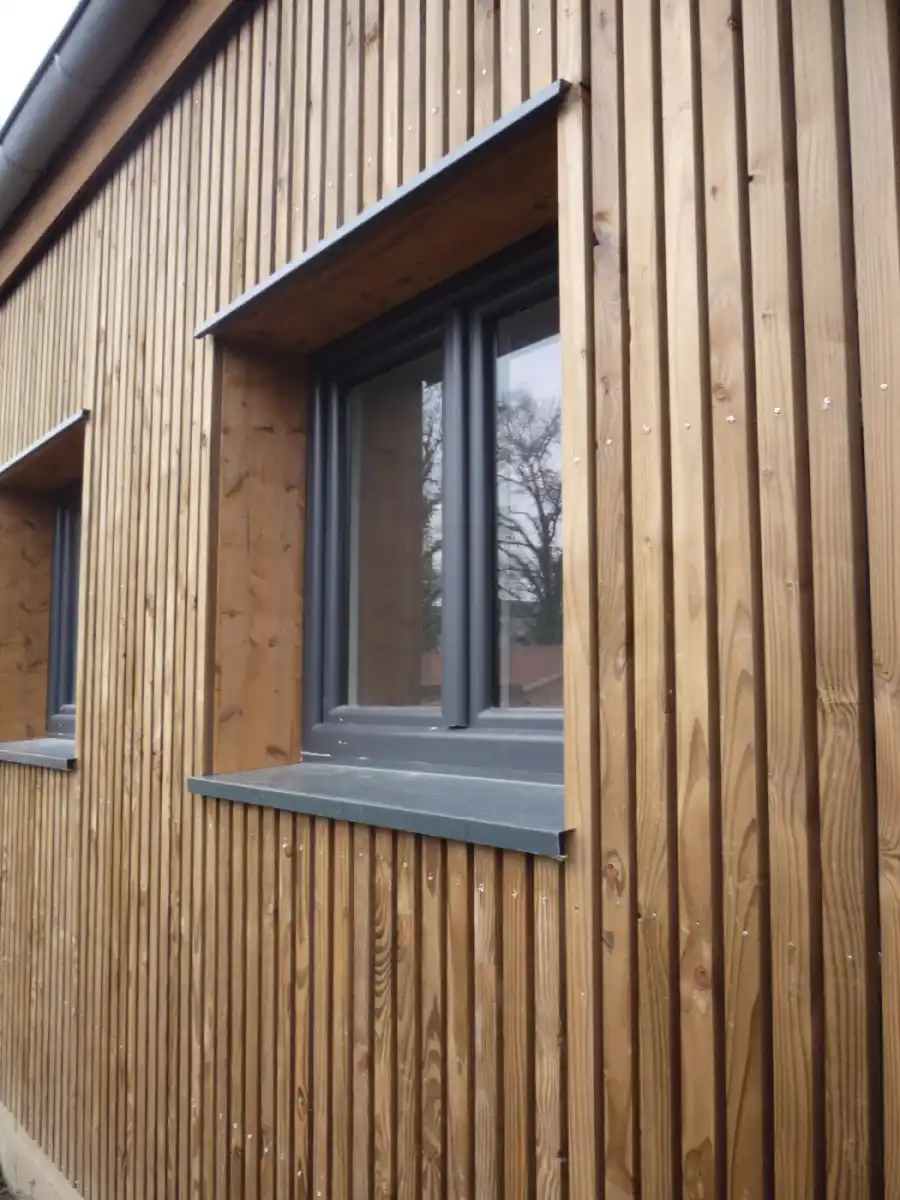
Lunawood ThermoWood cladding — the longest-lasting standard timber cladding specification available in the UK. Class 2 durable, zero maintenance, BRE-endorsed 30-year service life for above-ground exterior applications. The thermal modification process uses only heat and steam — no chemicals — to permanently upgrade durability and reduce moisture absorption by up to 50%. From £50.39/m².
How Long Does Timber Cladding Last UK — By Species
Class 2 durable. BRE-endorsed 30-year service life above ground. Zero maintenance — no treatment, no oiling, no painting. The most durable standard cladding timber available in the UK. Reduces moisture absorption by up to 50% versus untreated softwood.
Shop ThermoWood from £50.39/m² →Enhanced Class 3. The char layer provides additional moisture and UV resistance on top of larch's natural Class 3 durability. Zero maintenance ever — the char is structural, not a coating. The most visually bold long-life cladding specification.
Shop Charred SSB from £60.39/m² →Class 3 naturally durable. No preservative treatment needed above ground throughout its service life. Natural oils and resins resist biological decay. Weathers to warm silver-grey. The most popular UK cladding species for houses and extensions.
Shop Siberian Larch from £50.39/m² →Class 3 naturally durable. Distinctive fine straight grain with warm reddish-brown tone. No treatment needed above ground — optional oiling maintains colour. Popular on contemporary houses and barn conversions where a distinctive grain character is wanted.
Shop Douglas Fir →Class 4–5 — not naturally durable. Requires preservative treatment every 2–3 years. When maintained, achieves 15–25 years service life at the lowest upfront cost from £21/m². Without treatment, structural failure occurs within 10–15 years on exposed elevations.
Shop Nordic Spruce from £21/m² →How Long Does Larch Cladding Last UK?

Siberian larch cladding on a UK hospital — the natural Class 3 durability of larch makes it equally suitable for high-specification commercial and residential projects. The 20–30 year service life with zero treatment above ground is a significant operational advantage on a commercial building where maintenance scaffold costs would be substantial. See our commercial timber cladding guide.
Siberian larch cladding lasts 20–30 years in UK conditions above ground without any preservative treatment. Class 3 naturally durable — the natural oils and resins in larch heartwood resist the fungi responsible for biological decay throughout this period without chemical intervention.
Key factors that affect larch lifespan at either end of this range:
- Exposure: South and west-facing elevations in coastal or upland locations at the lower end (20–22 years). Sheltered north and east-facing elevations inland at the upper end (28–30+ years)
- Heartwood content: High heartwood content extends lifespan — sapwood has no natural durability. TCS stocks consistently high heartwood Siberian larch
- Ground clearance: 150mm minimum. Larch in direct contact with ground or below DPC level will decay within 5–10 years regardless of its above-ground durability
- Optional oiling: Applying UV-stable exterior oil on installation and every 3–5 years maintains the warm honey-gold colour longer and may extend service life marginally — but it is not required for structural performance
How Long Does ThermoWood Last UK?
ThermoWood cladding on a UK garden office — zero maintenance, 25–40 year service life. For garden rooms and offices where annual treatment is impractical, ThermoWood is the definitive specification. The natural weathering to silver-grey requires no intervention — the boards perform without any treatment throughout their service life. See our ThermoWood performance guide.
ThermoWood lasts 25–40 years in UK above-ground conditions with zero maintenance — the BRE endorses a 30-year service life for ThermoWood in above-ground exterior applications. It is the longest-lasting standard timber cladding specification available in the UK without chemical treatment.
The thermal modification process achieves this by permanently altering the timber's cellular structure — breaking down the hemicellulose that fungi feed on (achieving Class 2 durability) and reducing moisture absorption by up to 50% (reducing the cycling that causes physical degradation). The result is a timber that ages more slowly and more predictably than any untreated species.
Larch is Class 3, ThermoWood is Class 2 — one class higher on the BS EN 350 durability scale. In practical terms this means ThermoWood weathers more consistently, absorbs less moisture per cycle, and resists decay more effectively even on demanding north-facing and coastal elevations. For commercial projects, apartment blocks, and buildings where scaffold access for future maintenance would be costly, ThermoWood's Class 2 rating is the commercially rational specification.
How Long Does Spruce Cladding Last UK?
Nordic spruce exterior cladding — the most affordable UK cladding option at from £21/m². Class 4–5 not naturally durable, requiring preservative treatment every 2–3 years. When the treatment programme is consistently maintained, spruce achieves 15–25 years service life and performs well. The risk is when treatment lapses — decay begins relatively quickly on exposed elevations. See our larch vs spruce comparison.
Nordic spruce cladding lasts 15–25 years in the UK when maintained with preservative treatment every 2–3 years. Without treatment, structural decay begins within 5–8 years on exposed elevations and full structural failure within 10–15 years. The wide service life range reflects treatment consistency:
- 15–18 years: Inconsistent treatment, exposed south/west elevations, poor ground clearance detail
- 20–25 years: Consistent treatment programme, sheltered installation, correct rainscreen cavity and ground clearance
The honest assessment of spruce is that the 20–25 year end of its range is achievable but demands a genuinely consistent treatment programme — most UK homeowners do not maintain this, and the realistic service life of untreated or inconsistently treated spruce is closer to 12–15 years on exposed UK elevations.
How Long Does Charred Cladding Last UK?
Charred Shou Sugi Ban larch cladding — the char layer provides moisture, UV, and biological decay resistance on top of larch's Class 3 natural durability. Deep charred larch achieves 25–40 years service life with zero maintenance ever. The carbonised surface cannot peel, crack, or wash off — it is a structural transformation of the timber surface, not a coating. See our SSB deep charred guide.
Charred SSB cladding lasts 25–40 years with zero maintenance — zero oiling, zero re-staining, zero treatment of any kind. The char layer is not a coating applied to the timber surface; it is a structural transformation of the outer 2–3mm of the board. It cannot peel, crack, or be washed off. It provides:
- Moisture resistance: The carbonised surface layer significantly limits water absorption — more so than any surface oil or stain
- Biological decay resistance: The charring eliminates the surface sugars and nutrients that fungi and insects feed on
- UV resistance: The carbonised layer acts as a natural UV barrier, slowing the photodegradation that causes surface weathering
The combination of larch's Class 3 natural durability and the additional protection of the char layer produces the longest-lasting and most maintenance-free exterior timber cladding specification available in the UK.
What Makes Timber Cladding Last Longer UK — The Key Factors
Timber cladding on a UK commercial building — where whole-life cost and service life matter most, naturally durable or thermally modified species are always specified. The difference in upfront cost between spruce and ThermoWood is recovered within 6–8 years through avoided treatment costs on a commercial building — and the 25–40 year service life of ThermoWood avoids the scaffold cost of early reclad entirely.
| Factor | Extends lifespan | Shortens lifespan |
|---|---|---|
| Species choice | ThermoWood / larch / charred SSB — naturally durable | Untreated spruce or standard pine — no natural durability |
| Ventilated cavity | 38–50mm on exposed sites, always open at base and eaves | No cavity, or cavity blocked — moisture trapped indefinitely |
| Ground clearance | 150mm minimum — boards stay dry at the base | Boards at or near ground — continuous moisture wicking |
| End grain sealing | All cut ends sealed immediately — limits moisture entry | Unsealed end grain — absorbs 10x more moisture than face grain |
| Fixings | A4 stainless — zero corrosion throughout service life | Galvanised — corrode in contact with timber tannins, creating moisture entry points |
| Exposure | Sheltered inland — upper end of service life range | Exposed coastal / upland — lower end of service life range |
| Treatment (spruce only) | Every 2–3 years consistently — achieves maximum service life | Lapses in treatment — accelerating decay from missed applications |
Timber Cladding Lifespan vs Other Cladding Materials UK — Comparison
Larch vs Douglas fir — both Class 3 naturally durable with 20–30 year service lives above ground. Timber cladding lifespan vs other materials UK: timber performs comparably to fibre cement and composite on service life, at lower embodied carbon and with the option of zero maintenance when naturally durable species are specified.
Timber and metal cladding on a contemporary UK house — mixed material facades are increasingly popular, with each material playing to its strengths. Timber offers natural warmth, carbon storage, and 20–40 year service life. Metal offers indefinite lifespan but at significantly higher cost and embodied carbon. For most residential and light commercial projects, correctly specified timber cladding offers the best balance of lifespan, cost, and environmental performance.
| Material | Typical lifespan UK | Maintenance | Supply cost/m² |
|---|---|---|---|
| ThermoWood | 25–40 years | Zero | £50–65/m² |
| Siberian Larch | 20–30 years | None above ground | £50–63/m² |
| Composite cladding | 25–30 years | Low | £60–100/m² |
| Render | 15–25 years | Repaint every 8–12 yrs | £40–80/m² (applied) |
| Brick (new build) | 50–100+ years | Very low | £80–150/m² |
| Fibre cement (Cedral) | 25–40 years | Low | £50–90/m² |
| Nordic Spruce (maintained) | 15–25 years | Treatment every 2–3 yrs | £21–39/m² |
How long does timber cladding last UK?
Timber cladding lasts 15–40+ years in the UK depending on species. ThermoWood: 25–40 years, zero maintenance. Siberian larch: 20–30 years, no treatment above ground. Douglas fir: 20–30 years, optional oiling. Nordic spruce: 15–25 years, treatment every 2–3 years. Charred SSB larch: 25–40 years, zero maintenance. Species choice is the single biggest determinant of service life.
How long does larch cladding last UK?
Siberian larch cladding lasts 20–30 years in the UK above ground without preservative treatment. Class 3 naturally durable — its natural resins and oils resist biological decay without chemical treatment. Sheltered inland installations often exceed 30 years. Exposed coastal or upland sites are at the lower end of the range.
How long does ThermoWood cladding last UK?
ThermoWood cladding lasts 25–40 years in the UK with zero maintenance. The BRE endorses a 30-year service life for ThermoWood in above-ground exterior applications. Class 2 durable — the most durable standard timber cladding specification available in the UK. No treatment, no oiling, no maintenance required throughout its service life.
How long does spruce cladding last UK?
Nordic spruce cladding lasts 15–25 years in the UK when maintained with preservative treatment every 2–3 years. Without treatment, structural decay begins within 5–8 years on exposed elevations. Spruce is Class 4–5 — not naturally durable. The realistic service life of inconsistently treated spruce on exposed UK elevations is 12–15 years.
What makes timber cladding last longer UK?
The biggest factors: naturally durable or thermally modified species (larch, ThermoWood); correctly detailed ventilated rainscreen cavity (minimum 25mm); 150mm minimum ground clearance; sealed end grain on installation; A4 stainless fixings; vapour-permeable breather membrane; open base detail. For spruce: consistent treatment every 2–3 years. Species choice is the single most important decision.
How long does charred timber cladding last UK?
Charred SSB larch cladding lasts 25–40 years with zero maintenance. The char layer provides moisture, UV, and biological decay resistance on top of larch's Class 3 natural durability. The char is a structural transformation of the timber surface — it cannot peel or wash off — and requires zero re-treatment throughout the cladding's service life.
Timber Cladding Built to Last — ThermoWood, Larch & Charred SSB
TCS supplies the UK's longest-lasting timber cladding species — ThermoWood (25–40 yrs, zero maintenance), Siberian larch (20–30 yrs, no treatment above ground), charred SSB larch (25–40 yrs, zero maintenance). FSC and PEFC certified. Free samples posted within 1–2 days. Contact us with your project details for a precise quote.