ThermoWood is Class 2 Durable — the highest classification for a standard UK cladding timber. Siberian larch is Class 3 Naturally Durable. Charred SSB larch is Class 3 enhanced. All three require zero preservative treatment above ground and last 20–40 years in UK conditions. Non-durable species like Nordic spruce are also viable with consistent treatment. Durability is a specification decision, not a lottery.
Is timber cladding durable? It is one of the most frequently asked questions about exterior timber — and the answer is a clear yes, provided the correct species is specified. The durability of timber cladding in the UK varies enormously between species, from Class 2 (ThermoWood, lasting 25–40 years with zero maintenance) to Class 4–5 (untreated spruce, lasting 10–15 years without treatment). This complete 2026 guide explains exactly how timber durability is measured, what the BS EN 350 classes mean, which species are genuinely durable for UK exterior use, and what the most durable timber cladding specification looks like.
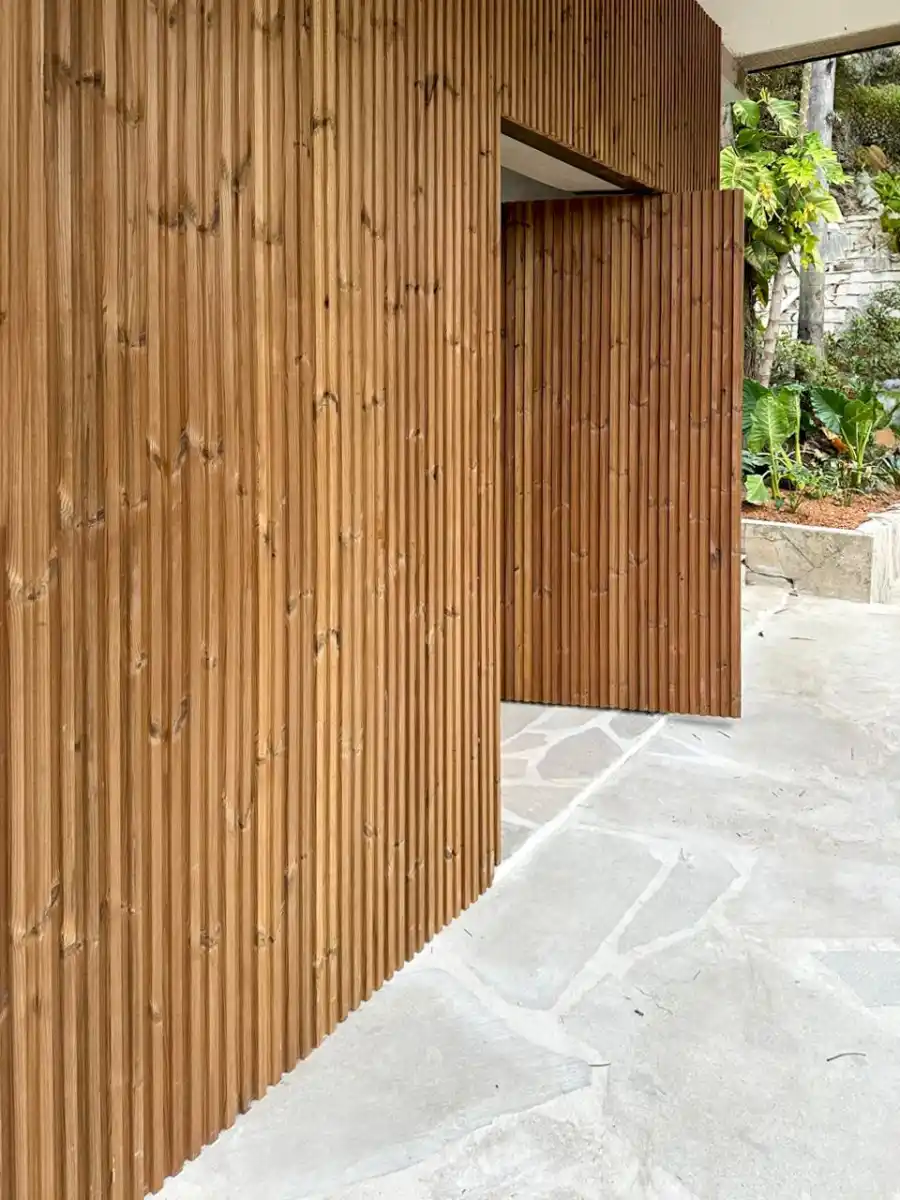
Lunawood ThermoWood cladding — Class 2 Durable (BS EN 350), the most durable standard timber cladding available in the UK. The thermal modification process uses only heat and steam to permanently upgrade biological durability from Class 4–5 to Class 2 — the same classification as Western red cedar — without chemical preservatives. Zero maintenance above ground throughout its 25–40 year service life.
How Timber Cladding Durability Is Measured — BS EN 350 Explained
Timber durability in the UK is measured against BS EN 350 — the European standard for natural durability of solid wood. The standard classifies timber heartwood into five durability classes based on its resistance to biological decay (fungi and insects) in the presence of moisture. This is the definitive measure of how long a species will last in exterior conditions without preservative treatment:
For UK exterior cladding above ground: Class 1–3 species do not require preservative treatment. Their inherent durability is sufficient to resist biological decay in normal above-ground conditions throughout their expected service life. Class 4–5 species require preservative treatment every 2–3 years to resist decay. The treatment substitutes for the natural durability the species lacks.
BS EN 350 measures biological decay resistance only — not strength, not dimensional stability, not weathering performance, and not maintenance obligation. A Class 2 timber is not necessarily stronger than a Class 4 timber — it simply resists biological decay more effectively. ThermoWood's durability advantage also includes dramatically reduced moisture absorption (50% less than untreated softwood) which improves dimensional stability and reduces physical weathering — a benefit not captured in the durability class rating alone.
Is Timber Cladding Durable — By Species
Thermal modification upgrades standard softwood from Class 4–5 to Class 2 without chemicals. Zero maintenance above ground. 25–40 year service life. BRE-endorsed 30-year service life. Reduces moisture absorption by 50%. Most durable standard UK cladding.
Shop ThermoWood from £50.39/m² →Larch Class 3 base durability enhanced by the carbonised surface layer which limits moisture absorption, UV degradation, and biological decay. Zero maintenance ever. 25–40 year service life. The most durable and maintenance-free specification available.
Shop Charred SSB from £60.39/m² →Natural oils and resins in larch heartwood resist biological decay without treatment above ground. 20–30 year service life. The most popular naturally durable cladding species in the UK for houses, extensions and commercial buildings.
Shop Siberian Larch from £50.39/m² →Class 3 naturally durable above ground. No treatment required. Distinctive fine straight grain with warm reddish-brown character. 20–30 year service life. Popular on barn conversions and contemporary houses where a distinctive species character is wanted.
Shop Douglas Fir →No natural durability — requires preservative treatment every 2–3 years. Class 4–5. With consistent treatment: 15–25 year service life. Without treatment: structural failure within 10–15 years. The most affordable specification from £21/m² — viable when treatment is maintained.
Shop Nordic Spruce from £21/m² →Is Timber Cladding Durable on Commercial Buildings UK?

Durable timber cladding on a UK commercial building — for commercial and public sector projects, Class 2–3 species are always specified. Maintenance access on commercial buildings (MEWP, scaffold) is expensive — a durable species that requires zero treatment above ground eliminates this overhead entirely. See our commercial timber cladding guide.
Timber cladding is highly durable on UK commercial buildings when correctly specified — and increasingly the preferred specification over render, composite, and fibre cement on many project types. The key commercial durability considerations:
- Zero-maintenance specification is commercially essential: Maintenance access on a commercial building (mobile elevating work platform or scaffold) costs significantly more than on a house. A Class 4–5 species requiring treatment every 2–3 years generates substantial whole-life maintenance costs. ThermoWood or larch with zero maintenance above ground eliminates this overhead entirely
- BREEAM Mat 01: Naturally durable and thermally modified timbers score well on life cycle impact credits — longer service life means fewer whole-life reclads and lower whole-life embodied carbon
- FSC and PEFC certification: All TCS stock is FSC and PEFC certified — meeting BREEAM Mat 05 responsible sourcing credits
- Fire rating: Euroclass B-s1,d0 fire retardant treatment is available on ThermoWood profiles on request — see our fire rated cladding guide
Is Larch Cladding Durable UK?
Siberian larch 3D effect exterior cladding — Class 3 Naturally Durable (BS EN 350). The natural oils and extractives in larch heartwood make it inhospitable to the fungi responsible for biological decay — no chemical treatment is required above ground throughout its 20–30 year service life. Larch is the most widely specified naturally durable cladding species in the UK for residential and light commercial projects.
Siberian larch is Class 3 Moderately Durable — genuinely durable above ground in UK conditions without any preservative treatment. Three important points about larch durability:
- Heartwood vs sapwood: The Class 3 durability rating applies to the heartwood only. Larch sapwood (the pale outer ring visible in some boards) has no natural durability. High-quality larch cladding is predominantly heartwood — always confirm heartwood content with your supplier
- Above ground vs ground contact: Class 3 durability applies above ground in a ventilated rainscreen system. Larch in direct ground contact or embedded in soil does not have Class 3 durability — always maintain 150mm minimum clearance from ground level
- Exposure matters: Class 3 is sufficient for most UK exterior applications above ground. On very exposed coastal or high-rainfall upland sites, ThermoWood (Class 2) gives a more comfortable durability margin and is the more conservative specification
Is ThermoWood Durable UK?
ThermoWood board-on-board cladding — Class 2 Durable, the highest durability classification for a standard UK softwood-based cladding timber. The thermal modification process permanently upgrades the timber's biological durability and reduces moisture absorption — without chemical treatment of any kind. FSC and PEFC certified. From £50.39/m². See our full ThermoWood performance guide.
ThermoWood is the most durable standard timber cladding specification available in the UK — Class 2 Durable, the same classification as Western red cedar, achieved without chemical preservatives. Why it outperforms Class 3 species on durability:
- Class 2 vs Class 3: One class higher on the BS EN 350 scale means ThermoWood resists biological decay more effectively than larch or Douglas fir — particularly relevant on north-facing elevations, high-moisture environments, and coastal locations where sustained wetness tests durability more severely
- 50% less moisture absorption: The modification breaks down the hemicellulose responsible for moisture uptake — ThermoWood absorbs significantly less water per wet-dry cycle, reducing both biological decay risk and physical weathering from swelling and shrinkage
- More consistent performance: Unlike natural durability (which depends on heartwood content and growth conditions), ThermoWood's durability is consistent throughout every board — every cubic centimetre of the modified timber is Class 2, not just the heartwood core
Is Charred Cladding Durable UK?
Deep charred Shou Sugi Ban cladding on a UK house — Class 3 base durability of larch enhanced by the 2–3mm carbonised surface layer. The char limits moisture absorption, eliminates surface nutrients that fungi and insects feed on, and provides UV protection that slows photodegradation. Zero maintenance throughout the 25–40 year service life. See our full SSB deep charred guide.
Charred SSB cladding is arguably the most durable exterior timber cladding specification available in the UK. The carbonised surface layer provides durability benefits beyond the base timber's natural classification:
- Moisture resistance: The char layer dramatically limits water absorption at the board surface — more effectively than any applied oil or stain, because it is a structural change to the timber rather than a surface coating
- Biological decay resistance: The charring process eliminates the surface sugars and nutrients that fungi and wood-boring insects feed on — the surface is genuinely inhospitable to biological colonisation
- UV resistance: The carbonised surface acts as a natural UV barrier, slowing the photodegradation process that causes surface weathering and fibre breakdown on all timber species
- Zero maintenance for life: The char is not a coating — it cannot peel, crack, or be washed off. Zero re-treatment required throughout the 25–40 year service life
Is Nordic Spruce Cladding Durable UK?
Nordic spruce vs Siberian larch side by side — the visual difference is immediately apparent. More importantly, the durability difference is significant: larch (right) is Class 3 and requires no treatment above ground, while spruce (left) is Class 4–5 and requires preservative treatment every 2–3 years to remain structurally sound. See our full larch vs spruce comparison.
Nordic spruce cladding is Class 4–5 — not naturally durable in UK exterior conditions without preservative treatment. This does not make spruce a poor cladding material, but it does make it a maintenance-dependent one:
- With consistent treatment (every 2–3 years): Spruce achieves 15–25 years service life and performs well. Factory-applied preservative stain gives the best durability per pound at from £21–25/m²
- Without treatment: Biological decay begins within 5–8 years on exposed south and west elevations. Structural failure within 10–15 years
- Where spruce is viable: Sheds, outbuildings, budget garden rooms, and any structure where treatment from ground level is easy and will be consistently maintained
- Where spruce is not viable: Houses, extensions, commercial buildings, or any structure where maintenance access is difficult, costly, or unlikely to be consistently maintained over 20+ years
Specifying Nordic spruce on a permanent house or extension because it is cheaper upfront — then not maintaining the treatment schedule. The consequence is accelerating biological decay that is expensive to identify and catastrophically expensive to remediate if it penetrates behind the cladding to the wall structure. The upfront saving of £29/m² over larch is recovered within 6–8 years in avoided treatment costs on a house — where scaffold access for treatment costs £800–£2,000 per visit. On a house, the durable specification is always the cheaper long-term choice.
Durability vs Whole-Life Cost — The Definitive Comparison
Douglas fir sawn finish cladding — Class 3 naturally durable, no treatment needed above ground throughout its 20–30 year service life. The distinctive fine straight grain and warm reddish-brown character of Douglas fir makes it an attractive alternative to Siberian larch at a similar price point. Available from TCS in rainscreen, tongue and groove, and batten profiles.
| Species | Class (BS EN 350) | 20-yr maintenance cost/m² | Supply cost/m² | 20-yr total/m² | Verdict |
|---|---|---|---|---|---|
| ThermoWood | Class 2 | £0 | £50–65 | £50–65 | Best whole-life value |
| Charred SSB Larch | Class 3+ | £0 | £60–87 | £60–87 | Most durable, zero maintenance |
| Siberian Larch | Class 3 | £0–15 (optional oil) | £50–63 | £50–78 | Excellent — best natural value |
| Douglas Fir | Class 3 | £0–15 (optional oil) | £45–60 | £45–75 | Good — distinctive character |
| Nordic Spruce | Class 4–5 | £40–80 | £21–39 | £61–119 | Higher 20-yr cost on most buildings |
Siberian larch board-on-board cladding — Class 3 natural durability in a bold, contemporary profile. The board-on-board format suits both traditional and contemporary architecture and provides excellent weather protection through the overlapping board detail. Zero treatment required above ground. See our board on board cladding guide.
Is timber cladding durable UK?
Yes — timber cladding is durable in the UK when the correct species is specified. ThermoWood is Class 2 Durable with a 25–40 year service life and zero maintenance. Siberian larch is Class 3 with a 20–30 year service life and no treatment above ground. Charred SSB larch is Class 3 enhanced. Durability is entirely a specification decision.
What is the most durable timber cladding UK?
ThermoWood is the most durable standard timber cladding in the UK — Class 2 Durable (BS EN 350), 25–40 year service life, zero maintenance above ground. Charred SSB larch is arguably more durable still — Class 3 natural durability enhanced by the carbonised surface layer that limits moisture, UV, and biological decay. Both require zero maintenance throughout their service life.
Is larch cladding durable UK?
Yes — Siberian larch is Class 3 Naturally Durable (BS EN 350). No preservative treatment is needed above ground. It lasts 20–30 years in UK conditions. It is the most widely specified naturally durable cladding species in the UK for houses, extensions and commercial buildings. The durability applies to heartwood — always confirm heartwood content with your supplier.
Is ThermoWood durable UK?
Yes — ThermoWood is Class 2 Durable (BS EN 350), achieved through thermal modification without chemical preservatives. Zero maintenance above ground throughout its BRE-endorsed 30-year service life. It also absorbs up to 50% less moisture than untreated softwood — improving dimensional stability alongside biological durability.
What does timber cladding durability class mean UK?
BS EN 350 durability class measures resistance to biological decay. Class 1 (Very Durable) to Class 5 (Not Durable). For UK exterior cladding above ground: Class 1–3 species do not require preservative treatment. Class 4–5 species require treatment every 2–3 years. ThermoWood is Class 2. Siberian larch and Douglas fir are Class 3. Nordic spruce is Class 4–5.
How durable is timber cladding durable vs other materials UK — timber cladding vs other materials?
Correctly specified timber cladding (ThermoWood or larch) is as durable as fibre cement and composite cladding — 25–40 years — at comparable or lower whole-life cost. It outperforms render (15–25 years before repainting) significantly. It does not match brick (50–100+ years) but outperforms it on embodied carbon, cost, and design flexibility. The durability reputation problem for timber comes from non-durable species (spruce) being incorrectly specified on permanent buildings.
Durable Timber Cladding UK — Class 2 & 3 Species From Stock
TCS supplies the UK's most durable timber cladding specifications — ThermoWood (Class 2), Siberian larch (Class 3), Douglas fir (Class 3) and charred SSB larch (Class 3 enhanced). All FSC and PEFC certified. Free samples posted within 1–2 days. Contact us with your project details for a precise quote.