- Natural material — warm, authentic appearance
- Carbon storing throughout service life
- FSC / PEFC certified — BREEAM credits
- Zero maintenance above ground (larch, ThermoWood)
- 25–40 year service life (ThermoWood)
- Individual boards replaceable — repairable
- Wide profile and species range
- Not suitable where A2 fire rating required
- Manufactured — cement, sand, cellulose fibres
- A2-s1,d0 non-combustible — compliant above 11m
- Factory colour — repaint every 10–15 years
- Does not rot or decay
- 25–40 year service life
- Brittle — cracks on impact, harder to repair
- Higher embodied carbon than timber
- Timber-look options available
Timber cladding vs fibre cement — the most common comparison question for UK houses and extensions in 2026. Fibre cement (Cedral is the dominant brand) has grown significantly in the UK market on the back of its low maintenance, colour stability, and fire resistance credentials. But naturally durable timber cladding — larch, ThermoWood, charred SSB — matches fibre cement on service life, beats it on sustainability, and produces a more authentic natural appearance that factory-moulded fibre cement cannot replicate. This complete guide covers every dimension of the timber cladding vs fibre cement decision so you can choose correctly for your project.
Contemporary timber cladding on a UK building — the natural warmth and grain character of timber is the defining advantage over fibre cement. No factory-manufactured product fully replicates the visual quality of natural timber — the variation in grain, the weathering response, and the way light interacts with the board surface. ThermoWood and Siberian larch match fibre cement on service life and beat it on sustainability — with the additional advantage of being genuinely repairable board by board.
What Is Fibre Cement Cladding UK?

Fibre cement cladding wall assembly — the technical build-up of a fibre cement rainscreen system. Fibre cement boards are manufactured from Portland cement, ground sand, and cellulose fibres — compressed and cured under high pressure. The resulting board is dense, non-combustible (A2-s1,d0), and dimensionally stable. The system install is essentially identical to timber — rainscreen cavity, breather membrane, batten framework, A4 stainless fixings. The board material is the only fundamental difference.
Fibre cement cladding is a manufactured board made from Portland cement, ground sand, water, and cellulose fibres — compressed and autoclaved (steam-cured) under high pressure. Cedral is the dominant brand in the UK market. Key characteristics:
- Non-combustible: A2-s1,d0 fire classification — meets the requirements for buildings above 11 metres height where the Building Safety Act 2022 mandates non-combustible external cladding
- Does not rot or decay: Cement-based board is immune to biological decay — no treatment required for structural protection
- Factory colour: Applied at manufacture — available in a wide range of colours. Requires repainting every 10–15 years on exposed UK elevations
- Brittle: Dense but brittle — cracks on significant impact (scaffold poles, ladders, falling branches) and is more difficult to repair invisibly than timber
- Timber-look profiles: Cedral and other manufacturers offer embossed wood-grain textured boards — a closer approximation to timber than smooth fibre cement, but not equivalent to natural timber grain
Timber Cladding vs Fibre Cement — Head-to-Head
Black timber cladding elevation — charred SSB or pre-treated larch in black achieves the same dark contemporary aesthetic as black fibre cement, with the additional advantages of carbon storage, genuine natural character, and individual board replaceability. At £60.39/m² for charred SSB spruce versus £50–70/m² for Cedral Click in black, the costs are directly comparable on a whole-life basis. See our charred vs stained black cladding guide.
| Property | Timber Cladding (larch / ThermoWood) | Fibre Cement (Cedral) |
|---|---|---|
| Supply cost/m² | £50.39–87/m² (larch, ThermoWood, charred SSB) | £35–60/m² (Cedral Click / Lap) |
| Whole-life cost | Lower — zero maintenance above ground | Higher — repaint every 10–15 years |
| Service life | 25–40 yrs (ThermoWood) / 20–30 yrs (larch) | 25–40 years |
| Maintenance | Zero above ground (larch, ThermoWood) | Repaint every 10–15 yrs |
| Fire rating | A2-s1,d0 — non-combustible | D-s2,d2 — combustible. Not suitable above 11m without FR treatment |
| Sustainability | Carbon storing — renewable, FSC/PEFC certified | Carbon intensive cement manufacture |
| Appearance | Natural grain — authentic, unique per board | Manufactured — consistent but uniform |
| Colour stability | Weathers to silver-grey naturally | Factory colour stable — slow fade |
| Rot / decay | No rot above ground (larch, ThermoWood) | No rot — cement based |
| Impact resistance | Flexible — dents rather than cracks | Brittle — cracks on significant impact |
| Repairability | Individual boards replaceable — invisible repair | Crack repair visible — colour matching difficult |
| BREEAM credits | Mat 01 + Mat 05 — responsible sourcing, low LCA | Mat 05 — responsible sourcing only |
| Installation | Standard rainscreen system | Standard rainscreen system — heavier boards |
| Profile range | Wide — shadow gap, shiplap, rainscreen, feather edge, T&G | Good — lap, click, weatherboard |
Cost — Timber Cladding vs Fibre Cement UK
Natural timber cladding on a UK house elevation — the warm natural tone of fresh larch or ThermoWood before weathering begins. At £50.39/m², naturally durable timber cladding is comparable in supply cost to mid-range fibre cement (Cedral Click from £35–40/m², Cedral Lap from £45–60/m²). The whole-life cost difference is where timber wins — zero maintenance above ground versus repainting fibre cement every 10–15 years.
| Specification | Supply cost/m² | 25-yr maintenance/m² | 25-yr total/m² |
|---|---|---|---|
| Nordic Spruce (maintained) | £21–39 | £35–60 | £56–99 |
| Siberian Larch | £50–63 | £0–10 | £50–73 |
| ThermoWood | £50–65 | £0 | £50–65 |
| Charred SSB Larch | £87–99 | £0 | £87–99 |
| Cedral Click (fibre cement) | £35–45 | £20–40 (2 repaints) | £55–85 |
| Cedral Lap (fibre cement) | £45–60 | £20–40 (2 repaints) | £65–100 |
ThermoWood and Siberian larch match or beat fibre cement on 25-year whole-life cost. The lower upfront price of Cedral Click (from £35/m²) is eroded by two repainting cycles over 25 years. On a 100m² elevation, two scaffold-access repaints cost approximately £2,000–4,000 in labour alone. On a whole-life basis, naturally durable timber is not more expensive than fibre cement — and is often cheaper.
Sustainability — Timber Cladding vs Fibre Cement UK
Timber cladding on a UK commercial building — the sustainability advantage of timber over fibre cement is significant. Timber stores carbon throughout its service life, is renewable and biodegradable, and scores well on BREEAM Mat 01 (life cycle impact) and Mat 05 (responsible sourcing). Cement manufacture — the primary constituent of fibre cement — is one of the most carbon-intensive industrial processes. For projects with sustainability targets, timber is the clearly preferable specification.
Timber cladding is significantly more sustainable than fibre cement across every standard measure:
- Carbon storage: Timber stores carbon throughout its service life — approximately 0.9 tonnes CO₂ per m³ of timber. Fibre cement releases carbon during cement manufacture — one of the most carbon-intensive industrial processes globally
- Renewability: FSC and PEFC certified timber is sourced from sustainably managed forests — the resource is renewable. Fibre cement uses Portland cement and sand — finite resources with no sustainable sourcing pathway
- Embodied carbon: The embodied carbon of timber cladding is significantly lower than fibre cement per m² of installed cladding
- BREEAM Mat 01: Timber cladding scores well on life cycle impact credits — lower embodied carbon, carbon storage, and biodegradability at end of life. Fibre cement performs poorly on Mat 01
- BREEAM Mat 05: Both FSC/PEFC certified timber and responsibly sourced fibre cement can score responsible sourcing credits. TCS stock is FSC and PEFC certified throughout
- End of life: Timber is biodegradable — can be chipped, composted, or used as biomass fuel. Fibre cement is inert waste — cannot be meaningfully recycled
Fire Rating — The Most Important Difference
Timber cladding is combustible — it does not achieve A2-s1,d0 non-combustible classification. Under the Building Safety Act 2022 and Approved Document B, buildings over 11 metres in height (and all residential buildings over 18 metres) require non-combustible external cladding. Timber cladding cannot be specified on these buildings without specialist fire retardant treatment — and even FR-treated timber may not satisfy all authorities having jurisdiction. Fibre cement is A2-s1,d0 non-combustible and meets these requirements without treatment. For any building over 11 metres, consult a fire engineer before specifying either material. For buildings under 11 metres, timber cladding is fully compliant with building regulations.
For the vast majority of UK residential projects — houses, extensions, garden rooms, single-storey commercial — this distinction is irrelevant. Timber cladding is fully compliant with building regulations on buildings under 11 metres. The fire rating issue only affects taller residential and commercial buildings where the Building Safety Act requirements apply.
Where fire retardant treated timber is required, TCS offers factory-applied fire retardant treatment on ThermoWood and larch profiles — achieving Euroclass B-s1,d0 where required by specification.
Appearance — Natural vs Manufactured
Composite and manufactured cladding on a UK garden room — the visual difference between manufactured boards and natural timber is apparent on close inspection. The repeat pattern of embossed grain on composite and fibre cement boards reads as manufactured at close range in a way natural timber does not. For projects where the cladding is seen from close quarters — a house, an extension, a garden room used daily — natural timber's authentic grain character is a significant visual advantage.
The appearance difference between timber and fibre cement is the most subjective — but also the most important — dimension of this comparison for most buyers. Key distinctions:
- Grain authenticity: Natural timber grain varies board-to-board — no two boards are identical. Fibre cement wood-grain boards use embossed patterns that repeat across the elevation. At close range and in low-raking light, the repeat pattern is visible and reads as manufactured
- Weathering: Timber weathers dynamically — greying at different rates on different elevations, responding to UV, moisture, and aspect. This is a feature for most buyers. Fibre cement's factory colour fades slowly and uniformly — a different but more controlled aesthetic
- Touch and texture: Natural timber has a tactile quality — the texture of grain, the slight variation in board face — that manufactured boards cannot replicate
- Dark finishes: Charred SSB cladding produces a genuinely black surface with natural char texture that no manufactured board replicates. Pre-treated black larch or ThermoWood is equally distinctive. Black fibre cement is consistent but flat by comparison
Maintenance — Timber vs Fibre Cement UK
Cladding and render on a UK house — render is the highest-maintenance exterior material (repaint every 8–12 years), followed by fibre cement (repaint every 10–15 years), followed by naturally durable timber (zero maintenance above ground for larch and ThermoWood). The maintenance comparison is one of the strongest arguments for naturally durable timber over fibre cement when whole-life cost and effort are the measure.
| Material | Maintenance required | Frequency | 25-yr maintenance cost |
|---|---|---|---|
| Render | Repaint entire elevation | Every 8–12 years | £30–60/m² |
| Fibre cement (Cedral) | Repaint or clean | Every 10–15 years | £20–40/m² |
| Nordic spruce | Preservative treatment | Every 2–3 years | £35–60/m² |
| Siberian larch | None above ground | Never | £0–10 (optional oil) |
| ThermoWood | None above ground | Never | £0 |
| Charred SSB | None — ever | Never | £0 |
Which to Choose — Project by Project
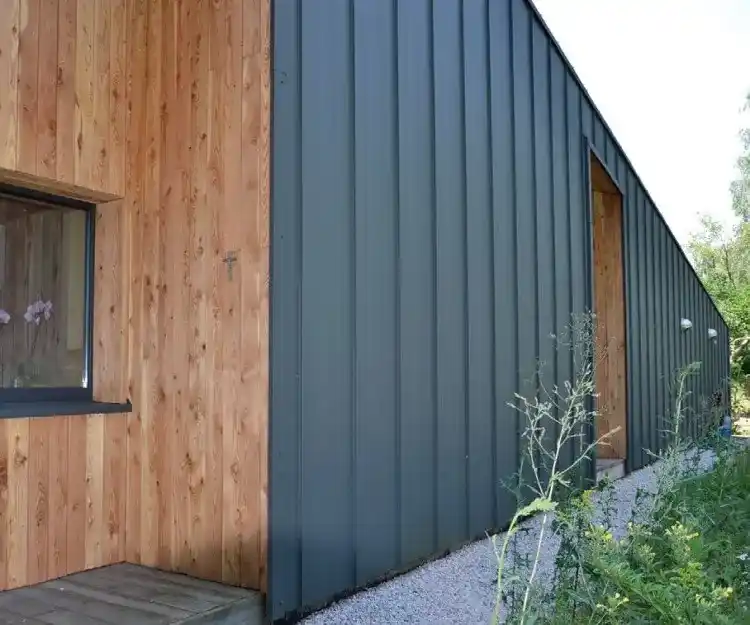
Mixed material facade — timber and metal on a contemporary UK building. Fibre cement sits between these two materials on the maintenance-vs-appearance spectrum: more maintenance-free than render, less so than naturally durable timber; more authentic-looking than metal or composite, less so than natural timber. For most UK residential projects, naturally durable timber gives a better result than fibre cement on both appearance and whole-life cost.
For the vast majority of UK houses and extensions, naturally durable timber cladding (larch or ThermoWood) gives better whole-life value than fibre cement — comparable or lower 25-year cost, zero maintenance above ground, genuine natural appearance, and significant sustainability advantages. This is the correct default specification for residential projects.
Where the Building Safety Act 2022 requires A2-s1,d0 non-combustible external cladding — residential buildings over 11m, all buildings over 18m — fibre cement is the compliant specification. Timber without fire retardant treatment does not meet these requirements. Fibre cement is the correct choice when fire rating is mandated by regulation.
For projects with sustainability targets, BREEAM ratings, or low embodied carbon specifications, timber is the clearly preferable material. Carbon storage, FSC/PEFC certification, BREEAM Mat 01 credits, and biodegradability at end of life all favour timber over fibre cement. No fibre cement product stores carbon — every timber cladding specification does.
Where a specific paint colour must be maintained precisely and consistently across an elevation for the long term — a corporate colour, a planning-authority-specified tone — fibre cement's factory colour and predictable fade may be preferable to timber's natural greying. Timber can be painted, but will require more frequent repainting to maintain a precise colour than factory-coated fibre cement.
Fibre cement is rarely specified on garden rooms or outbuildings — the cost, weight, and cutting difficulty make it impractical at smaller scale. For garden buildings, naturally durable timber or pre-treated Nordic spruce are the correct specifications. ThermoWood or larch on a garden room gives a 25–40 year zero-maintenance result that fibre cement cannot improve on at this scale.
On very exposed coastal sites where salt, UV, and driving rain are extreme and access for any future maintenance is genuinely difficult, fibre cement's immunity to biological decay and factory colour give a lower-risk specification than timber. ThermoWood (Class 2) is still an excellent coastal specification — but where the client wants absolute certainty on maintenance-free performance in the most demanding UK conditions, fibre cement is a defensible choice.
Is timber cladding better than fibre cement UK?
For most UK residential projects, yes — naturally durable timber cladding gives better whole-life value, lower embodied carbon, genuine natural appearance, and comparable or lower 25-year cost. Fibre cement is better where A2-s1,d0 fire rating is required (buildings over 11m), where a specific factory colour must be maintained, or on the most extreme coastal exposures. For houses, extensions, and garden rooms under 11m, timber is the stronger specification.
Is timber cladding cheaper than fibre cement UK?
Upfront, Cedral Click fibre cement (from £35/m²) is cheaper than naturally durable timber (from £50.39/m²). Over 25 years, naturally durable timber is cheaper — zero maintenance versus two repainting cycles for fibre cement. On a 100m² elevation, two scaffold repaints cost £2,000–4,000 in labour. The whole-life cost of ThermoWood at £50–65/m² total is lower than Cedral at £55–100/m² total over 25 years.
Does timber cladding last as long as fibre cement UK?
Yes — ThermoWood lasts 25–40 years in UK conditions, Siberian larch 20–30 years, both comparable to fibre cement's 25–40 year service life. Timber can rot if incorrectly specified, but correctly specified naturally durable timber in a properly detailed rainscreen system performs reliably for the same period as fibre cement. The service life comparison is broadly equal when timber is correctly specified.
Is timber cladding more sustainable than fibre cement UK?
Yes — significantly. Timber stores carbon, is renewable, FSC and PEFC certified, and biodegradable at end of life. Fibre cement uses cement — one of the most carbon-intensive manufactured materials — and is inert waste at end of life. For BREEAM Mat 01 and sustainability-driven specifications, timber is the clearly preferable material.
Can timber cladding replace fibre cement UK — replacing fibre cement with timber?
Yes — on buildings under 11 metres. The installation system is identical: rainscreen cavity, breather membrane, batten framework, A4 stainless fixings. The board material is the only change. For buildings over 11 metres where A2-s1,d0 fire classification is required, timber without specialist fire retardant treatment is not a compliant replacement. Check with a fire engineer for any building where height or use triggers fire safety requirements.
Is Cedral better than timber cladding UK?
Cedral is better than timber where A2 fire rating is required, and where colour consistency over time is the priority. For most UK residential projects — houses, extensions, garden rooms under 11m — naturally durable timber cladding (larch or ThermoWood) gives better whole-life value, lower maintenance, lower embodied carbon, and more authentic natural appearance than Cedral at a comparable 25-year total cost.
Naturally Durable Timber Cladding — The Alternative to Fibre Cement
TCS stocks ThermoWood, Siberian larch and charred SSB — the three zero-maintenance naturally durable timber cladding specifications that match or beat fibre cement on 25-year whole-life cost. FSC and PEFC certified. Free samples posted in 1–2 days. Contact us with your project details for a full cost comparison.