- Class 2 Durable — highest standard UK rating
- 25–40 year service life
- Zero maintenance above ground
- 50% less moisture absorption than untreated softwood
- Warm honey-brown weathering to consistent silver-grey
- Widest profile range — shadow gap, double, triple, rainscreen
- Best for: houses, commercial, apartment blocks, demanding exposures
- Class 3 — Moderately Durable (natural)
- 20–30 year service life
- Zero treatment above ground
- Natural resins and oils — heartwood only
- Warm reddish-brown weathering to silver-grey
- Limited profiles — T&G, rainscreen
- Best for: houses, barn conversions, distinctive grain character
ThermoWood vs Douglas fir cladding — two very different routes to a similar destination. Both are zero-maintenance above ground. Both weather to silver-grey naturally. Both are durable enough for UK exterior use without chemical treatment. But they differ in durability class, moisture absorption, profile availability, colour, and grain character in ways that make one clearly better suited to certain projects than the other. This complete 2026 comparison covers every dimension of the ThermoWood vs Douglas fir decision so you can choose the right specification for your project.
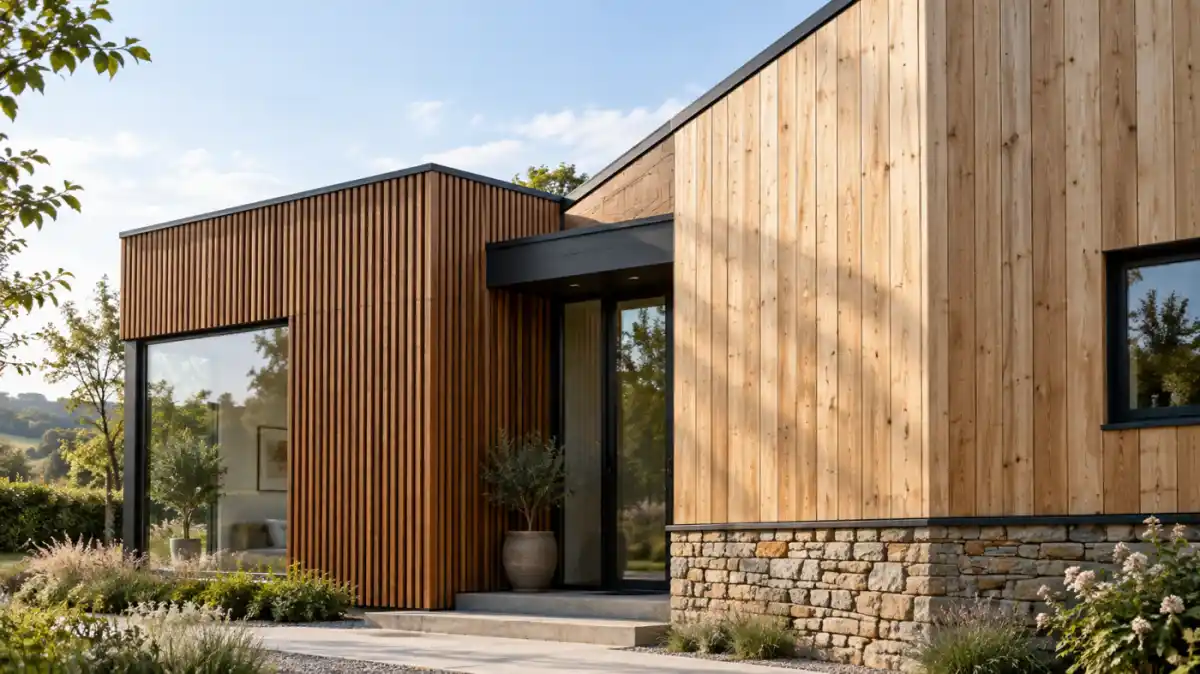
ThermoWood vs Douglas fir cladding — the two species side by side. ThermoWood (left) has the warm honey-brown characteristic of thermally modified timber, darkening with modification. Douglas fir (right) shows the warm reddish-brown of its natural heartwood with the fine, straight grain that makes it one of the most visually distinctive exterior cladding species available in the UK. Both weather to silver-grey over time without any treatment.
The Fundamental Difference — Modified vs Natural Durability
The most important distinction between ThermoWood and Douglas fir is how their durability is achieved:
- ThermoWood: Durability through thermal modification — standard pine or spruce (Class 4–5) permanently upgraded to Class 2 through exposure to 185–215°C in a controlled low-oxygen environment. The modification breaks down the hemicellulose that fungi feed on and reduces moisture absorption by up to 50%. Every cubic centimetre of the modified timber is Class 2 — not just the heartwood core
- Douglas fir: Durability through natural chemistry — Class 3 natural durability resides in the heartwood oils and resins that make the timber inhospitable to biological decay. As with all naturally durable species, the durability applies to heartwood only. Sapwood (the pale outer ring) has no natural durability and will decay without treatment
In practice: ThermoWood's Class 2 rating means it outperforms Douglas fir in wet, exposed conditions and on demanding north-facing or coastal elevations. Douglas fir's Class 3 rating is perfectly adequate for most UK residential and light commercial above-ground applications — and its distinctive grain and natural character is something ThermoWood, as a modified timber, cannot replicate.
Head-to-Head Comparison

ThermoWood tongue and groove cladding — the warm honey-brown of fresh ThermoWood before the natural greying begins over 2–4 years. ThermoWood's Class 2 durability and 50% reduced moisture absorption make it the most stable and most durable standard cladding timber available in the UK. Available in a wider range of profiles than Douglas fir — from 14mm shadow gap to 32mm triple shadow gap.
| Property | ThermoWood | Douglas Fir |
|---|---|---|
| Durability class (BS EN 350) | Class 2 — Durable | Class 3 — Moderately Durable |
| How durability achieved | Thermal modification (heat & steam only) | Natural heartwood oils and resins |
| Durability consistency | Entire board — Class 2 throughout | Heartwood only — sapwood not durable |
| Supply cost/m² | from £50.39/m² | from £60.39/m² |
| Service life UK | 25–40 years | 20–30 years |
| Maintenance above ground | Zero — never | None required — optional oiling |
| Moisture absorption | Up to 50% less than untreated softwood | Moderate — natural resins limit uptake |
| Dimensional stability | Excellent — least movement of any standard UK species | Good — natural resins aid stability |
| Fresh colour | Warm honey-brown | Warm reddish-brown — distinctive character |
| Weathered colour | Consistent silver-grey — very even | Silver-grey — some variation by elevation |
| Grain character | Fine, even — modification reduces grain contrast | Bold, tight straight grain — visually distinctive |
| Profiles available | Wide — shadow gap (single/double/triple), shiplap, T&G, rainscreen, feather edge, half-lap | Limited — T&G, rainscreen |
| Chemical treatment | None — heat and steam only | None — natural durability |
| FSC / PEFC certified | Yes — all TCS stock | Yes — all TCS stock |
| Pre-drilling required | Yes — more brittle than untreated softwood | Standard — less critical than ThermoWood |
ThermoWood — Where It Wins
Lunawood ThermoWood cladding on a UK building — Class 2 durability, zero maintenance, 25–40 year service life. On demanding exposures, commercial buildings, or any project where whole-life maintenance cost is a primary specification criterion, ThermoWood's Class 2 rating and 50% reduced moisture absorption give it a clear advantage over Douglas fir. See our full ThermoWood performance guide.
ThermoWood is the stronger specification in four distinct scenarios:
- Demanding exposures: North-facing elevations, coastal sites, high-rainfall upland locations, and any elevation with sustained wetness benefit from ThermoWood's Class 2 rating. Douglas fir's Class 3 rating is adequate for most above-ground UK applications — but ThermoWood gives a more comfortable safety margin on the most challenging elevations
- Commercial and apartment buildings: Where maintenance scaffold access costs are high and the building must perform for 30+ years without intervention, ThermoWood's Class 2 durability and consistent moisture performance across all board sections (not just heartwood) makes it the commercially rational specification
- Profile variety: ThermoWood is available in shadow gap (single, double, triple), shiplap, tongue and groove, feather edge, half-lap, and rainscreen profiles. Douglas fir is limited to T&G and rainscreen. Where a specific shadow gap profile is required, ThermoWood is the natural choice
- Dimensional stability: ThermoWood's 50% reduced moisture absorption means boards move less seasonally — producing flatter facades, more stable shadow gap lines, and fewer issues with fixings working loose over time. On large commercial elevations with long boards, this stability advantage is measurable
Douglas Fir — Where It Wins
Douglas fir cladding weathered naturally on a UK building — the silver-grey patina developing from the warm reddish-brown of fresh installation. Douglas fir's natural, unmodified character is visible in the grain even as it weathers — a quality that modified timbers cannot replicate. For projects where authentic natural timber character is the design intent, Douglas fir has a clear aesthetic advantage over ThermoWood. See our Douglas fir buyers guide.
Douglas fir is the stronger specification in three scenarios:
- Distinctive grain character: Douglas fir's bold, tight, straight grain and warm reddish-brown heartwood are genuinely unique — no modified timber replicates it. On barn conversions, contemporary rural houses, and projects where authentic natural timber character is a specific design requirement, Douglas fir has a clear aesthetic advantage that justifies the specification regardless of durability class
- Budget-conscious specification: At from £45/m² versus ThermoWood's £50.39/m², Douglas fir offers Class 3 natural durability and zero maintenance above ground at a marginally lower price. On a large project where both species are equally suitable for the exposure, the £5/m² saving is meaningful
- Natural credentials: Douglas fir achieves its durability through purely natural chemistry — no modification, no process, just the timber's own oils and resins. For clients who specifically want a species with an unmodified, natural provenance, Douglas fir is the only naturally durable softwood option at this price point
Colour and Weathering Compared
ThermoWood (thermally modified spruce) — the characteristic honey-brown colour produced by the thermal modification process. The caramelisation of timber sugars during modification creates this colour permanently — it is not a stain or coating. Over 2–4 years of UK weathering, ThermoWood transitions to a consistent silver-grey. Douglas fir starts from a warmer, more reddish-brown tone and follows a similar weathering path to silver-grey, retaining more grain variation throughout.
| Weathering stage | ThermoWood | Douglas Fir |
|---|---|---|
| Fresh installation | Warm honey-brown — even across all boards | Warm reddish-brown with bold grain contrast |
| Year 1–2 | Beginning to grey on south/west elevations | Beginning to grey — reddish tone fades first |
| Year 3–5 | Even silver-grey — very consistent across elevations | Silver-grey — some grain variation visible |
| Year 5+ | Stable grey — no further significant change | Stable grey — grain increasingly apparent in texture |
| Oiling to maintain colour | Delays greying — optional | Delays greying — optional |
| Weathering consistency | Excellent — best of any standard species | Good — some elevation variation |
Douglas Fir — Pre-Weathered Option
Douglas fir pre-weathered cladding — factory-applied grey stain on Douglas fir boards gives immediate grey colouring from installation without waiting for natural weathering. The stain must be reapplied every 3–5 years on exposed elevations to maintain the colour. ThermoWood weathers to grey naturally without any treatment — making it the lower-maintenance route to a consistent grey facade.
Douglas fir is available with factory-applied pre-weathered grey stain — giving immediate grey colouring from the day of installation without waiting 3–5 years for natural weathering. This is a popular specification for projects where the silver-grey weathered look is wanted immediately. Important considerations:
- Factory-applied stain must be reapplied every 3–5 years to maintain the even grey colour — unlike naturally weathered Douglas fir or ThermoWood which are maintenance-free once grey
- The stain adds approximately £4–8/m² to the supply cost versus untreated Douglas fir
- ThermoWood achieves the same weathered grey tone naturally over 2–4 years with zero treatment — for clients prepared to wait, ThermoWood is the lower-maintenance route to the same result
Profiles — ThermoWood Has the Wider Range
Douglas fir vertical shadow gap cladding — the warm grain character of Douglas fir visible even in a contemporary shadow gap profile. Douglas fir is available in fewer profiles than ThermoWood — primarily T&G and rainscreen in the UK market. Where a shadow gap profile is specifically required, ThermoWood is the natural choice. Where a rainscreen or T&G profile suits the design, Douglas fir is a genuinely distinctive alternative. See our Douglas fir profile guide.
| Profile | ThermoWood | Douglas Fir |
|---|---|---|
| Shadow gap (single) | ✓ 19x117mm, 19x140mm | — |
| Shadow gap (double) | ✓ 26x142mm | — |
| Shadow gap (triple) | ✓ 26x92mm, 32x140mm | — |
| Tongue & groove | ✓ 19x140mm | ✓ 20x140mm |
| Rainscreen / open joint | ✓ Multiple sizes | ✓ 27x68mm |
| Shiplap / half-lap | ✓ 19x117mm, 19x140mm, 19x144mm | — |
| Feather edge | ✓ 20x140mm | — |
Which to Choose — Project by Project
Class 2 durability, consistent moisture performance, and the widest profile range make ThermoWood the specification of choice for commercial projects. Where shadow gap profiles are required, ThermoWood is the only option. Where maintenance scaffold costs are high, Class 2 gives a better durability margin than Class 3.
Douglas fir's bold, tight straight grain and warm reddish-brown character is the definitive timber for barn conversions and rural contemporary architecture. No modified timber replicates this natural grain character. Where aesthetic authenticity is the primary driver, Douglas fir is the only choice.
Class 2 versus Class 3 — on demanding north-facing or coastal elevations where sustained wetness is a factor, ThermoWood's higher durability class and reduced moisture absorption give a more comfortable performance margin. The most conservative specification for high-exposure UK sites.
Where a T&G or open-joint rainscreen profile suits the design, Douglas fir offers Class 3 natural durability at a marginally lower price than ThermoWood with more visual character. The 27x68mm rainscreen profile in Douglas fir is distinctive — the reddish grain visible through the open joints reads particularly well on contemporary facades.
ThermoWood weathers to a more consistent, even silver-grey than Douglas fir across all elevations — particularly on multi-aspect buildings where north and south faces receive very different UV exposure. For projects where colour consistency is important, ThermoWood's weathering performance is superior.
Where both species are equally suitable for the project's exposure and profile requirements, Douglas fir's marginally lower entry price (from £45/m² vs £50.39/m²) makes it the budget-conscious choice between two zero-maintenance, naturally durable specifications. The whole-life cost difference is small — but the upfront saving is real.
ThermoWood cladding fully weathered to silver-grey on a UK house — the most consistent and predictable weathered grey of any standard UK cladding species. Both ThermoWood and Douglas fir reach silver-grey naturally over 3–5 years without any treatment. ThermoWood's weathered grey is more even across different elevations — Douglas fir shows more variation as the grain texture becomes more prominent with weathering.
Choose ThermoWood when Class 2 durability, profile variety, or consistent weathering is the priority. Choose Douglas fir when natural grain character, authentic species provenance, or a specific T&G or rainscreen profile in a naturally durable timber is the design intent. Both are excellent zero-maintenance specifications — the decision comes down to aesthetic preference and exposure level, not fundamental performance.
Is ThermoWood better than Douglas fir cladding UK?
ThermoWood is more durable (Class 2 vs Class 3), more dimensionally stable, and available in a wider profile range. Douglas fir has a more distinctive natural grain character and is marginally cheaper. ThermoWood is better for demanding exposures, commercial buildings, and shadow gap profiles. Douglas fir is better where authentic natural grain character is the design intent.
What is the difference between ThermoWood and Douglas fir cladding UK?
ThermoWood is Class 2 Durable (modified), Douglas fir is Class 3 (natural). ThermoWood lasts 25–40 years, Douglas fir 20–30 years. ThermoWood absorbs 50% less moisture. Douglas fir has a more distinctive reddish-brown grain. ThermoWood has a wider profile range. Both require zero treatment above ground and are FSC and PEFC certified.
Is Douglas fir cladding cheaper than ThermoWood UK — cost comparison?
Marginally — Douglas fir starts from approximately £45/m² versus ThermoWood at £50.39/m². Both are zero-maintenance above ground, so the whole-life cost difference is limited to this upfront gap. On most projects the £5/m² difference is not significant — the choice comes down to durability class, profile availability, and grain character.
Does Douglas fir cladding need treating UK?
No — Douglas fir does not need preservative treatment above ground. It is Class 3 Naturally Durable. Its natural oils and resins resist biological decay above ground without treatment throughout its 20–30 year service life. Optional oiling can maintain the warm reddish-brown colour longer. Always seal end grain on installation.
Which weathers better — ThermoWood or Douglas fir UK, which weathers more consistently?
Which weathers better ThermoWood or Douglas fir UK? ThermoWood weathers more consistently — its silver-grey is more even across different elevations than Douglas fir, particularly on multi-aspect buildings where north and south faces receive different UV exposure. Douglas fir weathers to grey well but shows more variation as the grain texture becomes prominent. For colour consistency across all elevations, ThermoWood is the better specification.
ThermoWood & Douglas Fir — Free Samples of Both Posted in 1–2 Days
TCS stocks both ThermoWood and Douglas fir cladding from UK stock — all profiles, FSC and PEFC certified, 7–14 day UK delivery. Not sure which is right for your project? Order free samples of both and compare in person against your render, brick, or existing materials before committing.